


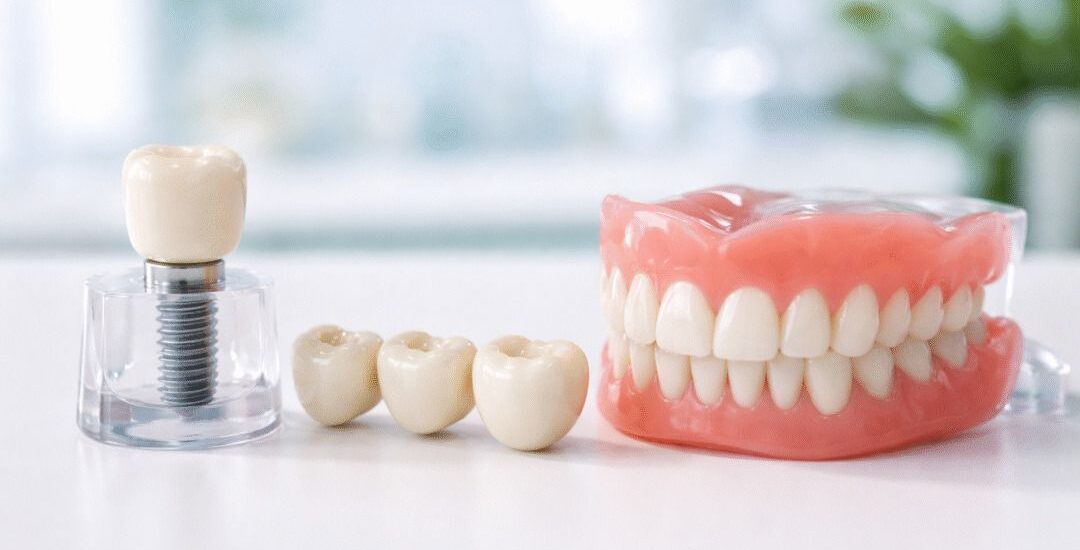
Dental implants, dentures, and bridges are the three main options for replacing missing teeth, and each one works differently depending on how many teeth are missing, the condition of your jawbone, and your long-term goals. The American College of Prosthodontists estimates that approximately 178 million Americans are missing at least one tooth. That number explains why tooth replacement is one of the most common conversations in dentistry. Each option has clear strengths, and the right choice depends on your specific situation. This article compares all three side by side, covering how each one works, how long it lasts, how it affects your jawbone and neighboring teeth, and who qualifies for each, so you can walk into your consultation prepared to make a confident decision.
How Do Dental Implants, Dentures, and Bridges Compare?
Dental implants, dentures, and bridges compare differently across five key factors: longevity, bone preservation, impact on neighboring teeth, stability, and treatment timeline. Dental implants offer the longest lifespan and the only option that preserves jawbone density, but they require surgery and the longest healing period.
Dental bridges provide a fixed, non-removable solution with a shorter treatment timeline, but they require reshaping healthy adjacent teeth to support the bridge structure.
Dentures replace multiple or all missing teeth at the lowest upfront cost, but they are removable and may need adjustment as the jawbone changes shape over time.
Understanding how each option works helps you ask the right questions during your consultation. The sections below define each option individually, then compare them head to head on the factors that matter most for everyday comfort, oral health, and long-term value.
What Are Dental Implants?
Dental implants are titanium posts that a dentist or oral surgeon places directly into the jawbone to replace missing tooth roots. The jawbone fuses with the titanium surface through a biological process called osseointegration, which typically takes 3 to 6 months. Once the post is fully integrated, a connector piece called an abutment is attached, and a custom crown, bridge, or denture is secured on top. The result is an artificial tooth that looks, feels, and functions like a natural tooth.
According to the American Dental Association, dental providers in the United States place over 3 million implants every year. A systematic review published in the Journal of Clinical Periodontology found that dental implants have a 10-year survival rate of 96.4%, making them one of the most reliable procedures in all of dentistry. The titanium post itself can last a lifetime with proper care, while the crown on top typically lasts about 15 years before needing replacement. Implants are the only tooth replacement option that stimulates the jawbone and prevents the bone loss that occurs after a tooth is extracted.
What Are Dental Bridges?
Dental bridges are fixed prosthetics that replace one or more missing teeth by anchoring an artificial tooth, called a pontic, to the natural teeth on either side of the gap. The anchor teeth, called abutment teeth, are reshaped and fitted with crowns that support the pontic between them. The entire bridge is cemented permanently in place, so it does not come in and out like a denture.
Bridges are a well-established treatment that works particularly well when the teeth adjacent to the gap already need crowns or have existing restorations. The Cleveland Clinic reports that traditional dental bridges typically last 5 to 15 years with good oral care. Bridges do not require surgery or a months-long healing period, which makes them appealing to patients who want a fixed solution on a shorter timeline. The trade-off is that bridges require removing enamel from the abutment teeth, and the jawbone beneath the missing tooth continues to lose density because there is no root replacement stimulating the bone.
What Are Dentures?
Dentures are removable prosthetic appliances that replace multiple missing teeth or an entire arch of teeth. Partial dentures replace several missing teeth and clip onto remaining natural teeth with metal or acrylic clasps. Full dentures replace all teeth in the upper or lower jaw and rest directly on the gum tissue, held in place by suction and sometimes denture adhesive.
Dentures offer the lowest upfront cost of the three options and do not require any surgical procedure. They can restore a full smile in a relatively short timeframe, often within a few weeks. Traditional dentures typically last 5 to 10 years before needing replacement, according to clinical consensus. The fit of dentures changes over time because the jawbone beneath them continues to resorb without tooth roots or implants to stimulate it. Dentures that once fit snugly may loosen as the bone shrinks, requiring periodic relines or adjustments to maintain comfort and function.
How Long Do Implants Last Compared to Bridges and Dentures?
Dental implants last the longest of any tooth replacement option, with the titanium post designed to last a lifetime and the crown lasting approximately 15 years. Bridges average 5 to 15 years depending on oral hygiene and the health of the abutment teeth. Dentures average 5 to 10 years before requiring full replacement, though they may need relines and adjustments more frequently within that window. The lifespan differences between the three options are significant because they directly affect the total long-term cost and the number of replacement cycles a patient can expect over a lifetime.
| Factor | Dental Implants | Dental Bridges | Dentures |
|---|---|---|---|
| Average Lifespan | Post: lifetime; Crown: ~15 years | 5 to 15 years | 5 to 10 years |
| 10-Year Survival Rate | 96.4% | Varies by type | N/A (removable) |
| Jawbone Preservation | Yes (stimulates bone) | No (bone loss continues) | No (bone loss continues) |
| Adjacent Teeth Affected | None | Enamel removed from 1-2 teeth | Clasps rest on teeth (partial) |
| Removable? | No (permanent) | No (cemented) | Yes (taken out daily) |
| Surgery Required | Yes (minor oral surgery) | No | No |
| Treatment Timeline | 4 to 9 months total | 2 to 4 weeks | 2 to 6 weeks |
| Chewing Efficiency | Closest to natural teeth | Good (fixed in place) | Reduced (may shift while eating) |
| Upfront Cost | Highest | Moderate | Lowest |
Sources: Journal of Clinical Periodontology; Cleveland Clinic; American Dental Association; American Academy of Periodontology; American College of Prosthodontists
The comparison table shows that each option occupies a different position across cost, longevity, and oral health impact. Implants require the highest upfront investment but deliver the longest functional life and the only bone preservation benefit. Bridges offer a strong middle ground with a fixed, non-removable result and a moderate timeline. Dentures provide the most affordable entry point and the broadest replacement capability for patients missing many or all teeth.
Do Dental Implants Prevent Bone Loss?
Yes, dental implants prevent bone loss because the titanium post replaces the missing tooth root and transfers chewing force directly into the jawbone, stimulating the bone to maintain its density. This stimulation follows a principle known as Wolff’s Law, which states that bone remodels and strengthens in response to the mechanical loads placed on it. Without a root or implant to provide that load, the bone in an extraction site begins to shrink.
The American Academy of Periodontology reports that the jawbone can lose up to 25% of its width in the first year after a tooth is extracted. Bone loss continues progressively in the following years, eventually changing the shape of the jaw and the appearance of the face. The sunken look around the mouth that some long-term denture wearers develop is a direct result of this ongoing resorption. Neither bridges nor dentures address the root cause of bone loss because neither one replaces the tooth root inside the jawbone. Implants are the only option that halts resorption by restoring the mechanical stimulation the bone needs to stay healthy.
Do Bridges Affect Neighboring Teeth?
Yes, bridges affect neighboring teeth because the teeth on either side of the gap must be reshaped to support the bridge. The reshaping process involves removing approximately 0.5 to 0.7 millimeters of enamel from each abutment tooth so that a crown can be placed over it. Enamel removal is permanent, meaning those teeth will always need a crown or other restoration going forward, even if the bridge is eventually replaced with a different treatment.
The long-term concern with abutment teeth is that the reshaped surface beneath the crown can develop decay if bacteria infiltrate the margin between the crown and the natural tooth. Flossing under a bridge requires a special floss threader or interdental brush, and patients who struggle with that technique face a higher risk of decay at the bridge margins over time. Dental implants avoid this issue entirely because each implant stands independently in the jawbone without involving the neighboring teeth. For patients whose adjacent teeth are completely healthy and unrestored, an implant preserves those teeth in their natural state.
When Is a Dental Bridge a Better Choice Than an Implant?
A dental bridge is a better choice than an implant when the teeth on either side of the gap already need crowns, when the patient cannot undergo surgery, or when a shorter treatment timeline is a priority. If the abutment teeth already have large fillings, cracks, or previous root canal treatment, they benefit from crowns regardless of how the gap is filled. Placing a bridge in that situation restores the gap and strengthens the compromised abutment teeth at the same time, addressing two problems with one treatment.
Bridges are also a strong choice for patients who have medical conditions that make surgery risky, patients who take medications that slow bone healing, and patients who prefer not to undergo the surgical phase and months-long osseointegration wait that implants require. A bridge can be completed in as few as two to three appointments over a period of two to four weeks, while implant treatment takes 4 to 9 months from start to finish. Your dentist evaluates your teeth, bone, and medical history during a dental exam and recommends the option that fits your clinical situation and personal goals.
What Are Implant-Supported Dentures?
Implant-supported dentures are a hybrid option that combines the stability of dental implants with the full-arch coverage of dentures. Instead of resting on the gums and relying on suction or adhesive, an implant-supported denture snaps onto four to six implant posts placed strategically in the jawbone. The implants anchor the denture firmly in place, eliminating the rocking, slipping, and clicking that traditional denture wearers often experience.
The All-on-4 technique, which uses four implants to support a complete arch of teeth, has a prosthetic survival rate of 98.8%, according to published clinical data. Implant-supported dentures restore approximately 70% to 80% of natural chewing force, compared to roughly 25% to 30% for conventional dentures, according to prosthodontic literature. Patients who have worn traditional dentures for years and are frustrated with fit issues, dietary restrictions, or adhesive mess often find that upgrading to implant-supported dentures transforms their daily comfort. The denture portion of an implant-supported system typically lasts 15 to 20 years before needing replacement, while the implant posts remain in the jawbone permanently.
Who Is a Good Candidate for Each Option?
The right tooth replacement option depends on the number of missing teeth, the health of your jawbone and remaining teeth, your overall medical condition, and your goals for comfort, appearance, and longevity.
- Dental implants work best for patients with adequate jawbone density, healthy gums, no uncontrolled chronic conditions, and a willingness to invest in the longest-lasting result. Implants replace single teeth, multiple teeth, or full arches. Patients who smoke face a 140.2% higher risk of implant failure, according to a study in the National Library of Medicine, so tobacco cessation is strongly recommended before implant placement.
- Dental bridges work best for patients missing one to three consecutive teeth where the adjacent teeth already need crowns or have existing restorations. Bridges are also a good fit for patients who cannot undergo surgery or who prefer a fixed solution with a shorter treatment timeline.
- Dentures work best for patients missing many or all teeth, especially when budget is a primary consideration. Partial dentures fill gaps when remaining teeth are not strong enough to support a bridge. Full dentures restore an entire arch. Patients who later develop adequate bone or financial readiness can upgrade from traditional dentures to implant-supported dentures.
A thorough evaluation at your dentist’s office determines which options are clinically viable for your mouth. We assess jawbone density, gum health, bite alignment, and medical history before recommending a treatment plan.
Patients in Sonora, CA and surrounding communities can schedule a consultation to discuss all three options and find the right fit for their situation.
How Do You Decide Between Implants, Bridges, and Dentures?
You decide between implants, bridges, and dentures by evaluating five factors in order of importance for your situation:
- Number of missing teeth. A single missing tooth is best served by a single implant or a three-unit bridge. Multiple consecutive missing teeth may call for an implant-supported bridge. Full-arch loss points toward full dentures or implant-supported dentures.
- Jawbone health. Adequate bone density is required for implants. If significant bone loss has occurred, bone grafting can rebuild the site, or a bridge or denture may be a more practical starting point.
- Condition of adjacent teeth. If the teeth next to the gap are healthy and unrestored, an implant preserves them. If those teeth already need crowns, a bridge treats the gap and the compromised teeth simultaneously.
- Timeline. Bridges and dentures can be completed in weeks. Implants take months. If you need a quick solution, bridges or dentures provide faster results. If you can plan ahead, implants offer the best long-term outcome.
- Long-term value. Implants have the highest upfront cost but the lowest replacement frequency. Bridges and dentures cost less initially but require replacement cycles every 5 to 15 years. Calculating total cost over 20 years, including replacements, relines, and maintenance, often changes the value comparison.
The American Academy of Cosmetic Dentistry reports that 99.7% of Americans consider a smile an important social asset. Whatever option you choose, replacing missing teeth restores your ability to eat comfortably, speak clearly, and smile with confidence. The best approach is a consultation with an experienced implant dentist who can present all three options with personalized recommendations based on your mouth, your health, and your goals.
Frequently Asked Questions
Can You Switch From Dentures to Implants Later?
Yes, you can switch from dentures to implants later, as long as you have enough healthy jawbone to support the implant posts. Patients who have worn dentures for many years may have experienced significant bone loss and may need bone grafting before implants can be placed. A consultation with your dentist includes imaging that evaluates your current bone volume and determines whether grafting is needed.
Can You Have Dental Implants if You Have Osteoporosis?
Yes, you can have dental implants if you have osteoporosis in many cases, though your dentist will evaluate your specific bone density and medication history. Some osteoporosis medications, particularly bisphosphonates, can affect jawbone healing and may require special treatment planning. Research published in the National Library of Medicine shows that implants can succeed in patients with osteoporosis when proper protocols are followed and bone quality is carefully assessed before surgery.
Is Getting a Bridge or Implant More Comfortable?
Getting a bridge is generally more comfortable during treatment because it does not involve surgery. Bridge placement requires local anesthesia for tooth preparation but no incision in the gum tissue. Implant placement involves minor oral surgery under local anesthesia, with mild soreness lasting about one to two weeks afterward. Once healed, both bridges and implants feel comfortable and natural during daily use. Sedation dentistry is available for patients who feel anxious about either procedure.
Do Dental Implants Look Like Real Teeth?
Yes, dental implants look like real teeth. The crown placed on top of the implant is custom-fabricated from porcelain or ceramic to match the color, shape, and translucency of your natural teeth. Once the crown is bonded to the abutment, the restoration blends seamlessly with the surrounding teeth. Most people cannot tell the difference between an implant crown and a natural tooth.
How Long Does Each Treatment Take?
Dental implant treatment takes 4 to 9 months from placement to final crown, with most of that time spent waiting for the jawbone to fuse with the implant. Bridge treatment takes 2 to 4 weeks, usually involving two to three appointments. Denture fabrication takes 2 to 6 weeks depending on the type and whether extractions are needed first. Same-day crowns can speed up the restoration phase for implant-supported crowns in some cases.
Does Insurance Cover Implants, Bridges, or Dentures?
Insurance coverage varies by plan and by procedure. Bridges and dentures are more commonly covered because insurance plans classify them as restorative procedures. Implants are less consistently covered because some plans classify them as elective, though coverage has been expanding. Your dentist’s office can submit a pre-treatment estimate to your insurance provider to determine your specific coverage before you commit to a treatment plan.
The Takeaway
Dental implants, bridges, and dentures each solve the problem of missing teeth in a different way. Implants offer the longest lifespan, the only bone preservation benefit, and the most natural function, but they require surgery and the longest treatment timeline. Bridges provide a fixed, non-removable solution with a shorter timeline, especially when adjacent teeth already need crowns. Dentures deliver the most affordable entry point for patients missing many teeth, with the option to upgrade to implant-supported dentures later for greater stability. The best choice is the one that matches your oral health, your goals, and your budget over the long term.
At Jeff Berger Dentistry, we offer all three tooth replacement options and are happy to help you find the right fit for your smile. Call us at 209-532-2915 to schedule your consultation.


