


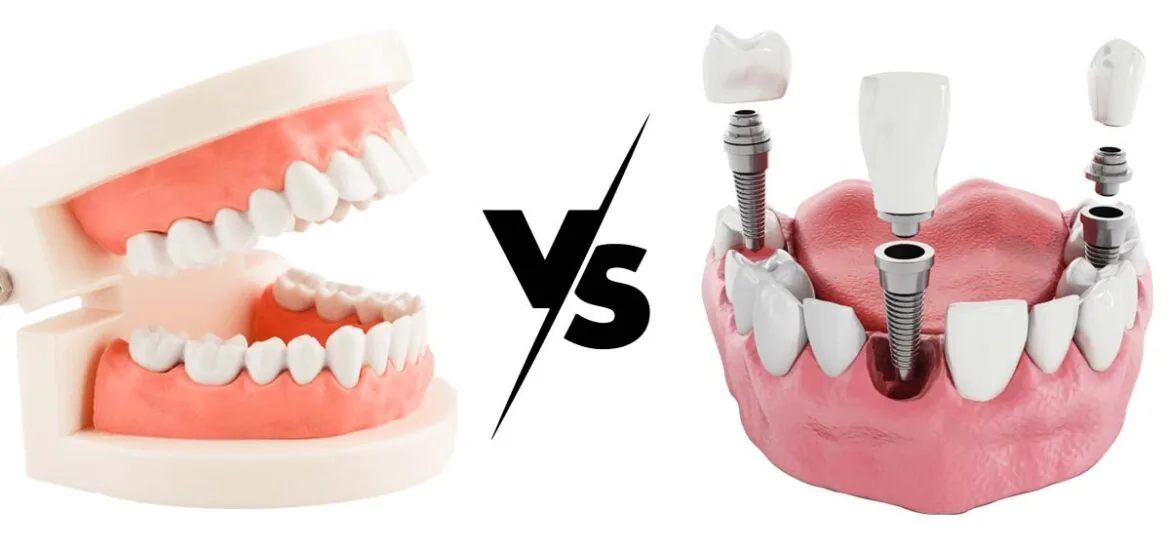
Dental implants are generally better for long-term stability and jawbone health, while dentures are the faster, non-surgical alternative. Neither option is universally better, because the right choice depends on your jaw, your health and your lifestyle.
Tooth loss is common enough that most people eventually face this decision. The American College of Prosthodontists reports that 120 million people in the United States are missing at least one tooth, and roughly 36 million have no natural teeth at all. Below we compare both options on the things that actually decide the answer: bone, lifespan, procedure, candidacy and daily upkeep.
What Is the Difference Between Dentures and Dental Implants?
The difference between dentures and dental implants is what holds them in place. Dentures are removable appliances that rest on your gums. Dental implants are titanium posts placed surgically into the jawbone, where they act as artificial tooth roots.
Artificial tooth roots are the whole distinction. A denture replaces the visible part of a tooth and nothing below the gumline. An implant replaces the root first, then carries a crown, bridge or full arch of teeth on top of it.
Replacing the root is what separates these two options on every measure that follows. It changes how they feel, how long they last, how they are cared for, and what happens to the bone underneath them.
Do Dentures Cause Bone Loss?
No, dentures do not cause bone loss, but they do not stop it either. Bone loss follows the missing root, not the appliance sitting above it. The missing root stops sending chewing force into the jaw, and a jaw that stops receiving force begins to shrink.
Shrinkage happens faster than most patients expect. A systematic review of ridge changes after extraction found that 29 to 63 percent of alveolar ridge width and 11 to 22 percent of ridge height are lost within the first year. Research by Schropp and colleagues found that two thirds of that change occurs within the first three months alone.
The first three months are only the beginning of the curve. Long-term research reports that 40 to 60 percent of total alveolar bone volume disappears within two to three years when nothing replaces the root, after which loss continues at roughly 0.25 to 0.5 percent per year for the rest of a person’s life.
Life with a removable appliance adds its own pressure to that process. A long-term study by Tallgren tracked complete denture wearers and recorded mean vertical reduction of the front lower ridge of 6.6 mm across seven years, roughly four times the rate measured in the upper jaw. This is the quiet reason dentures need refitting, and it is the strongest argument in favor of dental implants for patients who qualify.
How Do Dental Implants Prevent Jawbone Loss?
Dental implants prevent jawbone loss by restoring the chewing force the missing root used to deliver. The titanium post fuses directly with the surrounding bone in a process called osseointegration, so every bite transmits pressure into the jaw the way a natural root would.
Natural root behavior is what keeps bone active. Bone maintains itself in response to load, and load is exactly what an implant restores. No other tooth replacement does this, which is why implants are the only option that addresses the cause of ridge shrinkage rather than working around it.
How Long Do Dentures Last Compared to Implants?
Dentures last five to ten years and implants can last decades or a lifetime. The American Dental Association notes that dentures generally need replacement every five to seven years, Cleveland Clinic puts average denture lifespan at seven to ten years, and clinical research reports implant survival rates above 90 percent at the ten-year mark.
| Factor | Traditional Dentures | Dental Implants | Implant-Supported Dentures |
|---|---|---|---|
| Typical lifespan | 5 to 10 years | Decades to a lifetime | Implants last decades, denture portion 15 to 20 years |
| Maintenance cycle | Reline every 1 to 2 years | Crown may need replacing | Occasional attachment replacement |
| Effect on jawbone | Does not slow bone loss | Preserves bone | Preserves bone around the implants |
| Surgery required | No | Yes | Yes |
| Removable | Yes, daily | No | Depends on the design |
| Time to completion | Weeks | 3 to 6 months | 3 to 6 months |
Read across that table and the trade is clear. Dentures get you a working smile in weeks, and implants get you one that lasts. The reason those timelines differ sits entirely in the procedures behind them.
What Happens During Each Procedure?
During each procedure, dentures are shaped from impressions while implants are surgically placed and then left to fuse with bone. Denture fabrication involves impressions of your gums, a bite assessment, a preliminary set for fitting, then adjustments before the final appliance is made.
Adjustments are where the denture process ends and where the implant process barely begins. Implant treatment starts with imaging to measure bone volume and map nerve position, which is one of the main uses for the 3D imaging in modern dental offices.
Once the post is placed, biology takes over. The bone grows around the titanium in a process that cannot be rushed, and only when that fusion is complete does the abutment and crown go on top.
How Long Does Dental Implant Surgery Take?
Dental implant surgery takes about one to two hours for a single implant, and the full treatment takes three to six months from start to finish. The surgical appointment itself is short. The waiting is what stretches the timeline.
Waiting covers osseointegration, the three to six month window in which bone fuses to the post. Some cases allow a temporary tooth during that period, so the gap is rarely visible to anyone else.
How Long Do You Have to Wait After Getting Teeth Pulled to Get Implants?
You have to wait about two to six months after getting teeth pulled before implants are placed in most cases. The socket needs time to fill with new bone before it can support a post securely.
Securing a post in fresh bone is sometimes possible the same day, which is called immediate placement, though it depends on how much healthy bone surrounds the extraction site. Your dentist decides based on imaging rather than on a standard waiting period.
Who Is a Good Candidate for Dental Implants?
A good candidate for dental implants has enough jawbone to hold the post, healthy gums, and general health that supports normal healing. Those three conditions decide candidacy far more than age or the number of teeth involved.
Healing depends on the tissue the implant sits in, which is why gum health gets evaluated before anything is scheduled. Active periodontal disease is treated first, because bone that is already inflamed makes a poor foundation.
Foundations also weaken with smoking, which slows healing and reduces long-term implant success, so most dentists ask patients to stop before and during treatment. Patients who do not meet these conditions are not out of options. Dentures work regardless of bone volume, which is precisely why both treatments exist side by side, and why implant placement starts with an honest evaluation rather than an assumption.
Do You Need a Bone Graft for Dental Implants?
You need a bone graft for dental implants when the ridge has already shrunk too far to hold a post securely. Grafting rebuilds volume so the implant has something solid to fuse with, and it adds several months to the overall timeline.
Timelines lengthen because grafted bone has to mature before an implant goes in. This is also why waiting years after tooth loss makes implants more involved than acting sooner, since the ridge keeps shrinking the whole time.
At What Age Should You Not Get Dental Implants?
There is no upper age at which you should not get dental implants. Bone density, gum health and general medical condition determine candidacy, and healthy patients in their seventies and eighties receive implants routinely.
Routine use among older adults matches the utilization data. A 2018 study found implants are most commonly chosen by adults aged 55 to 64. The one real age limit sits at the other end, since teenagers whose jaws are still growing are generally not candidates.
Do All Your Teeth Get Pulled for Implants?
No, all your teeth do not get pulled for implants. Implants replace only the teeth that are missing or beyond saving, and healthy natural teeth stay exactly where they are. A single implant can replace one tooth without touching either neighbor.
Leaving neighbors untouched is one of the quieter advantages of implants. A patient missing one tooth can have one implant, a patient missing three can have three, and a patient missing an entire arch has options that do not require an implant for every tooth.
What Are Implant-Supported Dentures?
Implant-supported dentures are full dentures anchored to a small number of dental implants instead of resting on the gums. Two to four implants per arch hold the denture in place, so it snaps or screws into position rather than relying on suction or adhesive.
Relying on bone instead of gums solves the two problems patients report most with traditional dentures, which are slipping and sore spots. It also preserves bone around the implant sites, which a conventional denture cannot do.
This middle path suits people who are missing all their teeth in an arch but want more stability than a removable appliance provides, without an individual implant for every single tooth.
What Is All-on-4?
All-on-4 is an implant-supported denture system that uses four implants to carry a full arch of replacement teeth. The four posts are angled to make use of available bone, which often lets patients avoid grafting they would otherwise need.
Avoiding a graft shortens the overall timeline considerably. All-on-4 gives a secure, non-slipping full arch while protecting the jawbone at the implant sites, which is why it has become the most common answer for patients who feel caught between the two main options.
Can You Switch From Dentures to Implants?
Yes, you can switch from dentures to implants, and many patients do. Years of denture wear often reduce ridge volume enough to require grafting first, so a 3D scan comes before any commitment.
Commitments in tooth replacement are rarely permanent. Starting with dentures and moving to implants later is a legitimate path, particularly for patients who want a working smile now and a longer-term solution when circumstances allow.
How Do You Care for Dentures Compared to Implants?
You care for implants the same way you care for natural teeth, while dentures need a separate daily routine. Implants are brushed and flossed normally, with extra attention around the gumline where plaque collects.
Collected plaque is the main long-term threat to an implant, since inflammation around the post can loosen it over time. Dentures avoid that risk and trade it for a nightly routine instead:
- Remove the denture after eating and rinse away loose food.
- Brush it daily with a soft denture brush and a non-abrasive cleaner.
- Brush your gums, tongue and any remaining natural teeth separately.
- Soak the denture overnight in water or a cleaning solution.
- Rinse thoroughly before putting it back in.
- Return for relines as the ridge changes shape underneath it.
Both options still need regular checkups, because the gums, remaining teeth and fit all change over time regardless of which path you choose.
Do Dental Implants Have to Be Removed at Night?
No, dental implants do not have to be removed at night. They are fixed in the jawbone and stay in permanently, exactly like natural teeth.
Natural behavior extends to sleeping, eating and brushing. Removable dentures are the opposite case, since most dentists recommend taking them out overnight to let the gums rest.
Which Costs More Over Time, Dentures or Implants?
Implants cost more at the start and dentures cost more over a long enough horizon. The difference is not really price, it is timing. Implants front-load the investment into a single treatment, while dentures spread smaller costs across decades of relines, repairs and replacements.
Replacement cycles drive that math. A denture needing replacement every five to ten years, plus relining every one to two years, accumulates appointments that an implant does not require. An implant may need a new crown eventually, but the post itself is designed to stay.
Staying power is the honest way to frame this comparison. Which one works out cheaper depends on how many years you expect to use it, and on whether grafting or other preparation is needed first. We go through all of that specifically during a consultation, since the answer changes from one mouth to the next.
How Do You Decide Between Dentures and Implants?
You decide between dentures and implants by weighing five factors that together point clearly to one option:
- Jawbone volume. Sufficient bone opens the implant path. Significant loss points toward dentures or toward grafting first.
- How many teeth are missing. One or two missing teeth favor individual implants. A full arch opens the implant-supported denture option.
- Timeline. Weeks versus months matters if you have an event coming or simply want to eat comfortably sooner.
- Willingness to have surgery. Implants involve a surgical procedure. Dentures involve none, which is decisive for some patients.
- Daily routine preference. Some people would rather brush and forget. Others have no objection to a nightly soak.
Objections and preferences are legitimate inputs here, not obstacles to talk someone out of. Both treatments restore chewing, speech and appearance, and the best one is the one a patient will actually live with comfortably.
What Can I Do Instead of a Dental Implant?
Instead of a dental implant, you can choose a removable partial denture, a full denture, or a fixed bridge. Partial dentures replace several teeth while clasping to the remaining natural ones, and full dentures replace an entire arch.
Arches and gaps call for different answers. A fixed bridge fills a single gap using the neighboring teeth as anchors, which suits some situations well and is covered in our post on dental bridges. Every one of these options beats the fourth possibility, which is leaving the gap alone.
What Happens If You Do Not Replace a Missing Tooth?
If you do not replace a missing tooth, the neighboring teeth drift into the gap and the bone beneath it continues to shrink. Drifting changes how your teeth meet, which spreads uneven wear across the rest of your bite.
Uneven wear compounds quietly over years. The opposing tooth in the other jaw also begins to over-erupt into the empty space, since nothing is meeting it during chewing.
Meanwhile the ridge keeps resorbing at the rate described earlier, which narrows your future options. A gap left alone for a decade often needs grafting before an implant becomes possible, and a shrunken ridge also makes a stable denture harder to fit. Acting sooner keeps more doors open.
How We Approach Tooth Replacement at Our Office
We approach tooth replacement at our Sonora office by starting with your bone, your gums and your goals rather than with a recommendation. We provide full and partial dentures, All-on-4 implant-supported dentures, and full-service implant placement and restoration, so the evaluation drives the answer rather than the other way around.
Dr. Berger completed postgraduate implant training through the Misch International Implant Institute and studied occlusion under Frank Spear, which matters here because tooth replacement is as much about how your bite comes together as about filling a space.
Bites and spaces both show up in finished work, and you can see examples of both in our smile gallery. For patients weighing providers as carefully as they are weighing treatments, our post on choosing an implant dentist covers what to look for.
Frequently Asked Questions
Should a 70 Year Old Get Dental Implants?
Yes, a 70 year old can get dental implants if bone density, gum health and general health support healing. Age alone is not a limiting factor, and patients in their seventies and eighties receive implants routinely. What matters is whether the jaw can hold the post and whether the body heals normally.
Can You Sleep With Dentures In?
Most dentists recommend removing dentures at night. Sleeping in them keeps the gums under constant pressure and is associated with higher rates of gum inflammation and fungal infection. Overnight soaking also cleans the appliance more thoroughly than brushing alone.
Do Implants Feel Like Natural Teeth?
Yes, implants feel very close to natural teeth once healing is complete. Because the post is anchored in bone rather than resting on gum tissue, biting pressure travels through the jaw the way it always did. Most patients stop noticing the implant within a few weeks of the crown going on.
How Many Implants Are Needed for a Full Arch?
A full arch typically needs four to six implants rather than one per tooth. Four angled posts can carry an entire arch in an All-on-4 design, while some cases use six for additional support. The exact number depends on bone volume and bite forces, both of which are measured during planning.
Can You Get Implants if You Have Gum Disease?
You can get implants after gum disease has been treated and brought under control. Active periodontal disease has to be resolved first, because inflamed tissue and compromised bone make a poor foundation for a post. Many patients complete periodontal treatment and go on to receive implants successfully.
How Soon Can You Eat Normally After Each Option?
You can eat soft foods within days of receiving either option and return to a normal diet within weeks for dentures and a few months for implants. New denture wearers usually need a few weeks to adjust to chewing and speaking. Implant patients eat softly while the post fuses, then eat without restriction once the crown is placed.
The Bottom Line
Dental implants are the stronger long-term choice for patients with enough healthy jawbone, because they replace the tooth root, preserve the ridge, and can last for decades. Dentures are the faster, non-surgical option that works regardless of bone volume, restores chewing and speech within weeks, and remains the right answer for many people. Implant-supported dentures sit between the two and solve the stability problem without an implant for every tooth. Which one is better depends on your bone, your health, your timeline and how you want to spend five minutes of every evening.
The one choice that rarely works out well is waiting, since the ridge keeps shrinking and the options keep narrowing. We help patients across Tuolumne County sort through all of this with a scan and a straight conversation. Call Jeff Berger Dentistry to talk through your options, or schedule a visit whenever you are ready.


