


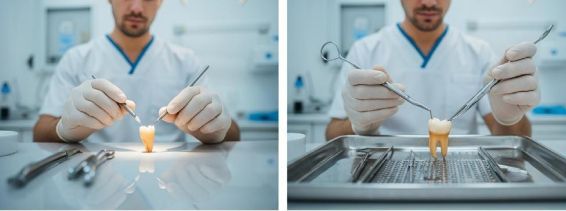
The most common dental emergencies include severe toothaches, knocked-out teeth, cracked or broken teeth, dental abscesses, lost fillings or crowns, and soft tissue injuries. Each type requires a different response, and knowing what to do in the first few minutes can determine whether a tooth is saved or lost. According to the ADA, there are roughly 2 million emergency department visits for dental pain every year in the United States. A study by the National Center for Health Statistics found the average annual rate of ER visits for tooth disorders was 59.4 per 10,000 people between 2020 and 2022. This article breaks down each common emergency, how to treat it before you see a dentist, and what professional treatment looks like.
Common Dental Emergencies That Require Immediate Attention
According to a peer-reviewed article in StatPearls (National Institutes of Health), dental emergencies fall into three categories: traumatic, infectious, and post-procedural. Traumatic emergencies include broken teeth, knocked-out teeth, and injuries from falls, sports, or accidents. Infectious emergencies come from untreated decay, abscesses, and gum disease. Post-procedural emergencies, like heavy bleeding after an extraction or dry socket, happen after dental work. Pain is the most common symptom across all three types.
Data from the AHRQ shows that dental caries and abscesses alone accounted for nearly 80% of all dental-related emergency room visits. That means the vast majority of dental emergencies are caused by infection and decay, not trauma. Regular preventive care is the most effective way to avoid them.
We treat all types of dental emergencies here in Sonora and make every effort to see you the same day. Call us at 209-532-2915 if you are in pain or have suffered a dental injury.
Severe Toothache
A severe toothache is the single most common reason people seek emergency dental care. According to the American Academy of Family Physicians (AAFP), dental caries is often the underlying cause. When decay reaches the inner pulp of the tooth, it causes inflammation called pulpitis. Left untreated, pulpitis leads to pulp death, then abscess formation.
For immediate relief, rinse your mouth with warm water. Gently floss around the affected tooth to remove any trapped food. Apply a cold compress to the outside of the cheek for 10 to 15 minutes at a time. Over-the-counter pain relievers like ibuprofen can help reduce inflammation. Do not place aspirin directly on the gum tissue, as the ADA warns it can cause chemical burns.
Professional treatment depends on how far the decay or infection has progressed. A simple filling may be enough if caught early. If the pulp is infected, root canal therapy removes the infection and saves the tooth. We use DIAGNOdent laser technology and CariVu imaging to locate decay that is invisible to the naked eye, which helps us catch problems before they progress.
Knocked-Out Tooth
A knocked-out tooth, also called an avulsed tooth, is one of the most time-sensitive dental emergencies. According to the American Association of Endodontists, more than 5 million teeth are knocked out each year in the United States. Falls, sports injuries, traffic accidents, and physical impacts are the most common causes.
The first thing to do is find the tooth and pick it up by the crown only. Never touch the root. Rinse it gently with water if it is dirty, but do not scrub it or use soap. Try to place the tooth back into the socket, root first. If that is not possible, store it in a container of cold milk. Milk has a balanced pH and proteins that help keep the root cells alive. A tooth replanted within 30 minutes has a success rate approaching 85% to 97%, according to clinical research. After 60 minutes, the odds drop significantly.
We have the advanced dental technology needed to evaluate the tooth and bone and determine the best approach. If replantation is not possible, we offer dental implants and bridges to replace the missing tooth permanently.
Broken or Chipped Tooth
Cracked, chipped, and broken teeth are among the most frequent dental injuries. According to the AAFP, dental trauma is extremely common and can happen to anyone at any age. The severity ranges from a small cosmetic chip to a deep fracture that exposes the nerve.
Rinse your mouth with warm water right away. If there is bleeding, apply gauze with gentle pressure. A cold compress on the outside of the face helps reduce swelling. Save any broken pieces and bring them to your appointment. Avoid chewing on the affected side.
Treatment depends on the extent of the damage. A minor chip may only need dental bonding. A larger break often requires a crown. Dr. Jeff Berger offers CEREC same-day crowns here in Sonora, so you can walk out with a permanent, custom-fit crown in a single visit. If the fracture has exposed the tooth’s nerve, root canal therapy may be necessary before placing the crown.
Dental Abscess
A dental abscess is a pocket of pus caused by bacterial infection at the root of a tooth or in the gum tissue. According to the NIH, dental caries affects nearly 100% of adults worldwide, and untreated caries is the primary pathway to abscess formation. The infection can spread to the jaw, neck, and bloodstream if untreated. A study in the Journal of Endodontics reported that septic shock from a dental abscess carries a mortality rate close to 50%.
Signs of an abscess include a persistent throbbing toothache, swelling in the face or cheek, fever, sensitivity to hot and cold, a foul taste in the mouth, and tender lymph nodes in the neck. If swelling is affecting your ability to breathe or swallow, go to the emergency room immediately.
Treatment involves draining the abscess, prescribing antibiotics when needed, and addressing the source of the infection. That usually means root canal therapy or, in severe cases, extraction. We also offer gum disease treatment using laser therapy for infections that originate in the periodontal tissue.
Lost Filling or Crown
A lost filling or crown exposes the tooth to bacteria, temperature sensitivity, and further damage. According to the ADA, a lost filling is an emergency because the unprotected tooth can crack, break, or develop a new infection quickly.
As a temporary measure, you can apply over-the-counter dental cement or even sugar-free gum to cover the exposed area. If a crown comes off, try slipping it back over the tooth using dental cement or denture adhesive. Do not use super glue. Call us the same day to schedule a repair.
We can replace a filling or re-cement a crown quickly. If the crown is damaged beyond repair, we use our CEREC machine to create a brand-new, custom crown in a single appointment. Families throughout Sonora, Jamestown, Columbia, and Twain Harte count on us for fast restorations that prevent small problems from turning into expensive ones.
Soft Tissue Injuries
Cuts, tears, and puncture wounds to the lips, cheeks, tongue, and gums qualify as dental emergencies if the bleeding is heavy or the wound is deep. These injuries commonly happen from falls, sports, biting down on hard foods, or accidental contact.
Clean the area gently with water. A warm salt-water rinse helps reduce bacteria. Apply moist gauze and hold it with gentle pressure for 15 to 20 minutes. A cold compress on the outside of the face helps with swelling. If bleeding does not stop after 20 minutes, go to the emergency room or call us immediately.
What Causes Most Dental Emergencies
According to the CDC, 1 in 5 adults aged 20 to 64 have at least one untreated cavity, and nearly half of adults over 30 show signs of gum disease. These two conditions lead to the majority of dental emergencies. Untreated cavities progress into infections. Untreated gum disease weakens the bone and tissue holding teeth in place, making them vulnerable to injury and loss.
Trauma is the other major cause. The NIH reports that falls, sports injuries, traffic accidents, and physical violence are the most common triggers for traumatic dental emergencies. Wearing a mouthguard during sports and avoiding chewing on hard objects like ice, popcorn kernels, and pen caps reduces the risk significantly.
Regular preventive dental care, including twice-yearly cleanings and exams, is the best way to stop small problems before they become emergencies. We use digital x-rays that emit about 90% less radiation than traditional x-rays, along with CariVu and DIAGNOdent, to catch decay and damage early.
Common Dental Emergencies at a Glance
Emergency | Primary Cause | Immediate First Aid | Professional Treatment |
Severe Toothache | Decay, pulpitis, infection | Warm rinse, cold compress, ibuprofen | Filling, root canal, or extraction |
Knocked-Out Tooth | Falls, sports, trauma | Replant or store in milk | Splinting, root canal, implant |
Broken/Chipped Tooth | Trauma, biting hard objects | Warm rinse, gauze, cold compress | Bonding, crown, or veneer |
Dental Abscess | Untreated decay, gum disease | Salt-water rinse, cold compress | Drainage, antibiotics, root canal |
Lost Filling/Crown | Wear, decay beneath restoration | OTC dental cement, avoid chewing | New filling, re-cemented or new crown |
Soft Tissue Injury | Falls, bites, accidents | Gauze pressure, salt-water rinse | Sutures, wound care, antibiotics |
Sources: American Dental Association, American Academy of Family Physicians, National Institutes of Health, American Association of Endodontists.
Frequently Asked Questions
What Is the Most Painful Dental Problem?
The most painful dental problem is typically a dental abscess or an advanced case of pulpitis where the nerve inside the tooth becomes severely inflamed or infected. The pain from an abscessed tooth is often described as a constant, deep throbbing that radiates into the jaw, ear, and neck. According to the NIH, an untreated abscess can progress through stages, starting with mild swelling and escalating to severe pain and systemic infection within days. A root canal is the most common way to eliminate the infection and stop the pain while preserving the tooth. If you deal with dental anxiety, we offer sedation dentistry in Sonora to keep you comfortable throughout the procedure.
What Are the Two Most Common Dental Diseases?
The two most common dental diseases are dental caries (cavities) and periodontal disease (gum disease). According to the CDC, 1 in 5 adults aged 20 to 64 have untreated cavities, and nearly half of adults aged 30 and older show signs of gum disease. The WHO reports that dental caries affects nearly 100% of adults globally. Both are caused by bacterial buildup and are largely preventable with good oral hygiene and regular dental visits. When untreated, cavities lead to infections and abscesses, and gum disease leads to bone loss and tooth loss. Both are major drivers of dental emergencies.
What Is a Red Flag for a Dental Infection?
A red flag for a dental infection is swelling that spreads beyond the tooth into the face, jaw, or neck. Other red flags include fever, difficulty opening the mouth, trouble breathing or swallowing, and pus draining from the gum near the affected tooth. According to a peer-reviewed article in the British Dental Journal, an odontogenic infection can progress from a localized abscess to life-threatening sepsis within days if left untreated. If you notice any of these signs, call us immediately for same-day care in Sonora.
How Can You Reverse Poor Dental Health?
You can reverse poor dental health by starting with a professional cleaning and exam to assess the current state of your teeth and gums. From there, a dentist can create a treatment plan to address cavities, gum disease, or infections. At home, brush twice a day with fluoride toothpaste, floss daily, and limit sugary foods and drinks. The CDC reports that 73% of the U.S. population served by public water systems has access to fluoridated water, which plays a significant role in cavity prevention. Consistent preventive dental care is the foundation for turning poor oral health around. If cosmetic concerns like staining or chipped teeth are part of the picture, we offer whitening, veneers, and bonding to restore your smile.
Should I Go to the ER or a Dentist for a Dental Emergency?
You should go to a dentist for a dental emergency in almost every situation. ERs do not have dentists on staff and cannot perform fillings, root canals, extractions, or place crowns. According to the ADA, an ER visit for dental pain averages $749, roughly three times more than a dentist visit, and the ER can only provide temporary relief like pain medication and antibiotics. The exceptions are a broken jaw, uncontrolled bleeding that will not stop, or swelling that makes it difficult to breathe. For everything else, calling a dentist first is faster, cheaper, and results in actual treatment. We offer same-day emergency care in Sonora for exactly these situations.
How Can I Prevent Dental Emergencies?
You can prevent dental emergencies by brushing twice a day, flossing daily, and seeing a dentist for cleanings and exams at least twice a year. Wear a mouthguard during sports. Avoid chewing on ice, hard candy, popcorn kernels, and non-food objects. Do not use your teeth to open packages or bottles. According to the CDC, over 34 million school hours are lost each year because of unplanned dental care. Catching small problems early is the most effective way to avoid emergencies. We serve families across Sonora, Tuolumne County, and surrounding areas with comprehensive emergency and preventive dental care.
What It All Comes Down To
Every dental emergency has a specific cause and a specific treatment. Knowing the difference between a toothache that can wait a day and a knocked-out tooth that needs attention in 30 minutes could save you pain, money, and a permanent tooth. The data is consistent: most dental emergencies come from preventable conditions like untreated cavities and gum disease, and a dentist is almost always the right first call.
If you or someone in your family is dealing with a dental emergency, Dr. Jeff Berger and the entire team at Jeff Berger Dentistry are here to help. We provide same-day emergency appointments with the technology and experience to handle any situation. Call us at 209-532-2915. We are located at 19604 Mono Way in Sonora and open Monday through Thursday.


