


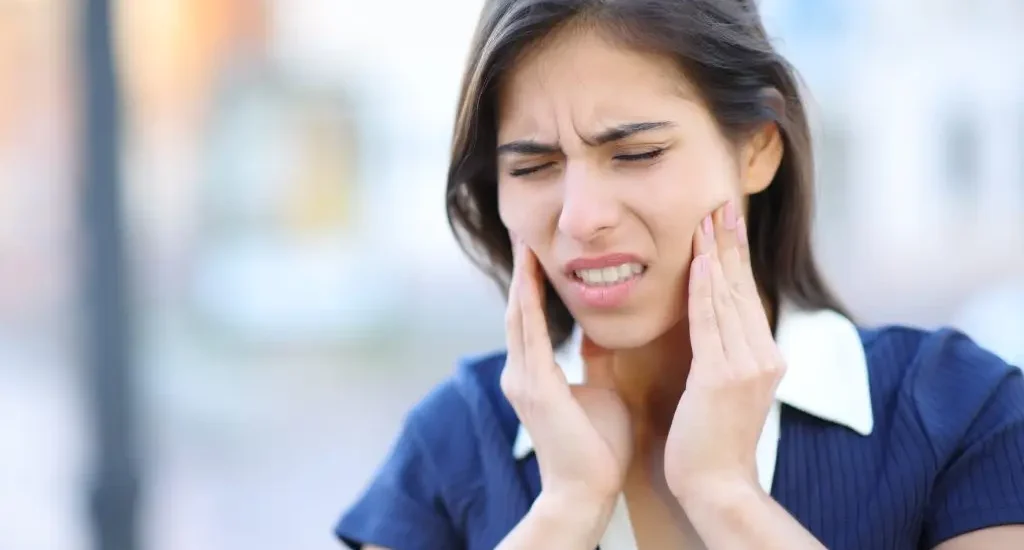
You may have a TMJ disorder if you notice pain in the jaw, clicking or popping sounds that come with discomfort, or trouble opening and closing your mouth normally. Those three signs are the ones worth watching. Everyone has temporomandibular joints, one on each side of the head, and having them is not a condition. A disorder exists only when those joints or the muscles around them start causing distress.
Below we cover what the signs actually feel like, which ones show up first, which jaw noises are normal and which are not, why so many symptoms appear somewhere other than the jaw, how to check yourself at home, and the point at which a jaw is worth having examined.
What Are the Signs You May Have TMJ Disorder?
The signs you may have TMJ disorder are jaw pain, joint noises with pain, restricted or locking movement, and pain referred into the head, ears and neck. Those four patterns are not a random list. They map onto how the National Institute of Dental and Craniofacial Research actually classifies these conditions.
NIDCR groups temporomandibular disorders into three main classes: disorders of the joints themselves including disc disorders, disorders of the masticatory muscles meaning the muscles used for chewing, and headaches attributed to a TMD. A person can have more than one class at the same time, which is why symptoms so often arrive as a cluster rather than one at a time. The table below sorts the common signs against those classes, drawing on NIDCR, Mayo Clinic and Cleveland Clinic.
| Sign | What It Usually Points Toward | How It Presents |
|---|---|---|
| Clicking, popping or grating with pain | A joint or disc problem | Noise at a specific point in opening, paired with a catch or an ache in the joint itself |
| Locking or restricted opening | A joint or disc problem | Jaw catches partway, drifts to one side, or will not open or close fully |
| Aching in the cheeks and temples | A chewing muscle problem | Dull, spread-out soreness that worsens through the day or peaks on waking |
| Pain while chewing | Either class, often both | Fatigue partway through a meal, or avoidance of foods that take effort |
| Temple headaches | Headache attributed to a TMD | Headache that changes with jaw movement, chewing or clenching |
| Earache, fullness or ringing | Referred symptoms | Ear discomfort with no infection found on examination |
| Neck and shoulder tension | Referred symptoms | Tightness that tracks with jaw symptoms rather than with activity |
Scale matters here as well. NIDCR reports that roughly 11 to 12 million US adults have pain in the region of the temporomandibular joint, and that these conditions appear twice as often in women as in men, particularly among women aged 35 to 44.
What Does TMJ Feel Like?
TMJ feels like a dull, tired ache in the cheeks and in front of the ears, punctuated by sharper pain when you bite down or open wide. Patients describe the baseline sensation as muscle fatigue rather than injury, similar to how a calf feels the day after a long hike.
That tired quality is the detail most people struggle to put into words. The jaw feels heavy, or like it has been working all night, or like it needs to be stretched the way you would stretch a stiff shoulder. Stretching brings a moment of relief followed by the same tightness returning.
Joint-driven pain feels different. It sits in a small, precise spot directly in front of the ear, and it shows up at a particular point in the opening arc rather than across the whole movement. Muscle pain spreads. Joint pain pinpoints. Many people have both at once, which is why the sensation rarely stays consistent from one week to the next.
What Are the Early Signs of TMJ?
The early signs of TMJ are morning jaw tightness, mild soreness in the chewing muscles, and fatigue partway through a meal. None of these hurt enough to prompt an appointment, which is exactly why they get ignored for months.
What to watch for in the first weeks:
- A tight jaw on waking that loosens after fifteen or twenty minutes of talking and moving.
- Tenderness when you press your cheeks, roughly an inch in front of the earlobe.
- Getting tired of chewing before the meal is finished, particularly with steak, bagels or raw vegetables.
- A new clicking sound where there was none before, with or without discomfort.
- Mild temple pressure in the late afternoon that you have been treating as a tension headache.
- Flattening or chipping on the teeth, which a dentist notices before the patient does.
Early signs matter because NIDCR notes that many TMDs last only a short time and resolve on their own, while some become chronic. Catching the pattern while it is still intermittent gives the simplest measures the best chance of working.
Why Does My Jaw Hurt When I Wake Up?
Your jaw hurts when you wake up because of clenching and grinding during sleep, a pattern known clinically as sleep bruxism. Eight hours of sustained muscle contraction produces exactly the stiff, fatigued jaw that so many people notice before anything else.
The numbers explain how common this is. A 2024 meta-analysis published in the Journal of Clinical Medicine put global sleep bruxism prevalence at 21%, with North America highest of any region at 31%. Measured objectively through polysomnography, meaning an overnight sleep study, the figure climbs to 43%. Most people who grind have no idea they do it, since the evidence disappears by breakfast.
Airway issues sit close to this. Disrupted breathing during the night is associated with more grinding, so patients who snore heavily or wake unrefreshed sometimes need sleep apnea ruled out before anything else is decided. Where grinding is the driver, custom mouthguards take the load off the joint overnight and protect the teeth while the muscles settle.
Is Jaw Clicking Without Pain Normal?
Yes, jaw clicking without pain is normal and generally needs no treatment. Pain, not noise, is what turns a clicking jaw into a disorder. NIDCR states directly that clicking or popping without pain is common, and Mayo Clinic notes that with no pain or limitation of movement related to the clicking, treatment is likely unnecessary.
The scale of this is larger than most people expect. The TMJ Association reports that roughly one third of the population experiences some jaw clicking or popping with no pain and no restricted movement, and that for this group nothing needs to be done at all.
The click becomes meaningful when something joins it. A sound that now comes with an ache, a catch, a change in how far the jaw opens, or a shift in where the teeth meet has changed category. That is the version worth having looked at, and the distinction is simple enough to monitor on your own.
Can TMJ Cause Headaches, Earaches and Neck Pain?
Yes, TMJ can cause headaches, earaches and neck pain, and those referred symptoms are often more noticeable than the jaw symptoms that produce them. NIDCR treats headache attributed to a TMD as one of the three main classes of these disorders rather than as a side effect.
The anatomy makes the connection straightforward. The temporalis muscle, one of the main jaw-closing muscles, fans across the side of the head above the ear. Sustained contraction there registers as a temple headache rather than as jaw pain. The formal diagnostic criteria for TMD define this headache specifically as temple-region pain that changes with jaw movement, chewing or clenching, which is a test any reader can run on themselves.
Ear symptoms follow the same logic of proximity. The joint sits immediately in front of the ear canal, close enough that inflammation there is experienced as ear pain or fullness. Neck and shoulder tension comes from the muscles that stabilize the head while the jaw works, which anchor into the neck and upper back.
NIDCR also notes that TMDs frequently occur alongside headaches, back pain, sleep problems, irritable bowel syndrome and fibromyalgia. Someone already managing two or three of those conditions can easily file jaw symptoms under one of them and never connect the dots.
Can TMJ Cause Tooth Pain, Dizziness or Ringing in the Ears?
Yes, TMJ can cause tooth pain, dizziness and ringing in the ears, though each arrives indirectly. Mayo Clinic lists tooth pain occurring alongside jaw tenderness among the recognized symptoms, and also includes eye pain, which surprises most patients.
Tooth pain from a TMD has a useful signature: it tends to move between teeth, affect several teeth on one side at once, and produce no findings on examination of the teeth themselves. Genuine tooth pain stays put. A tooth that hurts constantly in one identifiable spot needs a dental cause ruled out first, and where the nerve is involved a root canal resolves pain that a jaw appliance never would.
Ringing, fullness and mild dizziness stem from the joint’s position against the structures of the ear. These symptoms send a great many people to a physician for an ear examination that comes back clear, after which the jaw finally gets considered.
How Do I Know If I Have TMJ or Just Jaw Pain?
You likely have TMJ rather than ordinary jaw pain if the symptoms persist beyond a few weeks, change with jaw movement, and appear in more than one place at once. Isolated soreness after a long dental appointment or a hard night of grinding is a passing strain. A pattern is something else.
Three features separate the two. Duration is the first: ordinary strain fades within days, while a disorder settles into weeks or months. Movement dependence is the second: pain that predictably worsens with chewing, yawning or clenching points at the jaw system, while pain unaffected by movement usually points elsewhere. Distribution is the third: a disorder typically produces two or three of the signs in the table above together rather than one alone.
Plenty of jaw pain we see across Sonora and Tuolumne County turns out to be something other than a temporomandibular disorder, which is the reason to have it identified rather than assumed. The treatment for a cracked tooth and the treatment for a strained joint have nothing in common.
Can TMJ Affect Only One Side?
Yes, TMJ can affect only one side, and one-sided symptoms are common rather than unusual. You have two temporomandibular joints, and nothing requires them to behave identically.
One-sided presentation usually reflects one-sided habit. Chewing predominantly on one side, sleeping face-down with the head turned the same way each night, resting a chin on one hand at a desk, or an old injury to one joint all load one side harder than the other. A bite that meets unevenly does the same thing, since the jaw shifts toward the side that makes contact first.
The distinction has practical value. Symptoms confined to one side, particularly with a noise or a catch in that joint alone, point toward the joint classes. Aching spread symmetrically across both cheeks and temples leans muscular, which usually means clenching.
How Do You Self-Check for TMJ at Home?
You self-check for TMJ at home by feeling the joints as they move, measuring how far the jaw opens, and pressing the chewing muscles for tenderness. None of this diagnoses anything. It tells you whether a professional look is warranted.
- Place your index fingers directly in front of your ear openings and open and close slowly. You should feel both joints move together and evenly.
- Note any clicking, popping or grating, and note specifically whether the sound comes with pain or a catch.
- Watch your jaw in a mirror as you open fully. A jaw that veers to one side partway through is worth mentioning.
- Stack three fingers vertically and try to fit them between your upper and lower front teeth. A healthy jaw generally accepts them, roughly 40 to 50 millimeters of opening. Stop at the first sign of pain rather than forcing it.
- Press firmly on your cheeks about an inch in front of each earlobe, then on your temples. Tenderness in either location suggests the chewing muscles are involved.
- Close your teeth together gently and notice whether the bite feels even or whether one side contacts first.
- Write down what you found and how long the symptoms have been present. That record shortens the exam considerably.
Two findings deserve prompt attention rather than monitoring: a jaw that locks and will not move, and pain severe enough to disturb sleep.
Is TMJ a Serious Problem?
TMJ is usually not a serious problem, and most cases are mild, self-limiting and treatable with conservative care. Cleveland Clinic describes these disorders as common, treatable and rarely the cause of lasting problems.
The cases that do become serious share one feature: they were left alone for a long time. Persistent symptoms tend to entrench, chewing narrows toward soft foods, and sleep quality drops. Grinding that continues unchecked damages the teeth themselves, flattening the biting surfaces and cracking fillings, and that damage does not reverse on its own. Rebuilding worn surfaces with dental crowns restores function, though preventing the wear is the cheaper path by a wide margin.
Framing it usefully: TMD is rarely dangerous and frequently persistent. The reason to act early is not fear of the condition but avoidance of the years spent managing something that responds well to TMJ treatment when it is addressed while still mild.
Is TMJ Due to Stress?
TMJ is partly due to stress, though stress does not damage the joint directly. It drives the clenching and muscle guarding that do. Mayo Clinic lists stress, post-traumatic stress disorder, anxiety and depression among the factors that raise the risk of developing a TMJ disorder.
The mechanism runs through the muscles. Under sustained stress people clench during the day without noticing, hold the jaw in a braced position, and grind more at night. Each of those adds hours of load to a joint designed for intermittent work. Mayo Clinic also notes that the exact cause of TMJ disorder is often hard to determine and that pain usually reflects a mix of factors rather than a single one.
Worth saying plainly: identifying stress as a contributor does not mean the pain is imagined. The muscle fatigue is real, measurable and treatable. It simply means that managing the clenching matters as much as treating the joint.
What Autoimmune Disease Is Associated With TMJ?
The autoimmune disease most associated with TMJ is rheumatoid arthritis, which attacks joint linings throughout the body and can involve the temporomandibular joints along with everything else. Mayo Clinic lists rheumatoid arthritis, other forms of arthritis, connective tissue diseases and ankylosing spondylitis among the risk factors for TMJ disorders.
Inflammatory joint disease presents differently from the mechanical pattern most people have. It tends to affect both joints, comes with morning stiffness lasting well over an hour, and arrives alongside symptoms in other joints such as the hands, wrists or knees. Degenerative joint disease from osteoarthritis follows a different course again, developing gradually with age and often producing a grating sound rather than a distinct click.
Anyone whose jaw symptoms arrived alongside joint problems elsewhere in the body should mention that connection to both their physician and their dentist. It changes what the symptoms mean and who should be managing them.
Who Is Most at Risk for TMJ?
The people most at risk for TMJ are women between 35 and 44, people who grind or clench, and anyone with arthritis or a history of jaw injury. NIDCR reports these disorders as twice as common in women as in men, with that age band standing out particularly.
The recognized risk factors, drawn from Mayo Clinic and NIDCR, include:
- Rheumatoid arthritis, osteoarthritis and other forms of arthritis
- Prior injury to the jaw, face or neck
- Habits including gum chewing, nail biting, and grinding or clenching the teeth
- Certain connective tissue diseases
- Stress, anxiety, depression and post-traumatic stress disorder
- Fibromyalgia, ankylosing spondylitis and sleep disturbances
- Smoking
Risk factors are not predictions. Plenty of people carry several and never develop symptoms, while others develop a disorder carrying none. They are useful mainly for deciding how seriously to take an early sign.
Why Are So Many People Getting TMJ?
So many people are getting TMJ because the habits that load the jaw have become more common, not because the condition itself has changed. Grinding, sustained screen posture and chronic stress all press on the same joint system, and all three have grown.
Bruxism is the clearest driver. Global prevalence stands at 22.22% across sleep and awake forms combined, and North America leads the world in sleep bruxism at 31%. Awake bruxism, meaning daytime clenching, sits at 23% globally, and much of it happens during focused work at a screen without the person registering it at all.
Posture compounds the load. Holding the head forward toward a monitor for hours strains the muscles running from the jaw into the neck, and those muscles do not distinguish between screen strain and chewing strain. Awareness is part of the picture too. More patients now recognize jaw symptoms as a condition worth naming rather than something to endure, which raises the number of diagnoses independently of the number of cases.
When Should You Get Your Jaw Evaluated?
You should get your jaw evaluated if you have constant pain or tenderness in the jaw, sudden difficulty moving it, or a jaw that gets stuck. Mayo Clinic sets the threshold at exactly this point: constant pain or tenderness that occurs suddenly or during jaw movement, or an inability to open or close the jaw completely.
Three months of persistent symptoms is the other practical marker. Below that, watchful waiting with soft foods and reduced load is reasonable, since many TMDs resolve on their own. Past it, the case has stopped being self-limiting and deserves a proper look. A dental exam is the right starting point, because a dentist can sort jaw problems from tooth problems in the same visit.
One situation does not wait. A jaw locked shut that will not open needs urgent care the same day rather than an appointment next week.
What Happens at a TMJ Evaluation?
At a TMJ evaluation, a professional reviews your medical and dental history, examines the jaw by hand, and takes images when the joint structure needs seeing. Nothing about it is uncomfortable, and most of it takes minutes.
The hands-on portion covers what the self-check covers, done properly. We listen to and feel both joints through their full range, measure maximum opening, watch the path the jaw travels as it opens, press along the chewing muscles to locate tender points, and check how the teeth meet. That combination usually identifies which of the three NIDCR classes is involved, and often more than one.
Imaging comes in when the findings point at the joint itself rather than the muscles. Dental imaging shows the bony structures and rules out dental causes, while soft tissue and the articular disc require other methods through a physician. Formal diagnosis follows validated criteria that define specific conditions including joint pain, muscle pain with referral, and headache attributed to a TMD.
What Can Be Done Once You Know?
Once you know it is a TMJ disorder, treatment starts conservative and most people never need anything beyond the first few steps. Soft foods, heat and cold, habit changes, a properly fitted appliance and correction of an uneven bite resolve or substantially improve the large majority of cases.
What we handle directly is the dental side of that: custom appliances made from impressions of your actual bite, adjustment of how the teeth meet, and alignment work where uneven contact is driving the strain. Dr. Berger completed postgraduate training in occlusion, the study of how teeth contact each other, which is the discipline that sits underneath all of it. Patients looking for jaw pain relief generally find it here rather than further up the ladder. If you are deciding where to start, we have written about what to look for in a TMJ dentist.
Frequently Asked Questions
What Are the Four Stages of TMJ?
There is no official four-stage system for TMJ. NIDCR classifies temporomandibular disorders into three main classes rather than four stages: joint disorders, chewing muscle disorders, and headaches attributed to a TMD. The four-stage framing repeated on many websites comes from a staging system for disc displacement specifically, which describes one type of joint problem rather than TMD as a whole.
Does Resting Your Jaw Help TMJ?
Yes, resting your jaw helps TMJ, and it is the single most effective thing you can do without professional care. Soft foods, no gum, smaller bites and supported yawning take the load off within days. Rest is also diagnostic: symptoms that ease noticeably with a week of genuine jaw rest confirm that load is the driver.
Does TMJ Show Up on an X-ray?
TMJ sometimes shows up on an X-ray, though only the bony parts. Dental X-rays reveal the shape and condition of the joint surfaces and can identify degenerative change. The articular disc, the cartilage cushion inside the joint, does not appear on standard X-rays, which is why muscle-driven cases frequently produce entirely normal imaging.
What Could Be Mistaken for TMJ?
Conditions mistaken for TMJ include cracked teeth, infected tooth nerves, sinus infections, ear infections, trigeminal neuralgia and migraine. Each produces pain in the same region of the face, and several worsen with chewing. Sorting them apart takes an examination, since the treatments have nothing in common.
Can TMJ Go Away and Come Back?
Yes, TMJ can go away and come back, and that pattern is typical. NIDCR notes that many TMDs last only a short time and resolve on their own, while some become chronic. Symptoms commonly track with stressful periods, sleep quality and diet, so a quiet stretch followed by a bad month reflects changing load rather than a new condition.
Can a Dentist Tell If You Have TMJ Just by Looking?
A dentist can spot strong indicators just by looking, though confirming a TMJ disorder takes a hands-on exam. Flattened biting surfaces, chipped enamel, scalloped edges along the tongue and ridging inside the cheeks all signal sustained clenching. Those findings often surface at a routine checkup before the patient has mentioned any jaw symptoms.
The Bottom Line
Three signs are worth watching: jaw pain, joint noises that come with discomfort, and trouble opening or closing normally. Painless clicking on its own belongs to about a third of the population and needs nothing done about it. What changes the picture is pain, restriction, or symptoms appearing in two or three places at once, since a genuine disorder rarely shows up as a single isolated complaint.
Early signs are quiet by nature. Morning tightness, cheek tenderness and running out of chewing stamina partway through dinner are the usual openers, and they are easy to absorb into normal life for months. A five-minute self-check tells you whether the pattern is worth a closer look, and constant pain, a locking jaw or three months of symptoms are the points where waiting stops being reasonable.
If any of this sounds like your jaw, we are glad to examine it properly and tell you what is actually going on, whether that turns out to be the joint, the muscles, the bite or a tooth. You can find us at Jeff Berger Dentistry on Mono Way, and you are welcome to get in touch whenever it suits you.


