


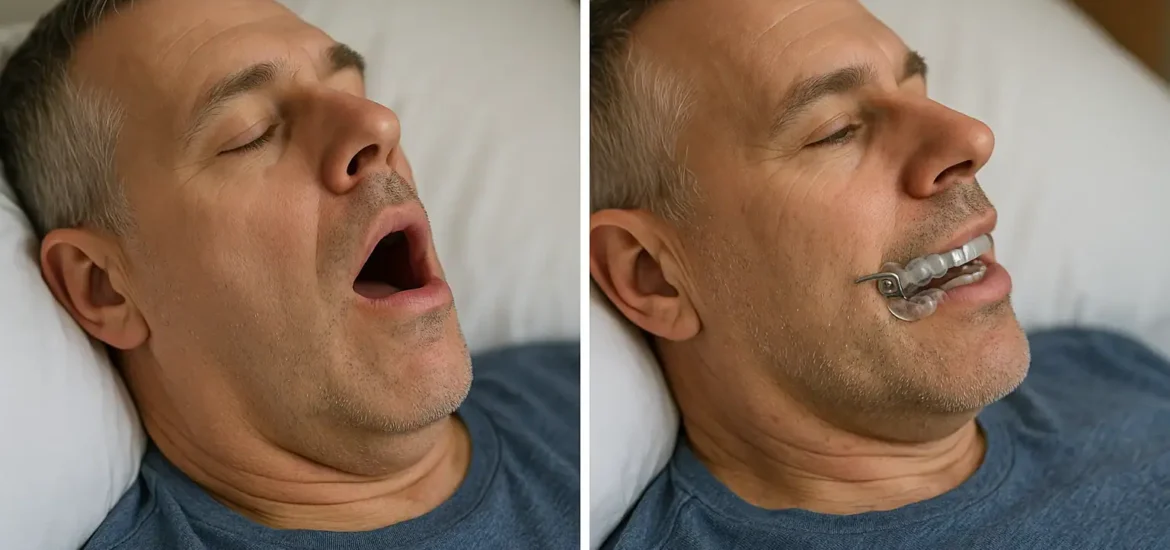
Yes, dental appliances work for obstructive sleep apnea. They reposition the lower jaw or the tongue forward to keep the airway open during sleep, which stops the soft tissue at the back of the throat from collapsing and blocking airflow. They work best for people with mild to moderate obstructive sleep apnea and for people who cannot tolerate a CPAP machine, and most patients wear them far more consistently than they wear a mask.
Below we cover how these devices work, what the success numbers actually look like, how they compare to CPAP on hard outcomes, who qualifies for one, what the fitting process involves, and how we handle the side effects that come with any device that moves your jaw.
Do Dental Appliances Work for Sleep Apnea?
Dental appliances work for sleep apnea by holding the airway open mechanically rather than by forcing air through it. The American Academy of Sleep Medicine and the American Academy of Dental Sleep Medicine put their 2015 clinical practice guideline behind this approach, recommending custom, titratable oral appliances for adults with obstructive sleep apnea (OSA) who are intolerant of CPAP therapy or who decline it. Oral appliance therapy (OAT) is a recognized medical treatment, not a comfort accessory.
Recognized treatment status rests on measured results. A 2026 systematic review and meta-analysis found that mandibular advancement devices reduced the apnea-hypopnea index by 15.78 events per hour compared with sham devices that looked identical but did not advance the jaw. The apnea-hypopnea index (AHI) counts breathing interruptions per hour of sleep, and the American Academy of Sleep Medicine sorts severity into mild at 5 to 14 events, moderate at 15 to 29, and severe at 30 or more.
Severity bands matter because they set expectations. One important limit applies throughout: dental appliances treat obstructive sleep apnea, where the airway physically collapses. They do nothing for central sleep apnea, where the brain fails to signal the breathing muscles, because there is no obstruction to open.
What Is the Success Rate of Dental Appliances for Sleep Apnea?
The success rate of dental appliances for sleep apnea is roughly 70 percent of patients cutting their apnea severity by more than half, with about one third seeing their symptoms resolve completely. Complete and partial response rates across studies published since 2005 range from 45 percent to 100 percent, and a review in the Journal of Thoracic Disease noted that the highest response rates came from patients who started with lower AHI scores.
Lower starting scores are not the only group that responds. In a cohort of patients with moderate to severe OSA, three months of mandibular advancement therapy brought mean AHI down from 27.2 events per hour to 9.1, and 85 percent of those patients reached an AHI below 15. Those numbers come from patients wearing the device about six hours a night, which is the variable that separates a device that works on paper from one that works in a bedroom.
How Does a Dental Appliance for Sleep Apnea Work?
A dental appliance for sleep apnea works by moving your lower jaw or your tongue forward a few millimeters, which pulls the tongue base away from the back of your throat and widens the airway behind it. The tongue base is the main culprit in most obstructive sleep apnea. When you fall asleep, the muscles holding it in place relax, and gravity drops it backward into the space your air travels through.
That space stays open when the mandible sits forward. Advancing the lower jaw stretches the pharyngeal soft tissue sideways as well as forward, so the airway gains width in two directions at once. Pharyngeal soft tissue under tension resists collapse the same way a tent wall under tension resists wind, which is why the effect holds through the deepest stages of sleep when muscle tone is at its lowest.
Muscle tone drops the same way every night, so the device has to be worn every night to hold the result. Our oral appliance therapy uses small, durable mouthpieces that carry no cords, no settings and no replacement parts, which is a large part of why patients keep using them.
What Is a Mandibular Advancement Device?
A mandibular advancement device (MAD) is a custom mouthpiece that fits over your upper and lower teeth and holds the lower jaw in a forward position while you sleep. Forward positioning is adjustable on the better designs, which is the feature that matters most. Two-piece titratable devices let us move the jaw forward in small increments over several weeks until breathing normalizes, and they consistently outperform one-piece devices that lock the jaw at a fixed position from the first night.
Fixed positioning explains why the research keeps pointing the same direction. MADs are the most frequently used oral appliance in obstructive sleep apnea treatment, and nearly all of the efficacy data cited throughout this article comes from studies of custom, adjustable mandibular advancement devices rather than generic mouthpieces.
What Is a Tongue-Retaining Device?
A tongue-retaining device (TRD) is a mouthpiece that holds the tongue itself forward using a soft suction bulb, instead of moving the jaw. Moving the jaw requires teeth to anchor against, and that is exactly the situation a tongue-retaining device solves. Patients with significant tooth loss, with dentures, or with jaw alignment that prevents forward movement can often use a TRD when a MAD is not an option.
Research on tongue-retaining devices shows they reduce interrupted breathing and daytime sleepiness, though they have been studied less extensively than mandibular advancement devices. Studies also show higher discontinuation rates, because the suction sensation on the tongue takes more getting used to than a device that simply fits over the teeth.
Is a Sleep Apnea Mouth Guard the Same as a Night Guard?
No, a sleep apnea mouth guard is not the same as a night guard, and the two devices do opposite things to your jaw position. Jaw position is the whole distinction. A sleep apnea appliance pulls the mandible forward to open the airway. A standard night guard sits between the teeth to absorb grinding force and holds the jaw where it already sits, or lets it settle backward.
Backward settling is the part patients never hear about. A flat night guard made without an airway evaluation can rotate the lower jaw down and back, which narrows the throat behind it. For someone whose grinding is a reflex response to a closing airway, a guard that protects the enamel while tightening the airway treats the symptom and feeds the cause. That is why we evaluate the airway before we make any nighttime device, and why a patient who needs TMJ treatment and shows airway signs gets screened for both at the same visit.
Screening both at once also prevents the reverse mistake. The two devices look similar enough that patients often assume the guard they already own is doing something for their breathing. It is not, and a guard cannot correct a restricted airway no matter how well it fits.
Do Oral Appliances Work as Well as CPAP?
Oral appliances do not reduce apnea events as powerfully as CPAP, but they produce comparable real-world results because patients wear them for more hours every night. Hours worn is the variable most comparisons leave out. Continuous positive airway pressure (CPAP) reduces AHI by roughly 70 to 90 percent according to a 2026 systematic review in the Journal of Sleep Research, while mandibular advancement devices reduce it by roughly 50 to 75 percent. In head-to-head trials pooled in a 2026 meta-analysis published in Frontiers in Neurology, CPAP cleared 8.45 more events per hour.
Events cleared per hour only count during the hours a device is actually in use. The same Frontiers in Neurology analysis measured objective nightly use and found mandibular advancement devices worn 0.71 hours longer per night than CPAP, with a 95 percent confidence interval of 0.30 to 1.13 hours. A separate review reported mean use of 6.5 hours a night for oral appliances against 5.2 hours for CPAP, and the Journal of Sleep Research review put adherence rates at 70 to 85 percent for appliances versus 50 to 70 percent for CPAP. Long-term CPAP adherence in general practice runs lower still, between 30 and 60 percent.
Treatment benefit equals how well a device works multiplied by how long it is worn. That arithmetic is why two devices with different laboratory scores land close together in patient outcomes. Both therapies produce comparable improvement in daytime sleepiness on the Epworth Sleepiness Scale, and a meta-analysis of 51 randomized controlled trials found oral devices as effective as CPAP at lowering blood pressure in patients with obstructive sleep apnea. The figures below pull those findings together.
| Factor | CPAP | Oral appliance |
|---|---|---|
| AHI reduction | Roughly 70 to 90 percent | Roughly 50 to 75 percent |
| Nightly use | About 5.2 hours; adherence 50 to 70 percent | About 6.5 hours; adherence 70 to 85 percent |
| Daytime sleepiness | Significant improvement | Comparable improvement |
| Blood pressure effect | Significant reduction | Equivalent across 51 randomized trials |
| Best fit by severity | Any severity, and the standard for severe cases | Mild to moderate, plus CPAP-intolerant patients at any severity |
| Practical profile | Mask, hose, power supply, humidifier maintenance | Fits in a pocket, silent, no power needed |
How to Help Sleep Apnea Without CPAP
You can help sleep apnea without CPAP by using a custom oral appliance as your primary treatment and supporting it with the changes that reduce airway collapse. Airway collapse worsens with alcohol or sedatives before bed, with back sleeping, with nasal congestion, with smoking, and with weight gain, and every one of those is modifiable.
Modifiable factors rarely solve moderate or severe apnea on their own. Weight loss can move a patient down a full severity category and occasionally resolves mild cases, but most people need an active nightly treatment alongside it. An oral appliance fills that role without a machine, which is the reason it exists as a category at all.
Who Is a Good Candidate for a Dental Appliance?
A good candidate for a dental appliance is an adult with diagnosed mild to moderate obstructive sleep apnea, or any adult who cannot tolerate CPAP, who has enough healthy teeth to anchor the device. Healthy teeth are the requirement most articles mention and nobody defines, so here is what we actually check during the evaluation:
- Enough sound anchor teeth in both the upper and lower arch to hold the device securely
- Stable gum and bone support, since the appliance transmits force to every tooth it grips
- Sound existing restorations, because crowns and fillings carry that force too
- Adequate jaw opening and the ability to move the lower jaw forward comfortably
- A temporomandibular joint healthy enough to hold a forward position for several hours
- No active decay or untreated infection that needs restorative work first
Active gum disease is the item that stops the most cases, because an appliance gripping teeth with compromised bone support accelerates the loss. In those cases gum disease treatment comes first, and the airway device follows once the tissue stabilizes.
Stabilizing the foundation also protects the investment in the device itself. Teeth that need restoration get restored before impressions are taken, since an appliance made around a failing tooth stops fitting the moment that tooth is treated. Patients who already have crowns and bridges can usually proceed without any issue, as long as those restorations are sound and well seated.
Can an Oral Appliance Treat Severe Sleep Apnea?
Yes, an oral appliance can treat severe sleep apnea in many patients, though CPAP remains the standard first choice at that severity. First-choice status is about probability, not possibility. A 2024 meta-analysis published in Otolaryngology–Head and Neck Surgery found roughly a 66 percent AHI reduction with mandibular advancement devices in severe obstructive sleep apnea, which is a meaningful result for a group once written off entirely.
Severe cases in the moderate-to-severe cohort described earlier responded more strongly than the moderate cases, with a 74.2 percent median AHI reduction compared with 57.3 percent. Response is difficult to predict in advance, which is why a follow-up sleep study after titration is part of the process rather than an optional extra. For a patient with severe apnea who has already abandoned a CPAP machine, a device worn every night beats a machine sitting in a closet.
Can You Use an Oral Appliance With Missing Teeth or Dentures?
You can often use an oral appliance with missing teeth or dentures, though the device has to change form depending on what is left to anchor to. Anchoring is the deciding factor. A mandibular advancement device needs teeth in both arches to grip, so a patient missing several back teeth on one side may not have enough support for one.
Support can be rebuilt. Patients wearing partial dentures sometimes have enough remaining natural dentition to hold a modified appliance, and a tongue-retaining device is the standard fallback when they do not, since it works off tongue suction rather than tooth grip.
Tooth grip returns permanently with fixed restorations. Dental implants anchor into bone and can carry appliance force the way natural teeth do, which turns a patient who had no option into a candidate. That sequencing conversation happens during the evaluation, not after a device has already been made.
Do You Need a Sleep Study Before Getting a Dental Appliance?
Yes, you need a sleep study before getting a dental appliance, because a formal diagnosis establishes that you have obstructive sleep apnea rather than central sleep apnea, and it records the AHI baseline that treatment is measured against. A baseline number is what makes success measurable later. Without one, nobody can say whether the device is working or whether symptoms simply feel better.
Feeling better and breathing better are not the same thing, which is why diagnosis belongs with a sleep physician. We screen, we flag the oral signs, and we coordinate the referral, but we do not diagnose sleep apnea and we do not run sleep studies. A thorough dental exam catches the markers that start the process: flattened teeth, a scalloped tongue, a dry mouth on waking, crowded airway space, and gum inflammation that outpaces a patient’s hygiene.
Markers like those turn up constantly in routine visits across Sonora, often in patients who have never once discussed their sleep with a physician. Dr. Jeff Berger works alongside your doctor rather than around them, and treatment follows the diagnosis in that order every time.
How Do You Get Fitted for a Sleep Apnea Mouthpiece?
You get fitted for a sleep apnea mouthpiece through a dental evaluation, digital records of your bite, fabrication of the custom device, and several weeks of gradual adjustment until your breathing normalizes. Gradual adjustment is the stage that determines the outcome, and it is the stage over-the-counter devices skip entirely. The full sequence runs like this:
- We evaluate your teeth, gums, restorations and jaw joint to confirm the device has a healthy foundation to work from.
- Your physician reviews your sleep study results and confirms obstructive sleep apnea with a baseline AHI.
- We measure your maximum protrusive range, meaning how far forward your lower jaw can move comfortably.
- We take records of both arches and your bite relationship.
- The laboratory fabricates the custom appliance set at a conservative starting advancement, usually a small fraction of your full range.
- You wear it nightly for one to two weeks while your jaw muscles adapt to the new position.
- We advance the device in small increments across several follow-up visits, tracking snoring, morning headaches, daytime alertness and jaw comfort at each step.
- Your physician arranges a follow-up sleep study once symptoms settle, which verifies the device is controlling your apnea rather than only quieting the snoring.
Verification at the end is what separates treatment from a guess, since snoring can stop while breathing events continue. Treatment ends up matched to your airway rather than to an average one, which is the entire argument for a custom device. Our sleep apnea treatment follows this sequence for every patient.
The records stage is faster and more comfortable than most patients expect. Digital impressions capture both arches without trays full of impression material, and they give the laboratory a more accurate model to build from.
How Long Does It Take for an Oral Appliance to Work?
An oral appliance takes a few nights to start helping and several weeks to reach full effect. Full effect waits on titration. Many patients notice quieter breathing, fewer morning headaches and a clearer head within the first week at the starting position, before any advancement has happened.
Advancement continues from there in small steps, and most patients reach their effective position within four to eight weeks. A follow-up sleep study after that point confirms the result objectively, and occasional re-adjustment keeps it there as your weight, muscle tone and bite change over the years.
How We Prevent Side Effects From an Oral Appliance
The side effects of an oral appliance are excess saliva, dry mouth, tenderness in the teeth and gums, morning jaw soreness, and gradual bite change with long-term use, and each one has a specific management that keeps it from becoming a problem. Management starts with how slowly the device advances. The early effects, saliva and tenderness and soreness, are generally mild and settle within a few weeks as the muscles and ligaments adapt, and a conservative starting position shortens that window considerably.
Shortening that window matters because comfort in the first month predicts whether a patient keeps wearing the device at all. We advance in small increments rather than jumping to maximum protrusion, we check the fit at every visit, and we address jaw soreness early rather than waiting for a patient to stop using the appliance on their own.
Bite change is the long-term item worth real attention, because small tooth movement can accumulate over years of nightly wear. Prevention here is concrete: a morning bite repositioner that guides the jaw back to its normal relationship after you remove the device, scheduled bite checks at every recall visit, and photographic and model records from the start so any drift is caught while it is still small. Patients who follow that routine keep their bite stable across years of successful therapy.
Do Over-the-Counter Sleep Apnea Mouthpieces Work?
Over-the-counter sleep apnea mouthpieces do not work reliably, because they cannot be titrated to your airway and they are built around a generic arch shape rather than your teeth. Your teeth are what hold any mandibular device in position, and a boil-and-bite tray molded at your kitchen stove grips unevenly, loosens through the night, and concentrates force on whichever teeth it happens to contact hardest.
A direct comparison published in the American Journal of Respiratory and Critical Care Medicine tested custom appliances against thermoplastic boil-and-bite devices in patients with mild sleep apnea and found the custom devices clearly superior. The thermoplastic devices also showed poor retention, which is the practical failure that leaves a patient treated on paper and untreated in bed.
Untreated in bed is the real risk here, because these devices often reduce snoring without touching the breathing events underneath. A quiet night convinces the patient and their partner that the problem is solved while oxygen levels keep dropping, and that false reassurance is worse than no device at all.
How Long Does a Dental Appliance for Sleep Apnea Last?
A dental appliance for sleep apnea lasts about three to five years with daily use and proper care, and longer for patients who do not grind their teeth. Grinding is the main thing that shortens that span. Sleep bruxism affects roughly 13 percent of adults, and nightly clenching loads wear through acrylic and fatigue the hardware on adjustable devices far faster than normal use does.
Normal use still takes a toll, so daily care extends the life of any device. Rinse it in cool water and brush it gently with a soft brush each morning, let it dry fully before storing it in a vented case, and keep it away from hot water and the dashboard of a car, since heat distorts the material permanently. Bring it to every dental visit so we can check retention, hardware and fit alongside your teeth.
Fit also shifts for reasons that have nothing to do with the device. New restorations, extractions, orthodontic movement and significant weight change all alter how an appliance seats and how much advancement you need, and any of those can make a replacement necessary well before the material wears out.
Are Oral Appliances for Sleep Apnea Worth It?
Oral appliances for sleep apnea are worth it for most people who qualify, because a device worn six hours a night delivers more real benefit than a more powerful therapy worn five hours or abandoned altogether. Abandonment is the quiet failure mode in sleep apnea treatment, and it is the problem oral appliance therapy was built to solve. With roughly 80 percent of the estimated 80.6 million American adults who have obstructive sleep apnea still undiagnosed, the number of people who have tried nothing at all dwarfs the number weighing one device against another.
Weighing the options comes down to three honest points. CPAP controls apnea events more completely and remains the right first choice for severe cases. An oral appliance controls them well enough in mild and moderate cases to produce equivalent improvement in daytime sleepiness and blood pressure. And an appliance gets worn, which is why patients in Sonora who switched after years of fighting a mask usually describe the change in terms of mornings rather than machines. A custom oral appliance protects your airway, your sleep and the teeth that untreated apnea quietly grinds down.
Frequently Asked Questions
Does a Sleep Apnea Mouthpiece Stop Snoring?
Yes, a sleep apnea mouthpiece usually stops snoring, because snoring is the sound of air vibrating through a narrowed airway and the device widens that airway. Snoring often quiets within the first few nights, well before the device reaches its full treatment position. Quiet breathing alone does not prove the apnea is controlled, which is why a follow-up sleep study still matters.
Does an Oral Appliance Change Your Bite Over Time?
An oral appliance can change your bite over time, with small tooth movement accumulating across years of nightly wear. A morning bite repositioner, gradual advancement and scheduled bite checks at every recall visit keep that movement minimal. Baseline records taken before treatment let us measure any drift precisely rather than guessing at it.
How Do You Clean a Sleep Apnea Mouthpiece?
You clean a sleep apnea mouthpiece by rinsing it in cool water each morning and brushing it gently with a soft toothbrush and mild soap rather than toothpaste, which is abrasive enough to scratch acrylic. Let it air dry completely before storing it, since a damp case grows bacteria. Never use hot water or boiling water, because heat warps the fit permanently.
Can Children Use an Oral Appliance for Sleep Apnea?
Children can use certain oral appliances for sleep apnea, though the devices and goals differ from adult treatment. Rapid maxillary expansion widens a narrow upper jaw during growth and can resolve obstructive sleep apnea in up to 25 percent of treated children according to a systematic review published in Laryngoscope. Pediatric cases are usually managed first by a physician, since enlarged tonsils and adenoids are the most common cause.
Can You Use an Oral Appliance Together With a CPAP Machine?
Yes, you can use an oral appliance together with a CPAP machine, and combination therapy helps some patients considerably. Advancing the jaw opens the airway mechanically, which often allows the machine to control apnea at a lower pressure setting. Lower pressure makes the mask easier to tolerate, so patients who were close to quitting sometimes stay with it.
Will an Oral Appliance Help If I Grind My Teeth at Night?
An oral appliance often reduces teeth grinding, because grinding in people with sleep apnea is frequently a reflex that fires as the body works to reopen a closing airway. Removing the trigger removes much of the grinding. Patients who grind heavily need a device built to handle that load, and we check the appliance for wear at every visit.
The Bottom Line
Dental appliances work for obstructive sleep apnea by moving the jaw or tongue forward to hold the airway open, and the evidence behind them is solid. They cut apnea severity by more than half for roughly 70 percent of patients and resolve symptoms entirely for about a third. They do not match CPAP event for event in a sleep lab, yet they close most of that gap in real life because patients wear them longer and more consistently, and they match CPAP on outcomes that matter beyond the lab, including daytime sleepiness and blood pressure.
What makes the difference is custom fitting, gradual titration and follow-up care, none of which a store-bought mouthpiece can offer. If you have been diagnosed with sleep apnea and the machine is not working out, or you suspect the problem and have never had it checked, we are glad to take a look and talk through whether an appliance fits your situation at Jeff Berger Dentistry.
Call 209-532-2915 or contact us whenever it suits you, and we will start with an evaluation and go from there.


