


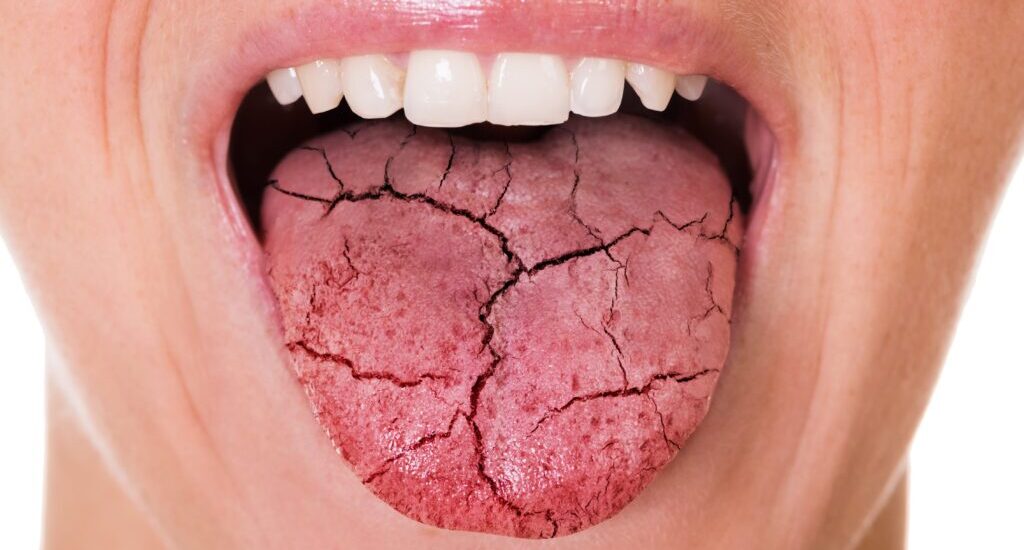
Sleep apnea affects your oral health through three pathways: chronic mouth breathing, unconscious teeth grinding, and the physiological stress of repeated oxygen drops during sleep. Those three pathways produce dry mouth, faster tooth decay, enamel erosion, worn and cracked teeth, jaw joint pain, gum disease, a scalloped tongue, and changes to jaw growth in children.
Below we walk through each oral effect, the mechanism behind it, what the research shows about how strong each link is, and how a dental exam catches the problem long before most people ever reach a sleep physician.
How Does Sleep Apnea Affect Your Oral Health?
Sleep apnea affects your oral health by drying out the mouth, forcing the jaw muscles to clench and grind all night, and flooding the body with inflammatory stress every time oxygen levels fall. Obstructive sleep apnea (OSA) is the form that does nearly all of this damage, and OSA accounts for more than 80 percent of sleep apnea cases in the United States, according to the American Academy of Sleep Medicine. The American Academy of Sleep Medicine also defines a single apnea event as a breathing pause lasting 10 seconds or longer, with 5 to 15 events per hour counted as mild, 15 to 30 as moderate, and more than 30 as severe.
Those breathing pauses happen when the soft tissues at the back of the throat relax and collapse into the airway. Airway collapse sets off a chain reaction the mouth absorbs directly. The jaw drops open to pull in air, the lips part, saliva evaporates, the tongue shifts forward against the teeth, the masticatory muscles fire to reopen the throat, and blood oxygen dips before the brain jolts the body back toward wakefulness. Every one of those responses leaves a mark on teeth, gums, or the jaw joint.
The scale of the problem is larger than most people assume. A prevalence meta-analysis published in Sleep Medicine estimated that 80.6 million American adults aged 20 and older were living with OSA in 2024, a 32.4 percent prevalence, with 39 percent of men and 26 percent of women affected after adjusting for obesity. That same analysis put severity distribution at 52 percent mild, 30 percent moderate, and 18 percent severe. The American Academy of Sleep Medicine estimates that roughly 80 percent of those cases are still undiagnosed, which means tens of millions of people are sustaining oral damage from a condition nobody has named yet.
What Are the Signs of Sleep Apnea in the Mouth?
The signs of sleep apnea in the mouth are flattened or chipped tooth surfaces, a dry mouth on waking, red and puffy gums, ridged indentations along the sides of the tongue, cracked fillings, and tenderness in the jaw joint. Flattened tooth surfaces come first in most exams because enamel wear is permanent and easy to measure against a patient’s previous records.
Previous records matter because these signs build slowly. A dry mouth on waking that lasts a few months changes nothing visible. The same dryness sustained across two or three years shifts the bacterial balance of the whole mouth. That shift shows up as decay along the gumline, chalky white spots near the enamel margins, and gum tissue that bleeds during a cleaning when it never used to.
Why Does Sleep Apnea Cause Dry Mouth?
Sleep apnea causes dry mouth because the airway closes at the nose and throat, which forces breathing through an open mouth for hours, and constant airflow across the oral tissues evaporates the thin layer of saliva faster than the salivary glands can replace it. The salivary glands are already working at their slowest rate at that hour. Unstimulated salivary flow drops sharply during sleep in healthy people, so mouth breathing compounds a low that already exists rather than creating a shortage from a normal baseline.
That compounded shortage is measurable. A prospective case-control study published in Medicina Oral Patología Oral y Cirugía Bucal found xerostomia, the clinical term for dry mouth, on waking in 45 percent of patients with sleep apnea-hypopnea syndrome compared with 20.4 percent of healthy controls. Xerostomia at that rate is not a comfort issue. Saliva neutralizes acid, washes food debris off tooth surfaces, delivers calcium and phosphate back into softened enamel, and carries antibacterial proteins that keep oral flora in balance.
Oral flora in balance is what protects teeth between brushings. Remove the saliva and the acid-producing bacteria gain hours of undisturbed activity every night, with no buffering and no rinsing. Those undisturbed hours are the single most important mechanism in this entire chain, and almost every other oral effect of sleep apnea traces back to them.
Can Sleep Apnea Cause Bad Breath?
Yes, sleep apnea causes bad breath, because reduced saliva lets sulfur-producing bacteria multiply on the tongue and along the gumline overnight. Sulfur-producing bacteria generate volatile sulfur compounds, and those compounds are the direct chemical source of morning halitosis.
Morning halitosis in a person with sleep apnea tends to be stronger and more persistent than ordinary morning breath, and it often returns within a few hours of brushing. That persistence is a useful clue, because it points to a dryness problem rather than a hygiene problem. We see patients who brush twice daily, floss nightly, and still report breath that embarrasses them by mid-morning.
Can Sleep Apnea Cause Tooth Decay and Enamel Erosion?
Yes, sleep apnea causes tooth decay and enamel erosion, because low saliva flow removes the mouth’s acid buffer, and without that buffer enamel loses mineral faster than it can rebuild. Enamel loses mineral whenever oral pH drops below roughly 5.5, and saliva normally pulls pH back above that threshold within 20 to 30 minutes after an acid challenge. Strip the saliva out and the recovery window stretches across the entire night.
A night-long acid exposure produces a specific damage pattern. Decay appears at the gumline and between the back teeth first, where saliva reaches least effectively. Erosion shows up differently, as smooth, cupped hollows on the chewing surfaces and a thinning, translucent look along the edges of the front teeth. Patients with sleep disorders report more dental pain as a result, with one published comparison finding dental pain in 19.79 percent of people with sleep disorders versus 11.8 percent of those without.
How Nighttime Acid Reflux Wears Down Enamel
Nighttime acid reflux wears down enamel by carrying stomach acid into the mouth while the body is lying flat and saliva is scarce. Lying flat removes gravity from the equation, and sleep apnea adds a second force on top of it. Each obstructed breath creates strong negative pressure inside the chest as the diaphragm pulls against a closed airway, and that negative pressure draws gastric contents up past the lower esophageal sphincter.
Gastric acid sits near pH 2, far below the threshold where enamel dissolves. Enamel exposed to that acid several nights a week thins first on the tongue side of the upper back teeth and the back of the upper front teeth, which is a pattern distinct from ordinary chewing wear. Teeth that erode past a certain point need coverage rather than a filling, which is why dental crowns enter the conversation for patients who have lived with untreated apnea and reflux for years.
Does Sleep Apnea Cause Teeth Grinding?
Yes, sleep apnea causes teeth grinding in many patients, because the body uses jaw muscle activity as a reflex to reopen a closing airway. The reflex runs in a fixed sequence. The throat narrows, oxygen drops, the brain fires a micro-arousal, the masticatory muscles contract, the mandible thrusts forward and clenches, the tongue base pulls away from the back of the throat, and air flows again. Bruxism, the clinical term for grinding and clenching, is the visible residue of that rescue sequence repeating dozens of times a night.
That repetition is why grinding in a person with sleep apnea behaves like a symptom rather than a habit. Sleep bruxism affects roughly 13 percent of adults generally, with a reported range of 8 to 31 percent across studies, and research summarized by the National Center for Biotechnology Information found that more than 80 percent of adults who grind at night have no idea they do it. Among people with apnea the rate climbs. A 2019 polysomnographic investigation of 147 patients found sleep-related bruxism in about one third of the OSA group, and those patients also showed more respiratory arousals and deeper oxygen desaturations than controls. A population-based study cited by the American Academy of Sleep Medicine put the odds of OSA at 1.8 times higher in people with sleep bruxism.
What Does Nighttime Grinding Do to Your Teeth?
Nighttime grinding flattens the cusps, chips the incisal edges, cracks enamel into vertical fracture lines, and exposes the softer dentin underneath, which produces sharp sensitivity to cold. Exposed dentin conducts temperature straight to the nerve, so a patient who never flinched at ice water starts avoiding it.
Fracture lines matter more than wear in the long run. A tooth that has lost its cusp height absorbs chewing force straight down its long axis instead of spreading it across sloped surfaces, and that concentrated force splits teeth that are already weakened by old fillings. Existing dental work takes the same beating. Porcelain chips, composite margins open up, and cemented restorations loosen under grinding loads that can far exceed normal chewing pressure. A dental crown placed over a cracked molar restores the tooth, though the crown will fail on the same schedule as the natural tooth did if the grinding behind it goes unaddressed.
Can Sleep Apnea Cause Jaw Pain and TMJ Problems?
Yes, sleep apnea causes jaw pain and TMJ problems, because the temporomandibular joint absorbs hundreds of forced clenching and forward-thrusting movements every night. Forced movements of that kind load the joint in a direction it was never built to sustain for hours, and the surrounding muscles stay contracted instead of resting.
Muscles that never rest produce the classic morning picture: a dull ache in front of the ears, a headache centered at the temples, soreness along the cheeks, and a jaw that feels tight for the first hour of the day. Research published in the Journal of Dental Research found that people with obstructive sleep apnea are roughly twice as likely to have temporomandibular joint disorders as people without it. Clicking, popping, limited opening, and pain during chewing follow as the joint disc and ligaments adapt to the constant load. Non-surgical TMJ treatment works by taking that load off the joint and correcting the bite relationship that concentrates it.
Correcting the bite relationship is only half the picture when an airway is involved, because the joint will keep taking the same nightly load until the breathing problem behind it is treated. That is the distinction we draw during a consultation for persistent jaw pain: joint symptoms with a clear dental cause behave differently from joint symptoms driven by a nightly airway struggle, and the second kind rarely resolves until the airway is addressed.
Does Sleep Apnea Cause Gum Disease?
Yes, sleep apnea causes gum disease, and the association is one of the strongest in the dental literature. A systematic umbrella review covering seven meta-analyses and more than 225,000 participants found an odds ratio of 1.96 for periodontitis in people with OSA, with a 95 percent confidence interval of 1.68 to 2.29. A 2023 meta-analysis of 31,800 participants within that same body of evidence reported an even higher odds ratio of 2.348 for periodontitis prevalence, along with greater probing depth and more clinical attachment loss.
Clinical attachment loss of that magnitude comes from two forces working together. The first is the dryness already described, which leaves gum tissue without its normal lubrication and antibacterial protection, so plaque matures into calculus faster and the tissue inflames more readily. The second force is systemic and almost nobody explains it: each apnea event drops blood oxygen, triggers a sympathetic surge, and raises circulating inflammatory markers. Chronic low-grade inflammation of that kind amplifies the body’s destructive response to the bacteria already sitting under the gumline.
Under the gumline is where periodontitis does its permanent damage, dissolving the bone that holds teeth in place. Periodontal pockets deepen, teeth loosen, and gum recession exposes root surfaces that have no enamel to protect them. Consistent gum disease treatment controls the bacterial side of that equation, and controlling the airway reduces the inflammatory side.
What Causes a Scalloped Tongue?
A scalloped tongue is caused by the tongue pressing outward against the inner surfaces of the lower teeth, which leaves a row of wavy indentations along its edges. Pressing outward is a posture, not an accident. When the airway narrows, the tongue braces forward and down to keep the throat open, and holding that position for six or seven hours stamps the shape of the dental arch into the soft tissue.
The soft tissue of the palate records the same struggle. Repeated tongue pressure against the roof of the mouth can leave a ridged or flattened pattern, and a high, narrow palate reduces nasal airway volume directly above it, which makes mouth breathing more likely and tightens the loop. A scalloped tongue by itself proves nothing, since large tongues and fluid retention produce the same marks. A scalloped tongue combined with flattened molars and a dry mouth on waking is a different matter, and that combination is one of the most reliable intraoral screening signals available.
Screening signals are easier to act on when they are read together rather than one at a time. The pattern below brings together the findings described above, drawing on the prevalence and association figures reported by the American Academy of Sleep Medicine, the Journal of Dental Research, and the umbrella review of OSA and periodontitis.
| Oral sign | What is happening underneath | What we look for in the chair |
|---|---|---|
| Dry mouth on waking | Open-mouth breathing evaporates saliva during the hours when flow is already lowest | Sticky tissues, frothy saliva, gumline decay; reported in 45 percent of apnea patients versus 20.4 percent of controls |
| Flattened, chipped teeth | Masticatory muscles clench and thrust the jaw forward to reopen the airway | Lost cusp height, vertical fracture lines, chipped porcelain; sleep bruxism carries 1.8 times the odds of OSA |
| Cold sensitivity | Enamel worn through to dentin, which conducts temperature to the nerve | Smooth, cupped chewing surfaces and translucent incisal edges |
| Red, bleeding gums | Low saliva plus systemic inflammation from repeated oxygen drops | Deeper probing depths and attachment loss; periodontitis odds ratio of 1.96 in OSA |
| Scalloped tongue | Tongue braced forward against the lower teeth to hold the airway open | Wavy indentations along both tongue borders, often with a ridged palate |
| Morning jaw ache | Joint and muscles loaded for hours without rest | Tenderness at the joint, clicking, limited opening; TMJ disorders roughly twice as common in OSA |
| Eroded upper back teeth | Negative chest pressure during obstructed breaths draws stomach acid upward | Thinning on the tongue side of upper teeth, a pattern distinct from chewing wear |
How Does Sleep Apnea Affect Children’s Teeth and Jaw Growth?
Those seven signs describe a mouth that has already finished growing. A child’s mouth responds to the same airway problem in a different way, because the bones are still forming around the breathing pattern the child uses every night.
Sleep apnea affects children’s teeth and jaw growth by locking in chronic mouth breathing, which narrows the upper palate, crowds the permanent teeth, and lengthens the lower third of the face. A narrowed palate is the hinge finding here. The tongue normally rests against the roof of the mouth and shapes the upper arch outward as it grows, and a mouth-breathing child holds the tongue low and forward instead, so the palate develops high and narrow with no counterforce. One craniofacial prevalence study of healthy children found an atresic, or narrow, palate in 53.9 percent of chronic mouth breathers.
The American Academy of Pediatric Dentistry reports that obstructive sleep apnea exists in 1 to 5 percent of children, occurs most commonly between ages 2 and 7, and names enlarged tonsils and adenoids along with obesity as the major risk factors in otherwise healthy kids. Parents of patients across Sonora often bring up snoring, bedwetting, restless sleep, or trouble focusing at school without connecting any of it to the crowding we are seeing on an x-ray. Crowded permanent teeth, an open bite, a crossbite, and a receded chin are the dental end of a breathing problem that started years earlier, and catching it while the jaws are still growing is the difference between guiding development and correcting it later.
What Happens If Sleep Apnea Goes Untreated for Years?
If sleep apnea goes untreated for years, the oral damage compounds from reversible to permanent, and the mouth moves from inflamed tissue to lost enamel, cracked teeth, failing restorations, receding gums, and bone loss around the roots. Lost enamel sets the boundary, because enamel contains no living cells and never regenerates once it is gone.
Gone enamel changes what treatment looks like. Early dryness responds to saliva support and fluoride. Two years of grinding on top of that dryness calls for restorative work. Five or ten years of both together moves patients into full coverage restorations on multiple teeth, periodontal therapy to stabilize the gums, and sometimes replacement of teeth that split beyond repair. Patients in this situation often need several teeth restored at once, which is where same-day crowns keep the process manageable instead of spreading it across months of appointments.
Beyond the mouth, the American Academy of Sleep Medicine’s Count on Sleep national indicator report, funded by the Centers for Disease Control and Prevention, estimated that roughly 23.5 million undiagnosed OSA cases in the United States cost about $149.6 billion annually through healthcare use, vehicle and workplace accidents, and lost productivity. That figure exists because untreated apnea raises risk across cardiovascular health, metabolic health, and daytime safety at the same time it is quietly dismantling the teeth.
Can Dentists Tell If You Have Sleep Apnea?
Dentists can tell if you are likely to have sleep apnea, though a dentist screens and refers rather than diagnoses, because a formal diagnosis requires a sleep study interpreted by a physician. A sleep study measures the apnea-hypopnea index, the count of breathing events per hour, and no dental exam can produce that number.
What a dental exam produces is earlier evidence. People see a dentist twice a year and a sleep physician almost never, so the first professional to notice flattened molars, a scalloped tongue, bone loss that outpaces a patient’s hygiene, and a dry mouth reported on waking is usually a dentist. A routine exam checks all of those at once, along with tonsil size, tongue position, palate shape, and how much of the throat is visible when the mouth opens.
When those findings line up, we raise it directly and help coordinate a referral for proper testing. Dr. Jeff Berger works alongside the patient’s physician rather than around them, and the sequence stays the same every time: the dental exam flags the pattern, a sleep physician confirms or rules out the condition, and dental treatment follows the diagnosis instead of preceding it.
How Did I End Up With Sleep Apnea?
You ended up with sleep apnea because of a combination of airway anatomy and risk factors that narrow the throat during sleep, most commonly excess weight, a small or set-back jaw, a large tongue, enlarged tonsils, nasal obstruction, age, and family history. Family history matters more than most people expect, since the shape of the jaw, the size of the airway, and the position of the hyoid bone are all inherited traits.
Inherited traits explain why plenty of people with apnea are not overweight at all. Obesity remains the single largest modifiable factor and accounts for a large share of moderate to severe cases, but a narrow dental arch, a receded chin, or chronic nasal congestion can collapse an airway in a person of perfectly average weight. Alcohol and sedatives add to it by relaxing throat muscles further, and smoking increases inflammation and fluid retention in the airway tissues.
How to Help Sleep Apnea Without CPAP
You can help sleep apnea without CPAP by using a custom oral appliance that holds the lower jaw slightly forward, which keeps the tongue base off the back of the throat and holds the airway open all night. Holding the airway open is the same goal CPAP achieves with air pressure, reached through jaw position instead of a machine.
Machines fail plenty of patients for practical reasons rather than medical ones. Published adherence data puts long-term CPAP use between 30 and 60 percent, and patients who abandon the machine over mask discomfort, noise, dryness, or travel hassle often go back to sleeping untreated. The American Academy of Sleep Medicine and the American Academy of Dental Sleep Medicine addressed exactly that gap in their 2015 clinical practice guideline, which recommends custom, titratable oral appliances for adults with obstructive sleep apnea who are intolerant of CPAP or decline it. Our sleep apnea treatment follows that model with small, durable mouthpieces that carry no cords, no settings, and no replacement parts.
Getting fitted for one follows a clear sequence:
- We screen the mouth during an exam and document the airway and wear findings.
- You complete a sleep study ordered through your physician, and the results confirm the diagnosis and severity.
- We evaluate whether your teeth, gums, and jaw joint can support an appliance, since the device anchors to your dentition.
- We take digital impressions and records of your bite and jaw range of motion.
- The custom appliance is fabricated and fitted at a comfortable starting position.
- We titrate the device forward in small increments across several weeks until symptoms resolve.
- Your physician verifies the result, and we check fit, bite, and joint comfort at follow-up visits.
What Helps Sleep Apnea Go Away?
What helps sleep apnea go away is treating the airway obstruction directly and removing the factors that worsen it, which for most adults means an oral appliance or CPAP paired with weight management, positional changes, and treatment of nasal congestion. Nasal congestion is worth treating on its own, because a blocked nose guarantees mouth breathing even on nights when the throat stays reasonably open.
Obstructive sleep apnea resolves completely in some cases and becomes well controlled in most. Children frequently see the condition clear after enlarged tonsils and adenoids are removed. Adults who lose substantial weight often drop a full severity category. Everyone else manages it the way they manage blood pressure, with a consistent nightly treatment that works as long as it is used.
What Makes Sleep Apnea Worse?
Sleep apnea gets worse with anything that relaxes the throat muscles, adds tissue around the airway, or blocks nasal breathing. Nasal breathing is the first thing to protect, and the list below runs from the factors with the fastest effect to the slowest:
- Alcohol within three hours of bed, which relaxes the throat muscles and deepens oxygen drops
- Sedatives and muscle relaxants, which produce the same relaxation pharmacologically
- Sleeping flat on your back, which lets the tongue fall straight back into the throat
- Untreated allergies, sinus problems, or a deviated septum that force mouth breathing
- Smoking, which inflames the airway lining and increases fluid retention in the tissues
- Weight gain, which adds fat deposits around the upper airway and narrows it further
- Sleep deprivation itself, which deepens muscle relaxation during the sleep you do get
How Protecting Your Airway Protects Your Teeth
Protecting your airway protects your teeth because every oral effect described above starts with a closed airway, so reopening it shuts off the mechanism rather than patching the damage. Shutting off the mechanism is what separates airway treatment from restorative work alone. Saliva returns when the lips close at night. Grinding quiets when the jaw stops fighting for air. Joint load drops. Inflammatory stress falls. Enamel that remains stops thinning, and gum tissue that still has bone behind it stabilizes.
There is one order of operations we hold to, and it is the reason we screen before we fabricate anything. A flat night guard made to stop grinding, built without checking the airway first, can push the lower jaw back and narrow the throat further in a patient whose grinding was an airway reflex all along. A properly fitted oral appliance does the opposite by advancing the mandible, which is why the diagnosis has to come before the device. We screen every patient in Sonora who shows the wear pattern, rather than assuming grinding is stress alone.
The same principle carries over to children, where the goal shifts from protecting what exists to guiding what is still forming. An airway identified at age six changes how the palate develops and how the permanent teeth erupt. The same airway identified at thirty changes how much enamel, bone, and dental work survives the next twenty years.
Frequently Asked Questions
Is Snoring the Same as Sleep Apnea?
No, snoring is not the same as sleep apnea. Snoring is the sound of air vibrating through a partly narrowed airway, while sleep apnea means the airway closes enough to stop breathing for 10 seconds or longer. Nearly everyone with obstructive sleep apnea snores, but plenty of people snore without ever having an apnea event, which is why snoring alone warrants a conversation rather than a diagnosis.
Does a Sleep Apnea Mouth Guard Stop Teeth Grinding?
A sleep apnea mouth guard often stops teeth grinding, because advancing the lower jaw keeps the airway open and removes the trigger that fires the jaw muscles in the first place. This is different from a standard night guard, which shields the enamel from damage without changing why the grinding happens. A sleep apnea appliance addresses the cause, and that distinction decides which device is appropriate for a given patient.
Does CPAP Cause Dry Mouth?
Yes, CPAP causes dry mouth in a meaningful share of users, usually when air escapes through the lips during the night or when humidification is set too low. Dry mouth is one of the most common reasons people abandon the machine, which matters because adherence runs between 30 and 60 percent long term. A heated humidifier, a better-sealing mask, or a chin strap resolves it for many users, and an oral appliance is a reasonable path for those it does not.
How Long Does an Oral Appliance Take to Work?
An oral appliance takes a few nights to several weeks to work, because the device is titrated forward in small increments rather than set to its final position immediately. Many patients notice quieter breathing and less morning headache within the first week. Full effect arrives once the advancement reaches the right position, and a follow-up sleep study confirms the result objectively.
Can Sleep Apnea Cause Cavities Even If You Brush and Floss Well?
Yes, sleep apnea causes cavities even in people who brush and floss well, because the damage happens during the seven or eight hours when no hygiene is possible. Saliva is what protects teeth in that window, and a dry mouth removes that protection entirely. Patients in this situation benefit from prescription-strength fluoride and more frequent cleanings alongside airway treatment.
Will Grinding Damage Shorten the Life of My Dental Work?
Yes, grinding damage shortens the life of dental work, because restorations absorb the same forces that wear natural enamel. Crowns, veneers, fillings, and bridges all fail faster under nightly clenching loads, and crown lifespan depends heavily on whether the grinding behind the original damage was ever resolved.
Should You See a Dentist or a Doctor First About Sleep Apnea?
You should see whichever one you have an appointment with first, since both routes lead to the same place. A dentist spots the oral signs and refers for testing, and a physician orders the sleep study that confirms the diagnosis. The two work together, and treatment follows the diagnosis regardless of which door you walk through.
The Bottom Line
Sleep apnea reaches the mouth through three doors: mouth breathing that strips away saliva, reflexive grinding that wears and cracks teeth, and the inflammatory stress of repeated oxygen drops that accelerates gum disease. Those three mechanisms produce dry mouth, decay, erosion, flattened teeth, jaw joint pain, periodontitis, a scalloped tongue, and in children a narrower palate and a crowded bite. With roughly 80 percent of cases still undiagnosed, most of that damage is happening to people who have never been told they have a sleep disorder at all.
The encouraging part is how much of it stops once the airway opens. Teeth that have not yet cracked stay intact, gums that still have bone behind them stabilize, and a jaw that has been working all night finally gets to rest. If you wake up with a dry mouth, a sore jaw, or teeth that look shorter than they used to, that pattern is worth a closer look at your next visit to Jeff Berger Dentistry.
We are always glad to take a look and talk through what we find, so feel free to contact us or call 209-532-2915 whenever it suits you.


