


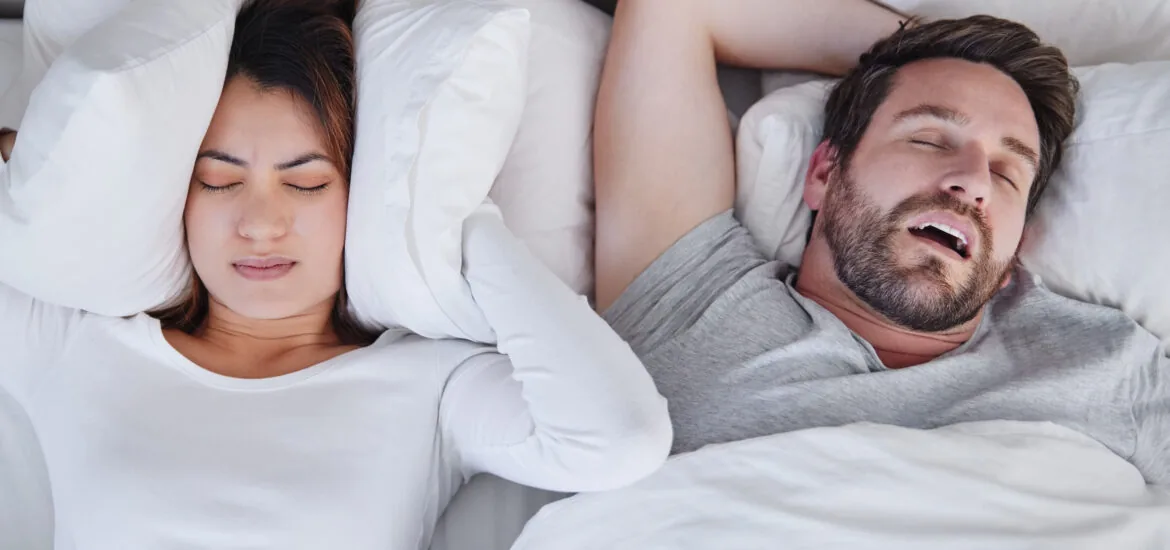
Snoring is the sound of air vibrating through relaxed throat tissue. Sleep apnea is a medical disorder in which breathing repeatedly stops and starts during sleep. One is a noise. The other is a breathing failure that happens to make noise most of the time.
The two separate along four lines: breathing pattern, with air moving steadily through a snore and stopping outright in apnea; sound profile, with snoring staying rhythmic while apnea breaks into silence and ends in a gasp; daytime impact, with simple snoring leaving your energy intact and apnea draining it; and health risk, with snoring usually a nuisance and apnea tied to high blood pressure and heart strain. Below we walk through each difference, what causes each condition, how to tell which one you are dealing with, and what the inside of your mouth reveals that sound alone cannot.
What Is the Difference Between Sleep Apnea and Snoring?
The difference between sleep apnea and snoring is that snoring is a symptom and sleep apnea is a diagnosis. A diagnosis requires measurement. Snoring is the audible result of airflow passing over relaxed soft tissue in the throat, and it can exist entirely on its own. Obstructive sleep apnea (OSA) means the airway narrows so completely that breathing stops, which the American Academy of Sleep Medicine defines as a pause lasting 10 seconds or longer.
Pauses of that length separate the two conditions in a way volume never will. Snoring can be loud enough to wake a household and still involve perfectly continuous airflow. Apnea can be quiet and still drop blood oxygen levels dozens of times an hour. What matters is not how much noise comes out of the mouth but whether air keeps moving through the throat.
Air movement is also why the two overlap as often as they do. Both conditions start with the same event, soft tissue relaxing into the airway during sleep, and they differ in degree rather than in kind. Research summarized by the American Medical Association suggests roughly half of people who snore loudly have obstructive sleep apnea, and the American Academy of Sleep Medicine reports that nearly 30 million American adults have OSA with about 23.5 million of those cases still undiagnosed. The figures below bring the comparison together.
| Feature | Snoring | Sleep apnea |
|---|---|---|
| Breathing | Air keeps moving steadily, with no pauses | Airflow stops or drops sharply for 10 seconds or longer |
| Sound | Regular, rhythmic, continuous | Loud and irregular, broken by silence, often ending in a gasp or snort |
| Frequency | Varies by night, position and congestion | Dozens to several hundred events a night, most nights |
| Daytime energy | Usually normal | Fatigue, morning headaches, poor concentration, unrefreshing sleep |
| Health risk | Mostly a social nuisance, though not risk-free | Linked to high blood pressure, heart problems, stroke and type 2 diabetes |
| How it is confirmed | No test needed, a partner hears it | A sleep study measuring breathing events per hour |
What Causes Snoring?
Snoring is caused by soft tissue in the nose, mouth and throat vibrating as air passes over it during sleep. Air passes faster through a narrower space, and faster airflow makes those tissues vibrate harder, which is why anything that narrows the airway makes snoring louder. The main contributors are:
- Sleeping on your back, which lets the tongue fall backward into the throat
- Nasal congestion from allergies, a cold, or chronic sinus problems
- A deviated septum or nasal polyps that restrict airflow through the nose
- Enlarged tonsils or adenoids, which is the most common cause in children
- Alcohol or sedative medication within a few hours of bed, which relaxes throat muscles further
- Smoking, which inflames the airway lining and increases fluid retention in the tissues
- Excess weight, which adds tissue around the upper airway
- Aging, since muscle tone in the throat declines over time
Declining muscle tone explains why snoring tends to arrive gradually rather than overnight. Each of those factors is additive, so a person who sleeps on their back after a glass of wine during allergy season may snore heavily on one night and barely at all the next.
Do Healthy People Snore?
Yes, healthy people snore, and most snoring has nothing to do with any underlying disease. Disease is the exception rather than the rule here. The American Academy of Otolaryngology reports that about 45 percent of adults snore at least occasionally and 25 percent are habitual snorers, and a patient page in JAMA Otolaryngology–Head & Neck Surgery puts regular snoring at 25 to 50 percent of adults.
Adults across that range include plenty of people with normal blood pressure, normal weight and normal energy. Snoring becomes worth investigating when it changes character: louder than it used to be, present every night rather than occasionally, or paired with the pauses and daytime symptoms covered further down.
At What Age Do Most People Start Snoring?
Most people start snoring in their thirties and forties, and snoring becomes steadily more common with age in both men and women. Both groups follow the same upward curve for the same reason, which is the gradual loss of muscle tone in the throat and soft palate. Published prevalence figures put snoring at roughly 35 to 45 percent in men and 15 to 28 percent in women, climbing through middle age.
Middle age is also when women’s rates rise most sharply, since hormonal changes after menopause reduce upper airway muscle tone. Children snore too, usually because of enlarged tonsils and adenoids rather than anything related to age.
Can You Snore Loudly Without Sleep Apnea?
Yes, you can snore loudly without sleep apnea. Primary snoring, meaning snoring with no breathing interruptions behind it, is the more common of the two conditions. Breathing interruptions are what separates the groups, and roughly half of loud snorers turn out not to have them when tested.
Testing is the only way to sort one group from the other, because volume is a poor predictor. A thin person with a deviated septum can snore loudly with a perfectly open airway, while someone with moderate apnea may produce a sound their partner describes as unremarkable. Acoustic research by Sowho and colleagues did find that measured snoring frequency ran higher in habitual snorers who had OSA than in those who did not, but that difference shows up in a laboratory recording, not to the ear of a person lying next to you.
Is Snoring Harmful on Its Own?
Snoring is not completely harmless on its own, even though it carries far less risk than untreated sleep apnea. Risk comparison is the honest framing here. A 2024 study by Lechat and colleagues found that snoring was associated with elevated blood pressure even among participants who did not have clinically significant sleep apnea, which complicates the long-standing assumption that primary snoring is purely a social problem.
Social consequences are real too, and they tend to be what finally prompts a visit. Bed partners lose sleep, couples move to separate rooms, and the snorer often wakes with a dry mouth and sore throat from breathing through an open mouth all night. That open-mouth breathing dries out the oral tissues and leaves gums more vulnerable to inflammation, which is one reason persistent snorers sometimes need gum disease care sooner than their brushing habits would predict.
What Is Sleep Apnea?
Sleep apnea is a disorder in which breathing repeatedly stops and restarts during sleep, with each pause lasting 10 seconds or longer. Each pause triggers a chain of events. Blood oxygen falls, the brain registers the drop, and it fires a brief arousal that re-engages the throat muscles so a recovery breath can happen. The sleeper almost never remembers any of it.
Memory has nothing to do with the damage, because the cycle can repeat dozens to several hundred times a night. Sleep physicians measure that frequency as the apnea-hypopnea index (AHI), the number of breathing events per hour, and the American Academy of Sleep Medicine sorts severity into mild at 5 to 14 events, moderate at 15 to 29, and severe at 30 or more. A prevalence meta-analysis published in Sleep Medicine estimated 80.6 million American adults were living with OSA in 2024, a 32.4 percent prevalence.
Prevalence that high means this is an ordinary condition, not a rare one, and it responds well to treatment once identified. Obstructive sleep apnea, where the airway physically collapses, accounts for the overwhelming majority of cases. Central sleep apnea, where the brain fails to signal the breathing muscles, is far less common and is managed differently, since sleep apnea treatment with an oral appliance addresses obstruction and has nothing to open in a central case.
Can You Have Sleep Apnea Without Snoring?
Yes, you can have sleep apnea without snoring, because apnea is defined by breathing pauses rather than by sound. Sound requires airflow moving over tissue, and a fully obstructed airway produces no airflow at all. Some people with OSA have events that are nearly silent, with the only audible moment being the gasp at the end.
Silent presentations are the reason a bed partner’s report of “no snoring” should never close the question. Daytime fatigue, morning headaches, waking unrefreshed after seven or eight hours, and waking repeatedly to use the bathroom all point at disrupted sleep regardless of what the night sounded like.
Is Sleep Apnea Missed More Often in Women?
Yes, sleep apnea is missed far more often in women. Research by Young and colleagues published in the Journal of Clinical Sleep Medicine found that approximately 90 percent of women with obstructive sleep apnea remain undiagnosed. Undiagnosed at that rate is not a small gap, and part of the explanation is that the screening habit built around loud male snoring does not fit how women present.
Presentation differs in several ways. Women with OSA report fatigue, insomnia, morning headaches, anxiety and low mood more often than they report the classic loud snoring with witnessed gasping. Prevalence itself is also real and rising with age, running roughly 3 percent of women aged 30 to 49 and 9 percent of women aged 50 to 70. Anyone whose sleep leaves them unrefreshed deserves evaluation whether or not the house hears anything at night.
How Can I Tell If I Snore or Have Sleep Apnea?
You can tell whether you snore or have sleep apnea by watching for pauses rather than listening for volume. Volume tells you almost nothing. Pauses, gasps and the daytime consequences of fragmented sleep are what point at a disorder, and they can be observed at home with some structure. Here is what we suggest tracking across a week:
- Ask your partner to listen on three separate nights rather than one, since position, alcohol and congestion change a single night considerably.
- Have them note whether the snoring is steady and rhythmic or whether it stops and restarts.
- Have them time any silence that follows a snore, since a gap of 10 seconds or longer is the clinical threshold for an apnea event.
- Have them note whether the silence ends in a gasp, choke or snort, which is the single most reliable signal.
- Have them count roughly how many such pauses occur in one hour, even approximately.
- Record your own morning symptoms each day: headache, dry mouth, sore throat, and how rested you feel after a full night.
- Track daytime alertness, especially whether you fight sleep while driving, reading or watching television.
- Note how many times you wake to use the bathroom, since frequent nighttime urination is a common and overlooked apnea symptom.
Overlooked symptoms show up in the jaw as well. Morning headaches and a tight, sore jaw often travel together in people with untreated apnea, because the muscles clench all night trying to reopen the airway, and persistent jaw pain belongs on the list alongside the breathing observations.
What Are the Daytime Warning Signs of Sleep Apnea?
The daytime warning signs of sleep apnea are excessive sleepiness, morning headaches, trouble concentrating, memory lapses, irritability and waking unrefreshed even after a full night. Waking unrefreshed is the one people dismiss most readily, because they assume everyone feels that way. Fragmented sleep prevents the deep stages that restore alertness, so the hours in bed stop translating into rest.
Rest is not the only thing affected. A 2021 survey of 2,006 adults by the American Academy of Sleep Medicine found that 26 percent of Americans were not at all familiar with obstructive sleep apnea and 48 percent did not know its symptoms, which is a large part of why 23.5 million cases sit undiagnosed. Most people simply do not know that the tiredness has a name.
Does Loud Snoring Mean Heart Problems?
Loud snoring does not mean you have heart problems, though it can be an early signal of the sleep apnea that raises cardiovascular risk. Cardiovascular risk follows the apnea, not the sound. Each breathing pause drops blood oxygen and triggers a stress response that raises heart rate and blood pressure, and repeating that cycle every night for years places measurable strain on the heart and blood vessels.
Measurable strain shows up in the overlap between these conditions. The American Academy of Sleep Medicine reports that between 30 and 40 percent of adults with high blood pressure also have sleep apnea, and untreated OSA is associated with stroke, heart rhythm problems and type 2 diabetes. The encouraging part is that this is one of the most treatable contributors to that risk once someone identifies it.
Identification usually comes from somewhere ordinary. The AASM’s 2021 survey found that nearly 70 percent of Americans who sleep with a bed partner report that their partner snores, which means the observation is already being made in most households. What is missing is the next step, and routine checkups are often where that step actually happens.
What Your Mouth Shows That Sound Does Not
Your mouth shows physical evidence of a struggling airway that no amount of listening can detect: flattened teeth, ridged tongue borders, a dry mouth on waking, and gum tissue that inflames faster than your hygiene explains. Hygiene that cannot explain the inflammation is the clue we notice first, because it separates a brushing problem from a breathing problem.
Breathing problems leave marks on enamel over months and years. When the airway narrows, the jaw muscles clench and thrust forward to reopen it, and that reflex grinding flattens cusps and cracks teeth. Sleep bruxism affects roughly 13 percent of adults and more than 80 percent of them have no idea they do it, so the wear pattern is often the first anyone learns of it. A cracked molar may need a dental crown regardless of what caused it, though the cause matters for whether the repair holds.
Holding up over time is why we look for the whole pattern rather than treating each finding alone. Dry mouth on waking occurred in 45 percent of sleep apnea patients compared with 20.4 percent of healthy controls in one case-control study, and research in the Journal of Dental Research found people with OSA roughly twice as likely to have temporomandibular joint disorders. We see these combinations regularly in Sonora patients who have never discussed their sleep with anyone, and when several teeth need restoration at once, same-day crowns keep that work manageable.
Manageable repair is only half of it, since the grinding continues until the airway is addressed. That is the practical value of this second channel of evidence: it works whether or not you sleep alone, whether or not you snore, and it tends to appear years before anyone books a sleep study. Non-surgical TMJ treatment relieves the joint symptoms, and screening the airway at the same visit addresses what keeps producing them.
How Can I Test Myself for Sleep Apnea?
You can test yourself for sleep apnea risk using a validated screening questionnaire, though a screening score estimates risk and only a sleep study produces a diagnosis. Diagnosis requires measuring your breathing, which no questionnaire does. The most widely used screening tool is STOP-BANG, which scores eight yes-or-no items: snoring, tiredness, observed breathing pauses, blood pressure, body mass index, age, neck circumference and sex.
Scoring is simple and the performance is strong. A STOP-BANG score of 3 or higher carries roughly 93 percent sensitivity for detecting moderate to severe obstructive sleep apnea and 100 percent sensitivity for severe cases, which makes it an excellent screen and a poor confirmation, since it also flags many people who turn out not to have apnea.
Confirmation comes from a sleep study, either overnight in a lab or with a home sleep apnea test. Both record breathing patterns, oxygen levels and heart rhythm overnight, and a physician reads the results and assigns the AHI. We do not diagnose sleep apnea and we do not run sleep studies. Dr. Jeff Berger screens for the oral signs, raises them directly, and helps coordinate testing through your physician.
How to Stop Snoring So Loudly
You can stop snoring so loudly by opening the nasal airway, changing sleep position, and removing the things that relax the throat muscles before bed. Throat muscle relaxation is the lever with the fastest effect, so cutting alcohol and sedatives in the three hours before sleep often changes a snore noticeably within a night or two.
Nights that stay loud despite that usually involve a blocked nose. Treating allergies, clearing congestion and addressing a deviated septum push air back through the nasal route, where it moves more smoothly and vibrates less. Weight loss reduces tissue around the upper airway and helps many people, and quitting smoking reduces the inflammation and fluid retention that narrow the airway from the inside.
Narrowing that stays after all of that is where a device earns its place. A custom oral appliance holds the lower jaw slightly forward, which pulls the tongue base away from the back of the throat and widens the space air travels through, and widening that space reduces the vibration producing the sound. The same device treats obstructive sleep apnea, which is why the screening question comes before the device rather than after.
Does Side Sleeping Help Snoring?
Yes, side sleeping helps snoring for most people, because lying on your back lets gravity pull the tongue and soft palate straight back into the airway. The airway stays wider on your side, and many people snore noticeably less within a night of switching. A body pillow behind your back makes the position easier to hold through the night.
Holding the position matters more than adopting it, since most people roll onto their back once they are asleep. Side sleeping also helps some people with mild positional sleep apnea, though it rarely controls moderate or severe cases on its own and is not a substitute for treatment once a diagnosis exists.
Who Should You See First About Snoring?
You should see whichever provider you already have an appointment with, because both a dentist and a physician can start the process and they end up in the same place. The same place is a sleep study, ordered and read by a physician, which is the only thing that settles whether snoring is simple or something more.
Something more shows itself in the mouth long before most people raise it with a doctor. People see a dentist twice a year and a sleep physician almost never, so flattened teeth, a ridged tongue, a dry mouth on waking and bone loss that outpaces someone’s hygiene are usually noticed in a dental chair first. We raise what we find, help coordinate testing, and provide a custom oral appliance once a diagnosis is in hand.
Patients across Sonora often arrive for a cleaning and leave with a referral they had not expected, which is a better outcome than another decade of tired mornings. If the answer turns out to be primary snoring, that is useful to know too, and the lifestyle steps above become the plan instead.
Frequently Asked Questions
Why Do Men Snore More Than Women?
Men snore more than women because of differences in airway anatomy, fat distribution around the neck, and throat muscle tone. A survey of 5,713 American adults published in Scientific Reports found habitual snoring in 24 percent of men and 13.8 percent of women, a ratio of roughly two to one. Women’s rates rise after menopause, narrowing that gap considerably with age.
Can Children Snore Without Having Sleep Apnea?
Yes, children can snore without having sleep apnea, and occasional snoring during a cold is common and harmless. Nightly snoring in a child is worth raising with a pediatrician, since enlarged tonsils and adenoids are the usual cause and can be treated. Bedwetting, restless sleep, mouth breathing and trouble focusing at school alongside snoring are the combination that warrants evaluation.
Does Snoring Get Worse Over Time?
Yes, snoring usually gets worse over time, because throat muscle tone declines with age and weight tends to increase through middle adulthood. Snoring and sleep apnea sit on a spectrum, and snoring that has grown steadily louder over several years can cross into apnea without any single moment marking the change. Worsening snoring is one of the better reasons to get evaluated rather than wait.
Can You Have Sleep Apnea If You Are Not Overweight?
Yes, you can have sleep apnea at any body weight, because airway size depends on inherited anatomy as much as on tissue volume. A narrow dental arch, a set-back lower jaw, a large tongue, enlarged tonsils or chronic nasal obstruction can collapse an airway in someone of average weight. Excess weight raises risk substantially, but its absence does not rule the condition out.
Does Alcohol Make Snoring Worse?
Yes, alcohol makes snoring worse by relaxing the muscles that hold the throat open, which lets the airway narrow further than it otherwise would. The effect is strongest within about three hours of drinking, so a drink with dinner matters less than one shortly before bed. Alcohol also deepens the oxygen drops during apnea events in people who already have the condition.
What Does a Home Sleep Test Involve?
A home sleep test involves wearing a small recording device overnight in your own bed, usually with a nasal sensor, a chest or abdominal belt and a fingertip oxygen monitor. The device records airflow, breathing effort, oxygen levels and heart rate while you sleep normally. A physician reviews the data afterward and calculates your apnea-hypopnea index to determine whether sleep apnea is present and how severe it is.
The Bottom Line
Snoring is a sound. Sleep apnea is a breathing disorder. They overlap often, with roughly half of loud snorers turning out to have obstructive sleep apnea, but neither the volume of a snore nor the absence of one settles the question. What does settle it is the pattern: steady rhythmic breathing versus pauses of 10 seconds or longer that end in a gasp, normal daytime energy versus fatigue and morning headaches that no amount of sleep fixes.
With roughly 80 percent of apnea cases still undiagnosed and women missed at an even higher rate, the useful move is to stop treating snoring as background noise. Track the pauses, note the mornings, and let someone look at what your teeth and gums have been recording all along. We are glad to take a look at your next visit to Jeff Berger Dentistry and talk through what we find.
Call 209-532-2915 or contact us whenever it suits you, and we will start there.


