


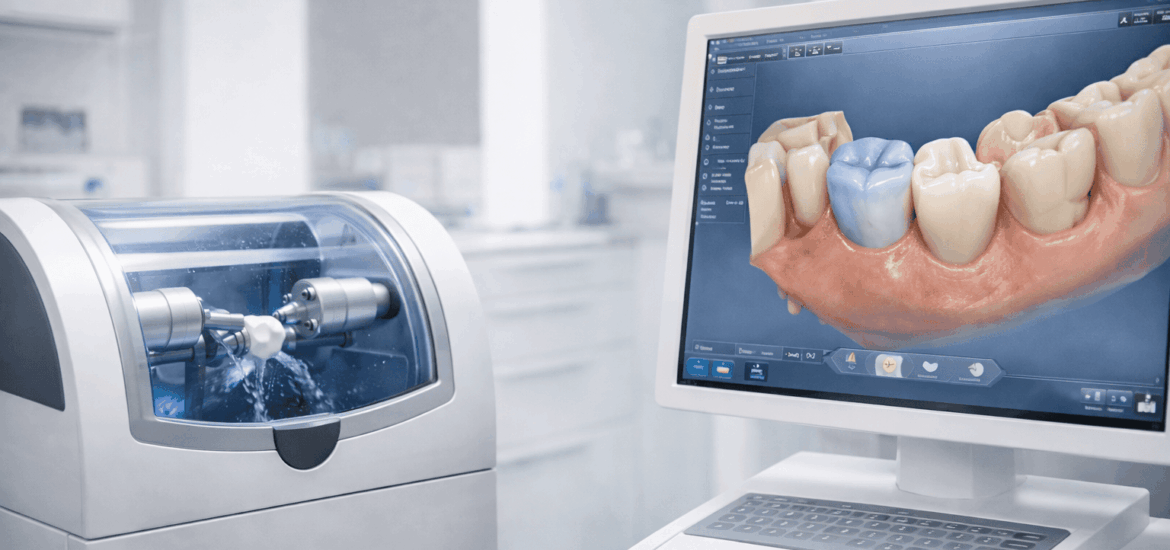
CEREC, which stands for Chairside Economical Restoration of Esthetic Ceramics, is computer-aided design and manufacturing technology that lets us design, build and place a permanent ceramic restoration in a single office visit. That includes crowns, veneers, inlays and onlays, all finished and bonded before you leave the chair.
What CEREC replaces is the older route: a tray of putty pressed against your teeth, a temporary crown cemented in place, an impression shipped to an outside laboratory, and a wait of one to three weeks before a second appointment. Below we walk through each stage of the CEREC process, how accurate the digital scan is, what the restorations are made of, how long they actually last according to decades of follow-up research, and what happens to the tooth underneath.
What Is CEREC?
CEREC is a chairside CAD/CAM system that turns a digital scan of your prepared tooth into a finished ceramic restoration in about an hour. CAD/CAM means computer-aided design and computer-aided manufacturing, the same category of technology used in aerospace and precision engineering, applied here to a tooth instead of a turbine part.
A turbine part and a crown share the same basic requirement, which is a shape cut to tolerances too fine for the human hand. The system has four components working together: an intraoral scanner that captures your tooth in three dimensions, design software that builds the restoration digitally, a milling unit that carves it from a solid ceramic block, and adhesive materials that bond the finished piece to your tooth.
Bonding at the end of that sequence is what makes the restoration permanent rather than provisional. The system has been in clinical service since 1985, and that long history matters more than it might sound, because restorations placed in the late 1980s are still being followed in the research literature today. Our same-day crowns come out of that same lineage of chairside milling.
What Can CEREC Make Besides Crowns?
Besides crowns, CEREC can make inlays, onlays, veneers and some fixed bridges. Bridges aside, the common thread is that each of these restores a specific amount of lost tooth structure, and the right choice depends on how much of the tooth is gone.
How much is gone sorts the options cleanly. An inlay fills a cavity that sits inside the cusps of a back tooth, where a filling would be too large to hold up. An onlay covers one or more cusps without covering the whole tooth. A crown covers the entire visible tooth. A veneer covers only the front surface, for appearance rather than structural repair. We also place conventional dental crowns and bridges made the traditional way when the case calls for it.
How Does CEREC Work?
CEREC works in four stages: a digital scan of the prepared tooth, a computer-aided design built from that scan, in-office milling of the restoration from a ceramic block, and permanent bonding of the finished piece. The finished piece never leaves the building, which is the whole reason the second appointment disappears.
Disappearing appointments are the visible benefit. The less visible one is control, because every decision stays with the dentist who examined the tooth rather than being described in notes and shipped to a technician who never sees your mouth. Here is what the appointment actually involves:
- We numb the area and remove decay or damaged structure, exactly as with any crown.
- We shape the tooth to create a stable foundation and a clean margin where the restoration will meet it.
- We capture the prepared tooth, the neighboring teeth and your bite with a handheld intraoral scanner, which takes a few minutes and involves no trays or putty.
- The software builds a three-dimensional model on screen, and we design the restoration on it, shaping the contours, the chewing surface, the contact points with adjacent teeth and the margin at the gumline. Design typically takes 10 to 15 minutes.
- The design file transfers to the milling unit, which carves the restoration from a solid ceramic block using diamond-coated burs. Milling runs about 15 to 20 minutes.
- We stain and glaze the milled piece to match the color and translucency of your surrounding teeth, then fire it in a small oven. This adds roughly 15 to 20 minutes.
- We try the restoration in, check that it seats fully, confirm the margins are sealed, and verify your bite feels even.
- We bond it permanently with adhesive resin, make final bite adjustments and polish it.
Polishing is the last step, and you leave with a finished tooth. Patients driving in from around Sonora and the surrounding foothill communities tend to appreciate this more than anyone, since a second trip is not a minor inconvenience when it means another hour on the road. The dental technology in our office is what makes that single trip possible.
How Long Does a CEREC Appointment Take?
A CEREC appointment takes about two to three hours from start to finish, depending on the tooth and the complexity of the case. Complexity shifts the design and finishing stages more than the milling stage, since milling runs on a fairly fixed clock regardless of which tooth is being restored.
Restoring a molar with heavy decay takes longer than restoring a premolar with a cracked filling. You spend most of that time in the chair, though the milling window is yours to spend however you like. Compare that to the traditional route, which is two appointments of roughly an hour each separated by one to three weeks of wearing a temporary.
How Accurate Is a Digital Scan Compared to a Putty Impression?
A digital scan is more accurate than a putty impression, capturing surface detail within 20 to 50 microns according to research published in Clinical Oral Investigations. A micron is one thousandth of a millimeter, so that range is finer than the width of a human hair at its thinnest.
Hair-width precision matters because of what happens to physical impressions after they leave your mouth. Impression material shrinks slightly as it sets, can distort if it is not poured promptly, and can deform during shipping to a laboratory. None of those failure points exists in a digital file, which stays identical from the moment of capture to the moment the milling unit reads it.
Reading errors are also caught immediately. We can see the scan on screen while you are still in the chair and rescan any area that came out incomplete, which removes the old problem of not discovering an impression was flawed until the lab crown came back and did not fit.
What Are CEREC Crowns Made Of?
CEREC crowns are made of solid blocks of dental ceramic, most often feldspathic porcelain, lithium disilicate or zirconia. Zirconia sits at the strong end of that range and feldspathic porcelain at the lifelike end, with lithium disilicate covering a great deal of ground in between.
In between is where most crowns land, because a restoration has to survive chewing and look like a tooth at the same time. Dr. Berger selects the material based on which tooth is being restored, how much force it absorbs, how visible it is when you smile, and what the surrounding teeth look like. Our milling system can also produce restorations in porcelain-fused-to-metal, metal or resin when a particular case calls for one of those. The same chairside process produces dental veneers, where translucency matters far more than crushing strength.
Can CEREC Mill Zirconia?
Yes, CEREC can mill zirconia, and zirconia blocks are milled in a partially sintered state, then fired in a furnace to reach full density and final shade. Final density is what gives zirconia its strength, and it is also why a zirconia restoration takes somewhat longer chairside than a glass-ceramic one.
Glass-ceramic materials like lithium disilicate can be milled, stained, glazed and bonded in one shorter sequence. Zirconia adds a firing cycle. For a back molar on a patient who grinds, that extra time is usually worth it.
What Is the Strongest Type of Dental Crown?
The strongest type of dental crown is monolithic zirconia, meaning a crown milled from a single solid block of zirconia with no porcelain layered over it. Layered porcelain is the weak point in older crown designs, since the thin outer layer can chip away from the stronger core underneath while the core stays intact.
Intact cores with chipped surfaces are exactly what monolithic designs avoid. Strongest does not automatically mean best, though. Zirconia is more opaque than natural enamel, so a front tooth often looks better in lithium disilicate or feldspathic porcelain even though those materials are less fracture resistant. Strength matters most where chewing force is highest, which is the back of the mouth.
Are CEREC Crowns Better Than Regular Crowns?
CEREC crowns are as durable as regular lab-made crowns and considerably more convenient, though neither route is better in every situation. Every situation is the qualifier that matters, because a CEREC crown matches a lab crown closely on clinical outcomes and beats it only on logistics.
Logistics aside, the research supports both. A review published in the Journal of the American Dental Association covering studies from 1985 through 2006 found survival probability of roughly 97 percent at five years and 90 percent at ten years for CEREC restorations, and a ten-year retrospective of 308 restorations by Zimmer and colleagues found survival comparable to cast gold, long considered the benchmark for longevity. The comparison below lays out where the two routes actually differ.
| Factor | CEREC same-day crown | Traditional lab-made crown |
|---|---|---|
| Appointments | One | Two, separated by one to three weeks |
| Impression | Digital scan, accurate within 20 to 50 microns | Physical putty impression, which can distort |
| Temporary crown | None needed | Required between visits |
| Who designs it | The dentist who examined your tooth | A laboratory technician working from notes and models |
| Materials | Feldspathic porcelain, lithium disilicate, zirconia and others | The full range, including hand-layered porcelain work |
| Adjustments | Made immediately in the chair | May require returning the crown to the lab |
| Survival | About 97 percent at five years, 90 percent at ten | Comparable across published studies |
When Is a Lab-Made Crown the Better Choice?
A lab-made crown is the better choice when several front teeth need to match each other precisely, or when the margin of the prepared tooth sits deep below the gumline where a scanner cannot see it clearly. Seeing the margin clearly is the one technical requirement digital scanning cannot work around, since the scanner captures surfaces it has a line of sight to.
Line of sight is rarely a problem on a single tooth with a healthy gumline. It becomes one when gum tissue has receded unevenly or when decay extends well below the gum. Multi-unit front cases are the other situation, because matching four or six adjacent teeth to each other and to the rest of the smile sometimes benefits from a ceramist hand-layering porcelain over several appointments.
Several appointments are a fair trade in those specific cases, and Dr. Jeff Berger will tell you plainly which route suits your tooth. Most single crowns, inlays, onlays and single veneers are excellent candidates for the same-day approach.
How Long Do CEREC Crowns Last?
CEREC crowns last 10 to 15 years on average and often far longer, with published survival around 97 percent at five years, 90 percent at ten years, and 88.7 percent at seventeen years. Seventeen years is not the outer limit of the data either. A follow-up study of 200 chairside restorations placed in 108 patients between 1989 and 1991 found 87.5 percent still in service after up to 27 years.
Twenty-seven years of service in a private practice setting is an unusually long record for any dental restoration. Other research lines up with it. A systematic review of 15 clinical studies covering 2,862 CEREC inlays reported a 2.6 percent failure rate over four years. A ten-year prospective study by Otto and De Nisco found 90.4 percent survival. A meta-analysis estimated total five-year survival at 91.6 percent with a confidence interval of 88.2 to 94.1 percent, and pooled ten-year survival across 2,154 ceramic inlays, onlays and overlays came to 91 percent.
Ninety-one percent at a decade is the number to hold onto, because it tells you most restorations are still working at ten years and roughly one in ten has needed attention. What determines which group yours falls into comes down largely to bite force and the condition of the tooth underneath.
What Happens to Crowns After 10 Years?
After 10 years, most crowns are still in place and functioning, while a minority have fractured, developed decay at the margin, or needed replacement for other reasons. Fracture leads that list by a wide margin. The Journal of the American Dental Association review identified ceramic fracture as the primary mode of failure for CEREC restorations, and in the 27-year follow-up study, 65 percent of all failures were ceramic fractures and another 13 percent were fractures of the underlying tooth.
The underlying tooth accounted for more failures than decay, which caused 18 percent, with endodontic problems making up the remaining 4 percent. Those proportions are useful because they point directly at what protects a restoration: controlling grinding and clenching forces, and keeping the margin clean so decay never starts there.
How Much Tooth Is Left Under a Crown?
Under a crown, most of the tooth is still there, reduced by roughly one to two millimeters on the surfaces the crown will cover. One to two millimeters is about the thickness of a stack of two or three sheets of paper, and it is removed to make room for the restoration so the finished tooth is not bulkier than the original.
The original shape is what we are rebuilding, which is why reduction is deliberate rather than generous. The entire root stays intact, the nerve stays alive in most cases, and the inner core of the tooth remains. What gets removed is the outer layer of enamel on the covered surfaces, plus whatever decay or cracked structure made the crown necessary in the first place.
Necessary reduction varies by material too. Zirconia can be milled thinner than feldspathic porcelain while staying strong, so a zirconia crown sometimes allows a more conservative preparation than a layered porcelain crown would.
What Happens to Natural Teeth Under Crowns?
Natural teeth under crowns stay alive and function normally, as long as the margin stays sealed and the gum tissue around it stays healthy. Healthy gum tissue is half the equation, because the junction between crown and tooth sits right at the gumline where plaque collects most readily.
Plaque at that junction is what eventually causes trouble, not the crown itself. Bacteria work at the margin, and if inflammation sets in, the gum can recede and expose root surface that has no enamel protecting it. Patients who develop inflammation around a crowned tooth benefit from gum disease treatment well before the crown itself is at risk.
How Do You Keep a Tooth Healthy Under a Crown?
You keep a tooth healthy under a crown by cleaning the margin thoroughly every day and having it checked at every dental visit. Every dental visit is when the margin gets examined with an explorer and, where appropriate, an x-ray, which catches a developing problem while it is still a small filling rather than a failed crown.
Small problems caught early almost never become large ones. Day to day, the work is simple: floss or use an interdental brush along the crowned tooth exactly as you would a natural one, brush the gumline rather than skating over it, and mention any new sensitivity or a feeling that food is catching in a new spot. A routine exam twice a year is what keeps that margin under observation across the decades a crown is expected to last.
When Is It Too Late to Put a Crown on a Tooth?
It is too late to put a crown on a tooth when too little healthy structure remains above the gumline for the crown to grip, or when the supporting bone has been lost to advanced gum disease. Gripping structure is the first requirement, and the general rule is that a crown needs a solid band of tooth around its base to hold securely.
Holding securely is not always out of reach when structure is short. A tooth with deep decay can often be rebuilt with a core buildup before the crown is made, and a tooth with an infected nerve can be saved with a root canal and then crowned. Those steps convert many teeth that look hopeless into good crown candidates.
Good candidacy ends when the root itself is cracked vertically, when decay extends far below the bone level, or when periodontal support is gone. In those cases we talk through extraction and replacement, usually with an implant, which restores function without asking a failing tooth to carry a restoration it cannot support.
Does Getting a CEREC Crown Hurt?
Getting a CEREC crown does not hurt, because the tooth is fully numbed with local anesthetic before any preparation begins. Preparation is the only part of the appointment that would be uncomfortable without anesthesia, and it happens at the start while the area is at its most numb.
Numbness carries through the rest comfortably. Scanning involves nothing more than a small wand moving around the tooth. Milling happens outside your mouth entirely. Try-in and bonding are pressure rather than pain. Most patients describe the longest part of the appointment as simply sitting still.
Sitting still afterward, some patients notice mild sensitivity to cold or pressure for a few days to a few weeks. The Journal of the American Dental Association review found that post-operative sensitivity after CEREC restorations is mainly caused by small bite interferences rather than by the restoration itself, and that long-term sensitivity is not a reported problem. If a new crown feels high when you bite, tell us, because a one-minute adjustment usually resolves it. For patients who find dental visits stressful regardless of comfort level, our approach to cosmetic dentistry and restorative work is built around keeping appointments calm and unhurried.
How Do You Care for a CEREC Crown?
You care for a CEREC crown by treating it like a natural tooth and protecting it from the fracture forces that cause most restoration failures. Fracture forces are the documented primary failure mode, so the care list below is built around them:
- Brush twice daily and clean along the gumline where the crown meets your tooth
- Floss or use an interdental brush around the crowned tooth every day, sliding the floss out sideways rather than snapping it up through the contact
- Avoid chewing ice, hard candy, popcorn kernels and other items that concentrate force on a single point
- Stop using your teeth to open packaging or hold objects
- Wear a protective nightguard if you grind or clench while you sleep
- Keep your recall appointments so the margin and bite can be checked
- Report any new sensitivity, roughness or a bite that feels uneven rather than waiting it out
Waiting out a grinding habit is the one item on that list with real consequences, since nightly clenching loads can exceed normal chewing force considerably and ceramic is strong but brittle. Patients who grind often have jaw symptoms alongside the wear, and non-surgical TMJ treatment addresses both the discomfort and the force that threatens the restoration.
Threats aside, a well-cared-for ceramic restoration is a remarkably durable piece of work. We check every restoration we have placed at each recall visit for patients throughout the Sonora area, which is how a one-visit crown ends up lasting the fifteen and twenty years the research describes.
Frequently Asked Questions
Do You Need a Temporary Crown With CEREC?
No, you do not need a temporary crown with CEREC, because the permanent restoration is finished and bonded during the same appointment. This removes one of the most common frustrations with traditional crowns, since temporaries can loosen, come off while eating, or leave the prepared tooth sensitive during the weeks between visits.
Is CEREC the Same as a 3D Printed Crown?
No, CEREC is not the same as a 3D printed crown. CEREC uses subtractive milling, carving the restoration out of a solid pre-manufactured ceramic block, while 3D printing is additive and builds an object up layer by layer. Milled ceramic blocks are manufactured under controlled industrial conditions, which gives them consistent density and strength throughout.
Can You Get a CEREC Crown After a Root Canal?
Yes, you can get a CEREC crown after a root canal, and a crown is usually recommended for back teeth once root canal treatment is complete. A treated tooth has lost internal structure and becomes more prone to fracture, so full coverage protects it. In many cases the root canal and the crown can be handled across a short sequence rather than spread over weeks.
Do CEREC Crowns Look Natural?
Yes, CEREC crowns look natural, because the milled ceramic is stained and glazed chairside to match the color, translucency and surface character of your surrounding teeth. Real enamel is not uniformly colored, so matching involves adding subtle variation rather than applying a single shade. Designing the restoration in front of you also means you can see and discuss the shape before it is bonded.
Can CEREC Be Used for Front Teeth?
Yes, CEREC can be used for front teeth, and single front crowns and veneers are routinely made this way. Material selection matters more here than on a molar, since front teeth are judged on translucency and shade rather than on crushing strength. Cases involving several adjacent front teeth that must match each other precisely are sometimes better served by laboratory fabrication.
Can a CEREC Crown Be Repaired or Replaced?
A CEREC crown can usually be replaced, and small chips can sometimes be polished or repaired with bonded composite. A fractured ceramic restoration generally needs replacement rather than repair, which is straightforward since a new one can be scanned, milled and bonded in another single visit. The more important step is identifying why the first one fractured so the replacement does not follow it.
The Bottom Line
CEREC turns a two-appointment process spread across weeks into one visit of about two to three hours. We scan the prepared tooth digitally with accuracy measured in microns, design the restoration on screen, mill it from a solid ceramic block in roughly 15 to 20 minutes, stain and glaze it to match your smile, and bond it permanently before you leave. There is no putty, no temporary crown, and no second trip.
The convenience would matter less if the results did not hold up, and decades of follow-up research say they do: roughly 97 percent survival at five years, 90 percent at ten, and 87.5 percent in one group of restorations still in service after 27 years. Ceramic fracture is the main thing that ends a crown’s life, which makes a protected bite and a clean margin the two habits worth building. If you need a crown and would rather not spend three weeks in a temporary, we would be glad to see you at Jeff Berger Dentistry and talk through whether your tooth is a good candidate.
Call 209-532-2915 or contact us whenever it suits you.


