


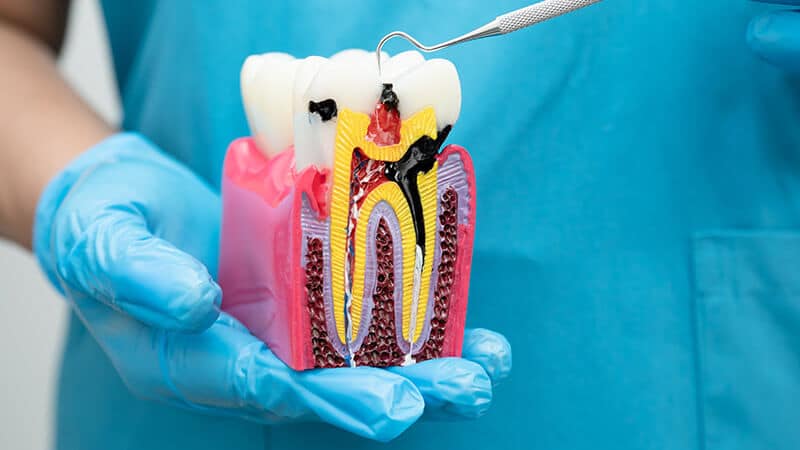
A root canal removes the infected or inflamed pulp from inside a tooth so the tooth can stay in your mouth instead of coming out. The appointment moves through seven stages in a fixed order: numbing the tooth, placing a dental dam, opening the crown, removing the pulp, cleaning and shaping the canals, filling the space with gutta-percha, and restoring the tooth with a filling and usually a crown. Most root canals take about 60 to 90 minutes, according to Cleveland Clinic, and modern instruments make the experience close to having a cavity filled.
Below we walk through each stage in the order you will live it, starting with how we confirm the tooth needs treatment and ending with what the tooth looks like ten years later.
What Happens During a Root Canal Procedure?
During a root canal procedure, we numb the tooth, isolate it, remove the damaged pulp, clean and seal the canals, and rebuild the tooth. Every root canal follows that sequence. The differences between one appointment and another come down to how many canals the tooth holds and how much infection has spread, not to the order of the steps.
Here is the full sequence:
- Numbing the area. We place a local anesthetic and wait until the tooth itself is numb, not just the lip and cheek.
- Placing a dental dam. A thin protective sheet isolates the tooth, keeping it clean and dry and keeping saliva out of the canals.
- Opening the tooth. We make a small opening through the biting surface to reach the pulp chamber.
- Removing the pulp. Fine instruments clear the infected nerve tissue and blood vessels from the chamber and the canals.
- Cleaning and shaping. The canal walls are washed with a disinfecting solution and shaped so the filling material can reach the tip of each root.
- Filling the space. The dried canals are filled with gutta-percha, a rubber-like material, placed along with a sealer.
- Restoring the tooth. A temporary filling closes the opening, and a permanent crown follows to protect the tooth and return it to full chewing function.
More than 15 million teeth are treated and saved this way every year, according to the American Association of Endodontists. Root canal treatment is one of the most routine procedures in dentistry, and the steps above are the same ones performed millions of times a year across the country.
How Do We Know You Need a Root Canal?
We know you need a root canal by combining an X-ray with a set of short tests on the tooth itself. Symptoms point us toward a tooth. Testing confirms whether the pulp inside it is still healthy.
The X-ray comes first. It shows how deep the decay runs, whether the infection has reached the bone at the root tip, and how many roots the tooth has. Bone changes at the root tip are often the clearest evidence that the pulp has died, even in a tooth that has stopped hurting.
Testing follows the X-ray, and none of it is uncomfortable. We tap the tooth lightly to check whether the ligament around the root is inflamed. We apply something cold and watch how the tooth responds, because a healthy pulp reacts briefly and then settles, while an inflamed pulp keeps aching after the cold is gone. We may also use an electric pulp test, which sends a very small current through the tooth to check whether the nerve is alive at all. A tooth that gives no response at all has usually lost its pulp entirely.
Cleveland Clinic lists the same set: biting checks, swelling checks, hot and cold sensitivity, and the electric pulp test. A regular dental exam catches many of these teeth before symptoms ever start, because the X-rays taken at a checkup show decay that has not yet reached the nerve.
Do’s and Don’ts Before a Root Canal
The main thing to do before a root canal is eat a normal meal, and the main thing to avoid is arriving without telling us about your medications. Preparation is genuinely light, which surprises most patients.
- Do eat beforehand. You can eat normally before a root canal. A full stomach also makes the appointment easier to sit through.
- Do tell us what you take. Blood thinners, heart medications, and any antibiotic you were already prescribed all affect how we plan the visit.
- Do keep taking prescribed antibiotics. A heavily infected tooth is harder to numb, and a course started beforehand calms the infection down first.
- Do arrange a ride, if you choose sedation. Local anesthetic alone leaves you clear to drive yourself.
- Do bring headphones. Music removes most of what people find unpleasant about the sound.
- Don’t skip the appointment because the pain stopped. Pain stopping often means the nerve has died, not that the tooth healed.
- Don’t drink alcohol the night before. It can interfere with anesthetic and with pain medicine afterward.
Patients coming to our Sonora office are welcome to call ahead with questions about any of this, and we would rather answer five questions before the visit than have someone sit in the chair worrying about one.
What Happens When the Tooth Is Numbed?
When the tooth is numbed, we place a local anesthetic beside the root and wait for the nerve inside the tooth to stop sending signals. Numb lip and cheek come first, usually within a minute or two. Full numbness inside the tooth takes longer, and that is the state we actually wait for.
Waiting properly matters more than most patients realize. We test the tooth before starting, and if any sensation is left, we add anesthetic and wait again. Nobody is asked to push through a sensation. Telling us the moment something feels sharp is the most useful thing you can do during the appointment.
Anxiety is a separate problem from sensation, and it deserves a separate solution. Conscious sedation, the NuCalm relaxation system, and nitrous oxide are all sedation options that let nervous patients get through treatment calmly rather than bracing through it.
Why Do We Place a Dental Dam?
We place a dental dam to keep saliva, and the bacteria it carries, out of the canals we are about to clean. The dam is a thin sheet that fits around the tooth and isolates it from the rest of the mouth, leaving only the tooth being treated exposed.
Saliva is the reason this step exists. The entire purpose of a root canal is to remove bacteria from inside the tooth and seal the space so bacteria cannot return. A single drop of saliva entering an open canal reintroduces exactly what we spent the appointment removing. The dam also catches the disinfecting solutions we use, and it protects your airway from small instruments.
Here is something worth knowing as a patient, because it does not appear in most articles about this procedure. The American Association of Endodontists treats dam isolation as the standard of care for root canal treatment, yet compliance across the profession is uneven. A study published in the Journal of the American Dental Association through the Dental Practice-Based Research Network found that only 44 percent of general dentists always used a dental dam during root canal treatment. A separate national survey published in the Journal of Endodontics put it at 60 percent always and 11 percent never, and that same research reports roughly 70 percent of root canal treatment in the United States is performed by general dentists rather than specialists.
Asking whether your dentist uses a dental dam is a fair question and an easy one to answer. We use one on every root canal, without exception.
How Do We Clean and Shape the Canals?
We clean and shape the canals with fine flexible files and a disinfecting rinse, working from the opening in the crown down to the tip of each root. Cleaning removes the tissue and bacteria. Shaping widens the canal slightly so the filling material can reach every part of it.
The files doing this work are the source of most of the sound you hear. Modern files are made of nickel-titanium, a metal flexible enough to follow the curve of a root rather than fight it, and they are driven by a slow handpiece rather than a drill. A national survey of general dentists published in the Journal of Endodontics found that 74 percent now use nickel-titanium rotary instrumentation, a shift that has made this stage faster and gentler than it was a generation ago.
Precision at the root tip is the hardest part of the job, and two tools handle it. An electronic apex locator measures exactly where each canal ends, so we clean to the tip and no further. Magnification, used by 80 percent of general dentists in that same survey, lets us find narrow or extra canals that are easy to miss with the naked eye. Missed canals are one of the most common reasons a root canal has to be redone years later.
Between file passes, the canal is flushed with a disinfecting solution that dissolves remaining tissue and kills bacteria the files cannot physically reach. The dental technology we use during endodontic therapy exists for this stage in particular, because how completely the canal system is cleaned determines whether the tooth stays healthy for decades.
How Are the Canals Filled and Sealed?
The canals are filled with gutta-percha, a rubber-like material placed alongside a sealer that closes off every remaining gap. Filling happens only after the canals are cleaned, shaped, and dried completely.
Gutta-percha comes from a tree and has been used in dentistry for well over a century, because it is biocompatible, stable, and does not break down inside the tooth. The sealer placed with it fills the microscopic spaces between the gutta-percha and the canal wall. Sealing those spaces is what prevents bacteria from re-entering the root, which is the whole point of the appointment.
A temporary filling then closes the opening in the crown. If the tooth has lost a great deal of structure, we may place a small post inside the root to give the final restoration something to hold onto. The temporary filling is a placeholder and nothing more, which is why a permanent crown follows within a few weeks.
What Is the Most Painful Stage of a Root Canal?
The most painful stage of a root canal is the numbing injection at the very beginning, and it lasts a few seconds. Every stage after it happens on a tooth that cannot send pain signals.
Patients who rank the stages afterward usually put jaw fatigue from holding the mouth open second and the sound of the handpiece third. Neither involves the tooth. The soreness people remember tends to come from the days after treatment rather than the appointment itself, and that soreness is mild and short.
How Long Does a Root Canal Take?
A root canal takes about 60 to 90 minutes per appointment, across one or two visits. Cleveland Clinic gives that same range, and the American Association of Endodontists reports that most root canals are completed in one to two appointments of roughly 90 minutes each.
Tooth position drives nearly all of the variation. A front tooth usually has a single canal. A molar commonly has three or four, sometimes more, and each canal must be measured, cleaned, shaped, and sealed on its own. Molars also carry the bulk of this work, making up 61 percent of treated teeth according to National Dental Practice-Based Research Network data, compared with 28 percent premolars and 11 percent front teeth. The table below shows how those differences play out.
| Tooth type | Typical canals | Usual appointment length | Typical visits | Share of treated teeth | Crown usually needed |
|---|---|---|---|---|---|
| Front tooth (incisor or canine) | 1 | About 60 minutes | 1 | 11% | Not always |
| Premolar | 1 to 2 | 60 to 90 minutes | 1 to 2 | 28% | Yes |
| Molar | 3 to 4, sometimes more | About 90 minutes | 1 to 2 | 61% | Yes |
A longer appointment on a molar is not a harder appointment for the patient. The tooth stays numb the entire time regardless of how many canals it holds.
Is a Root Canal a Big Surgery?
A root canal is not a big surgery. It is a routine outpatient dental procedure done with local anesthetic while you stay fully awake. Nothing is cut, nothing is stitched, and no part of the tooth root is removed.
The misconception that the root gets taken out is the most common one dentists hear. Root canal treatment removes the pulp inside the root, and the root itself stays exactly where it is, holding the tooth in the bone. That distinction is why the tooth continues to function normally afterward.
Recovery reflects the scale of the procedure. You walk out, you go back to your day, and most people are back to normal routines the same afternoon.
What Happens Right After the Procedure?
Right after the procedure, your mouth stays numb for two to three hours and you go home with a temporary filling in place. There is no recovery room and no observation period.
Numbness is the only real limitation in those first hours. Waiting until it wears off before eating prevents accidentally biting your cheek or tongue, which is the most common avoidable problem after a root canal. Local anesthetic does not affect alertness or coordination, so driving yourself home is fine when you had numbing only.
The other thing you leave with is a set of instructions about the treated tooth. Chewing on it before the permanent restoration is placed risks fracturing a tooth that has already lost structure, and that single restriction matters more than anything else in the first few weeks.
What Is the Recovery Like After a Root Canal?
Recovery after a root canal is mild and short, with most people fully comfortable inside a week. Cleveland Clinic describes the same window, noting that most people recover in less than a week and that pain lasting beyond that should be checked.
Soreness usually shows up as tenderness when biting on the treated tooth, along with a slightly achy jaw on that side. Both come from the ligament around the root tip, which was already inflamed before treatment and needs a few days to settle. The Pak and White systematic review published in the Journal of Endodontics found that 40 percent of patients report some pain at 24 hours, dropping to 11 percent at one week.
Over-the-counter pain medicine handles that soreness for the large majority of patients. Pain that climbs instead of falling, or swelling in the face or gum, is worth a phone call rather than a wait.
How Many Days of Rest Do You Need After a Root Canal?
You need no days of rest after a root canal. Most patients return to work or school the same day or the next morning.
Taking the rest of the day easy is reasonable if your appointment ran long or you were sedated. Beyond that, normal activity is fine. Exercise, work, and driving all resume immediately, and there is no restriction on talking, brushing, or flossing.
How Should You Sleep After a Root Canal?
Sleep with your head slightly elevated for the first two or three nights after a root canal. An extra pillow keeps blood pressure in the head lower, which reduces throbbing in the treated area overnight.
Sleeping on the opposite side also helps, because it keeps pressure off the treated jaw. Taking over-the-counter pain medicine shortly before bed on the first night is the other practical step, since the first night is typically the least comfortable one.
What Should You Not Do After a Root Canal?
The main thing not to do after a root canal is chew on the treated tooth before the permanent restoration is placed. Everything else on this list supports that one rule.
- Don’t chew on that side until the permanent crown or filling is in place. An unrestored tooth is prone to fracture.
- Don’t eat until the numbness wears off, to avoid biting your cheek or tongue.
- Don’t eat hard or sticky foods that can crack or pull out a temporary filling. Soft foods like yogurt, eggs, and fish ask very little of the tooth.
- Don’t smoke. Smoking slows healing, and the American Association of Endodontists reports that smokers are nearly twice as likely to need a root canal in the first place.
- Don’t stop brushing and flossing. Clean the area normally unless we tell you otherwise.
- Don’t delay the restoration appointment. This is the single most common reason a successful root canal fails later.
When Do You Get the Crown After a Root Canal?
You get the crown after a root canal within a few weeks of the procedure, and sooner is better. The temporary filling protecting the tooth in the meantime is not built to last.
The evidence on timing is blunt. In the Salehrabi and Rotstein study of 1,462,936 treated teeth drawn from a national insurance database, 85 percent of the teeth that eventually had to be extracted had never received full crown coverage. Teeth that got their crown stayed in the mouth at significantly higher rates across every tooth group tested.
Placing that crown quickly is straightforward. We shape the tooth, capture a digital scan, and fit a restoration matched to the shape, size, and color of the teeth beside it. Same-day crowns close the gap in a single appointment rather than leaving a temporary filling in place for weeks.
How Long Does a Root Canal Last, and What Happens 10 Years Later?
A root canal lasts decades, and 10 years later a properly restored tooth is typically still doing its job with no symptoms at all. The treated tooth is not on a countdown.
Salehrabi and Rotstein found 97 percent of teeth still in the mouth eight years after initial nonsurgical treatment, with the combined rate of retreatment, surgery, and extraction sitting at 3 percent, most of it occurring within the first three years. A long-term retrospective cohort published in Clinical Oral Investigations followed teeth further out and reported cumulative survival of 97 percent at 10 years and 81 percent at 20 years. The American Association of Endodontists puts the overall success rate above 90 percent.
What you notice at the 10-year mark is usually nothing. The tooth chews normally, feels normal, and needs the same brushing and checkups as the teeth around it. The crown on top of it is the component most likely to need attention first, and how crowns work explains what that maintenance looks like.
What Are the Alternatives to a Root Canal?
The only real alternative to a root canal is removing the tooth and replacing it. An infected pulp does not heal on its own, so leaving it alone is not an option that ends well.
Extraction is simpler on the day it happens and more complicated afterward. A gap where a molar used to be lets neighboring teeth drift, changes how your bite loads, and allows the jawbone under the space to shrink over time. Filling that gap means a dental implant, a bridge, or a partial denture, each of which takes more appointments and more healing time than saving the tooth would have.
That is why we treat extraction as the fallback rather than the equal option. A natural tooth root keeps stimulating the bone around it, and no replacement reproduces that as well as the tooth you already have.
Can You Wait to Get a Root Canal?
You cannot safely wait months to get a root canal. Infection inside a tooth spreads outward into the bone, and the longer it runs, the fewer options remain.
A tooth that stops hurting has often not improved. Pain frequently fades once the nerve dies completely, while the infection keeps moving into the surrounding bone. Waiting turns a tooth that could be saved into one that is fractured too far below the gumline, too decayed to rebuild, or sitting in bone that no longer supports it.
Severe pain, facial swelling, or a fever needs same-day attention, and our emergency dentist team keeps room in the schedule for it. For a tooth that is aching but stable, scheduling root canal care within days rather than months gives the tooth its best chance.
Frequently Asked Questions
Is a Root Canal Procedure Very Painful?
A root canal procedure is not very painful, because local anesthesia blocks the nerve before any work begins. Most patients describe it as similar to having a cavity filled. Mild soreness for two or three days afterward is normal and responds to over-the-counter pain medicine.
What’s the Success Rate of Root Canals?
The success rate of root canals is above 90 percent, according to the American Association of Endodontists. Insurance database research covering nearly 1.5 million treated teeth found 97 percent still in place eight years later. Prompt placement of a crown and consistent oral hygiene are the two factors most closely tied to that success.
Can You Eat Before a Root Canal?
You can eat before a root canal, and eating a normal meal beforehand is a good idea. Local anesthetic does not require an empty stomach the way general anesthesia does. Eating first also means you will not be hungry while waiting for numbness to wear off afterward.
Can You Drive Yourself Home After a Root Canal?
You can drive yourself home after a root canal performed with local anesthetic only. You stay awake and alert throughout, and numbness is limited to the treated area. Arrange a ride, if you choose oral sedation or nitrous oxide.
Do You Need Antibiotics Before or After a Root Canal?
You do not need antibiotics for most root canals, because the procedure itself removes the infected tissue. Antibiotics are used when infection has spread beyond the tooth into surrounding tissue, or when a heavily infected tooth needs calming before treatment so it can be numbed properly. We decide that case by case after reviewing the X-ray.
Can a Root Canal Be Done in One Visit?
A root canal can be done in one visit in many cases, particularly on front teeth and premolars with simple canal anatomy. The American Association of Endodontists reports that most root canals take one to two appointments. A separate short visit is still needed afterward to place the permanent crown.
Does a Root Canal Tooth Feel Normal Afterward?
A root canal tooth feels normal afterward once the permanent restoration is in place. It bites, chews, and looks like the teeth around it. The one difference is that it no longer senses hot or cold, because the nerve that produced those sensations has been removed.
The Bottom Line
A root canal is a seven-stage procedure that runs about 60 to 90 minutes and ends with your own tooth still in your mouth. We numb the tooth, isolate it behind a dental dam, clear the damaged pulp, clean and shape the canals with instruments built for the job, seal the space with gutta-percha, and rebuild the tooth with a crown. Recovery takes less than a week for most people, and the long-term numbers are strong, with 97 percent of treated teeth still in place eight years later.
The part worth acting on is the timing. An infected tooth does not settle down on its own, and the window for saving it narrows every week it is left alone. Our office is on Mono Way in Sonora, and the team at Jeff Berger Dentistry is happy to walk you through exactly what your tooth needs before you commit to anything. Reach out whenever you are ready.


