


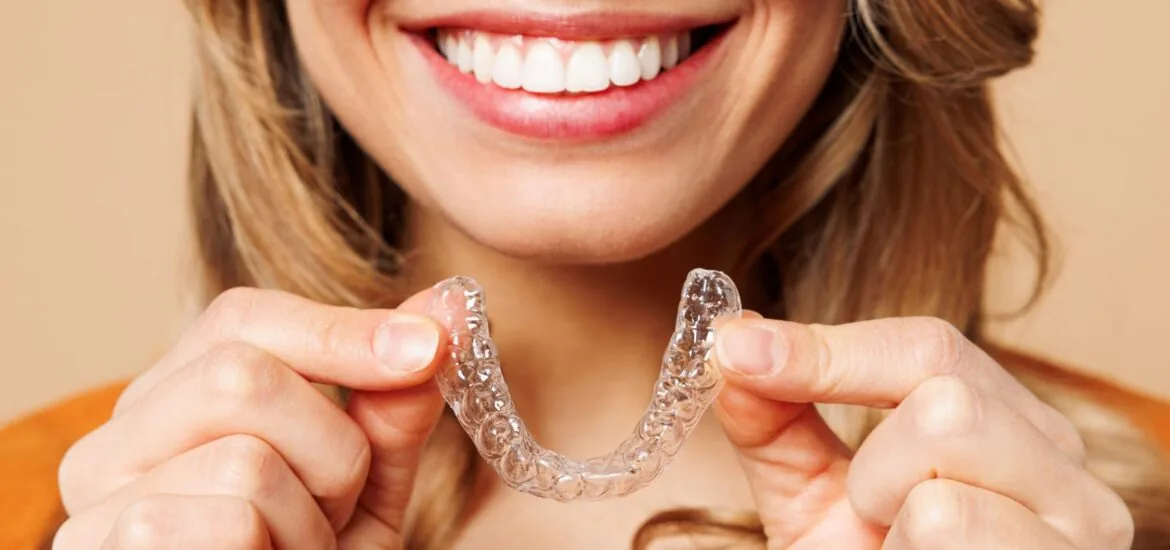
Invisalign straightens teeth using a series of custom-made clear plastic trays that apply gentle, controlled pressure to move teeth into better positions. The process runs in four parts: a digital scan of your teeth, a treatment plan that maps every small movement from start to finish, a set of custom trays made from that plan, and daily wear of 20 to 22 hours with a new tray every two weeks. Each tray is shaped slightly straighter than your teeth currently sit, so it pushes each tooth roughly 0.25 mm, and the jawbone around that tooth dissolves on one side and rebuilds on the other to let it travel.
Below we explain the biology that makes that movement possible, then walk the full treatment from the first scan to the retainer you wear at the end.
How Does Invisalign Work?
Invisalign works on two layers at once: a mechanical layer, where a sequence of clear trays applies steady pressure, and a biological layer, where your jawbone rebuilds itself around each moving tooth. Most explanations cover only the first layer, which is why the process can feel like plastic magic.
The mechanical layer is straightforward. Each tray in the series is manufactured to a slightly different shape, matching one step in a planned sequence. Pressing a tray that does not quite match your current tooth positions onto your teeth creates a small mismatch, and that mismatch is the force.
The biological layer is where the actual movement happens. Teeth are not fixed into the jaw like fence posts in concrete. Steady light pressure triggers a remodeling process in the bone that allows a tooth to travel through it, slowly and safely, and the tray simply tells the bone which direction to go.
Scale explains why the system has held up. Align Technology reported in its annual filing that over 22 million people worldwide have been treated with Invisalign as of the end of 2025, including more than 6.5 million teens and children, with over 2.4 billion aligners manufactured. Invisalign treatment is now one of the most studied orthodontic approaches in use.
How Do Invisalign Aligners Move Teeth?
Invisalign aligners move teeth by pressing on one side of the tooth, which compresses the ligament on that side and stretches it on the other, signaling the jawbone to dissolve where the tooth is heading and rebuild where it came from. That two-sided response is the whole mechanism.
Compression on the pressure side activates cells called osteoclasts, which break down bone in the tooth’s path. Stretching on the tension side activates osteoblasts, which lay down new bone behind the tooth to fill the space it vacated. Research published in Frontiers in Oral Health describes this pairing as the core of all orthodontic tooth movement, whether the force comes from a wire or a clear tray.
Force level matters more than force size. Studies of orthodontic tooth movement have found that light continuous force speeds movement while heavy force actually slows it down, because heavy pressure crushes the blood supply in the ligament and stalls the cells doing the work. A clear tray applies force in the useful range and holds it there, which is the reason the movement per tray is deliberately small, around 0.25 to 0.3 mm.
What Is the Periodontal Ligament?
The periodontal ligament is the thin layer of fibers that suspends each tooth inside its bone socket. It is what makes tooth movement possible at all, because a tooth fused directly to bone could not be moved without breaking something.
Fibers in the ligament work like a hammock, holding the tooth in place while allowing a fraction of a millimeter of give. That give is what your tray presses against. Frontiers in Oral Health research notes that the ligament widens on the tension side during movement, which is exactly why a tooth partway through treatment can feel slightly loose. Slight looseness during active movement is normal and it resolves as the new bone hardens around the tooth.
Why Do Your Teeth Feel Sore When You Switch Trays?
Your teeth feel sore when you switch trays because a new tray restarts the pressure phase of bone remodeling on teeth that had just finished settling. Soreness is a sign the system is working, not a sign something is wrong.
Pressure on the ligament triggers an inflammatory response that recruits the bone cells doing the remodeling. That response peaks in the first day or two after a tray change, then fades as the tooth begins to move and the pressure releases. Most patients describe it as tightness or tenderness when biting rather than sharp pain.
Each new tray produces less of this than the one before it, because you get used to the rhythm. The first tray in the series is almost always the most noticeable one of the whole treatment.
What Are the Steps of Invisalign Treatment?
Invisalign treatment follows six steps, from the first scan through to the retainer that holds your result. Here is the sequence as we run it:
- Consultation. We look at your teeth and bite to determine whether clear aligners are the right approach for your case, or whether another option fits better.
- Digital impressions. We take impressions of your teeth using advanced dental technology, which produces a precise three-dimensional model of both arches.
- Treatment plan. Planning software maps out every movement in sequence, tooth by tooth. We can project how your teeth will look once the series is finished, before a single tray is made.
- Aligners manufactured. The approved plan is converted into a full series of custom trays, each one representing a single step in the sequence.
- Daily wear. You wear the trays 20 to 22 hours a day, removing them to eat, drink anything other than water, and brush. Trays are switched every two weeks.
- Check-ins and retention. You visit us about every two months so we can confirm progress is tracking, and you finish with a retainer that holds the result.
The whole sequence typically runs 9 to 15 months for our patients, with simpler cases finishing in as little as 6 months.
How Are Invisalign Aligners Made?
Invisalign aligners are made from a medical-grade thermoplastic called SmartTrack, shaped over 3D-printed models of each planned stage of your treatment. Every tray in your series corresponds to one of those stages.
SmartTrack was developed specifically to solve a problem with ordinary plastic. Standard thermoplastic delivers a hard burst of force that fades quickly, which wastes most of the two weeks you spend in a tray. SmartTrack flexes more and holds its force longer, so pressure stays in the light continuous range that bone remodeling actually responds to. It also conforms more closely to tooth shape, which improves grip.
Manufacturing happens at a scale that is hard to picture. The 2.4 billion aligners Align Technology reports producing are individually made, because no two trays in any patient’s series are identical and no two patients share a series. Each one is a single-use object shaped for one tooth arrangement that exists for two weeks.
What Are Invisalign Attachments and What Do They Do?
Invisalign attachments are small tooth-colored bumps of composite bonded temporarily to certain teeth, giving the smooth plastic tray something to push against. They are removed at the end of treatment and leave nothing behind.
Attachments exist because smooth plastic on a smooth tooth has limited grip. Tipping a tooth is easy for a tray to do. Rotating a round tooth like a canine, or pulling a tooth downward into place, is much harder, because the tray slides instead of gripping. An attachment gives the plastic a handle.
The clinical data shows exactly where the difference lands. A systematic review and meta-analysis published on PubMed Central found canine derotation accuracy of 61.2 percent with conventional attachments and 71.5 percent with optimized attachment shapes. Earlier work by Kravitz and colleagues found that pulling a tooth downward, the movement called extrusion, was the least predictable of all at 29.6 percent accuracy without that extra grip.
Attachments are placed only where the plan calls for them, and they are tooth-colored. Most people never notice them on someone else.
Do They Reshape Your Teeth for Invisalign?
They do reshape teeth slightly in some Invisalign cases, using a technique called interproximal reduction, or IPR. IPR removes a very thin amount of enamel from the sides of certain teeth where they contact each other.
Crowding is the reason it exists. Straightening crowded teeth requires space for them to move into, and there are only a few ways to create that space. IPR creates it by reclaiming fractions of a millimeter from between teeth that are pressed together. The amounts are small, typically a fraction of the enamel thickness, and the outer surface of the tooth is untouched.
Not every case needs it. Cases with existing gaps need the opposite, and cases with mild crowding often resolve without it. When a plan does call for IPR, we walk you through exactly which teeth and how much before anything is done, and a routine dental exam beforehand confirms the enamel and gums are healthy enough for it.
How Long Do You Wear Invisalign Each Day?
You wear Invisalign 20 to 22 hours each day, removing the trays only to eat, drink anything other than water, and clean your teeth. That number is not a suggestion, and the reason sits in the biology.
Bone remodeling responds to continuous light force. Pressure has to be sustained long enough to recruit the cells that break down and rebuild bone, and those cells take time to arrive and get to work. Every extended break resets part of that process, and the ligament pulls the tooth back toward where it started before the cells have finished.
Two hours a day of removal covers three meals and brushing comfortably. Stretching it to four or five hours does not slow treatment by a few days, it can stall a tray entirely, which means wearing that same tray longer to catch up. Patients who treat the 22-hour figure as the target rather than the ceiling almost always finish on schedule with clear aligners.
How Often Do You Change Invisalign Trays?
You change Invisalign trays every two weeks in our practice. Some protocols move faster, and the evidence supports the slower interval for most cases.
Two weeks gives each planned movement enough time to complete before the next set of forces arrives. A clear aligner scoping review published on PubMed Central compared change intervals directly and found two-week protocols delivered measurably better results than one-week protocols, with 0.49 mm greater closure on the movement studied. Bone simply needs the time.
Moving to the next tray before a tooth has finished traveling creates a gap between where the plastic expects the tooth to be and where it actually is. That gap is what causes a tray to fit poorly, and poor fit is the most common reason a case falls behind schedule.
Which Week of Invisalign Is the Hardest?
The hardest week of Invisalign is the first one. The first tray introduces pressure your teeth have never felt, and it arrives alongside every new habit at once.
Three things stack in that opening week. Your teeth are sore in the way described earlier, as the remodeling process starts. Your tongue is adjusting to the trays, which affects speech for a few days. And the routine of removing trays before eating and replacing them afterward is unfamiliar enough to feel like work.
All three fade quickly. Speech normalizes within about a week as the tongue adapts. The tray routine becomes automatic by the second or third change. And the soreness on each subsequent tray is milder than the first, because the pattern is familiar and the movements are incremental.
How Long Does Invisalign Treatment Take?
Invisalign treatment takes 9 to 15 months for most of our patients, with simple cases finishing in as little as 6 months. Case complexity drives nearly all of the variation, and consistency of wear drives the rest.
Published orthodontic ranges put clear aligner treatment between 6 and 18 months overall, which brackets that window closely. Number of trays follows the same logic: each tray is two weeks, so the length of treatment is essentially the length of the series. The table below shows how case type maps onto the timeline.
| Case type | Approximate trays | Typical length | Check-in visits | Attachments usually needed |
|---|---|---|---|---|
| Mild crowding or small gaps | 12 to 20 | About 6 to 9 months | 3 to 4 | Sometimes |
| Moderate crowding or bite correction | 20 to 32 | About 9 to 15 months | 5 to 7 | Usually |
| Complex movement or rotations | 32 or more | 15 months or longer | 7 or more | Yes |
Seeing finished cases makes the ranges concrete, and our smile gallery shows results from patients whose starting points varied across all three rows.
What Problems Can Invisalign Fix, and Does It Change Your Bite?
Invisalign fixes crooked teeth, crowded teeth, gaps, and a bad bite, and yes, it does change your bite by design. Changing how your upper and lower teeth meet is part of the treatment goal rather than a side effect.
Bite correction works differently from straightening. Straightening moves teeth within an arch, closing gaps and unwinding crowding. Bite correction moves the arches in relation to each other, which is how an overbite is reduced or an edge-to-edge bite is opened up. The planning software handles both at once, sequencing the arch movements alongside the individual tooth movements.
Predictability varies by movement type and by patient. A clear aligner scoping review reported that anterior intrusion accuracy ran 63.5 percent in adolescents compared with 45.3 percent in adults, a reminder that biology, not just the plan, shapes the outcome. Teeth that are cosmetically imperfect rather than misaligned are a different conversation, and cosmetic dentistry covers those options.
Can You Tell If Someone Is Wearing Invisalign?
You usually cannot tell if someone is wearing Invisalign unless you are looking closely from very near. The trays are clear, thin, and shaped to the teeth rather than sitting over them as a separate layer.
What people occasionally notice is a faint reflection in bright light or direct sunlight. Attachments are the other thing a close observer might catch, and since they are matched to tooth color, they read as a slight texture rather than as hardware. Nothing metal appears anywhere in the system.
Removability makes the difference complete for anything that matters socially. Trays come out for a meal, a photograph, or a presentation, which is not an option with fixed appliances. Patients weighing appearance alone sometimes also consider dental veneers, though veneers address a different problem than alignment does.
What Happens at Your Check-Up Visits?
At your check-up visits we confirm that your teeth are where the plan says they should be at that point in the series. Tracking is the entire purpose of the appointment.
Tray fit is the main thing we look at. A tray that seats fully against every tooth means the previous movements completed. A visible gap between the plastic and a tooth edge means that tooth is lagging, and catching it early is far easier than catching it ten trays later. We also check your gums and any attachments, and hand over the next batch of trays.
This is also where refinement trays come in, and they are worth explaining honestly. Planned movement and achieved movement do not match perfectly in any aligner system. A landmark study by Kravitz and colleagues measuring 401 teeth found mean accuracy of 41 percent between predicted and achieved positions, and a follow-up study by Haouili and colleagues a decade later put it at 50 percent, showing real improvement over time. Neither number means treatment fails. It means a second short series, a refinement, is a normal and expected part of finishing a case precisely.
Planning for refinements from the start is why we see patients about every two months rather than handing over the full series and waiting. Dr. Berger reviews each case at those intervals, and our team includes an orthodontic-certified assistant who manages the tracking from the first tray onward.
What to Know Before You Start Invisalign
The most important thing to know before starting Invisalign is that the result depends heavily on how consistently you wear the trays. Everything else on this list follows from that.
- Wear time is the variable you control. The plan assumes 20 to 22 hours a day. Treatment tracks to the plan when the wear tracks to the plan.
- Trays come out for everything but water. Coffee, tea, and soda stain the plastic and can trap sugar against enamel.
- Brushing habits change. Teeth need cleaning before trays go back in, which means brushing after meals rather than twice a day.
- Gum health matters first. Teeth move through bone, and bone that is already compromised complicates that. Treating any existing gum health issue comes before aligners, not during.
- Some cases need attachments or IPR. Both are routine, and both are explained before treatment begins rather than sprung on you mid-series.
- Refinements are common. A short additional series at the end is normal and is how cases finish precisely.
- Clear aligners are not the only option. Six Month Smiles uses discreet fixed brackets and suits some cases better. We will tell you which approach fits yours.
- Retainers are permanent homework. Straight teeth stay straight because something holds them there.
What Happens After Invisalign Treatment Ends?
After Invisalign treatment ends, you move into retainers, which hold your teeth in their new positions while the bone around them finishes hardening. Skipping this step undoes the work.
Relapse is a biological reality rather than a sign of failed treatment. The bone rebuilt behind each moved tooth is new, and new bone takes months to reach full density. The ligament fibers that were stretched during movement also retain a memory of their original arrangement and pull gently backward. Retainers hold the teeth still while both of those settle.
Wear schedules typically start full-time and step down to nights over the following months. Many patients also choose this moment for teeth whitening, since newly aligned teeth are easier to whiten evenly than crowded ones were. Finishing short term Invisalign and protecting the result are two halves of the same treatment.
Frequently Asked Questions
Does Your Jawline Change After Invisalign?
Your jawline does not change after Invisalign in any structural sense, because aligners move teeth through bone rather than repositioning the jaw itself. Some patients notice a subtle difference in how the lips and lower face sit, which comes from teeth being in different positions underneath them. The jawbone itself keeps its shape.
Can You Drink Coffee With Invisalign In?
You cannot drink coffee with Invisalign in without consequences. Hot liquids can warp the thermoplastic, and coffee stains the trays quickly, which defeats the point of a clear appliance. Take the trays out, drink, rinse your mouth, and put them back.
Does Invisalign Affect Your Speech?
Invisalign affects speech slightly for the first few days, usually as a mild lisp on s-sounds. The tongue adapts to the new surface quickly, and most patients report normal speech within a week. Talking and reading aloud during those first days speeds the adjustment.
How Is Invisalign Different From Braces?
Invisalign differs from braces in three ways: the trays are removable, they are clear instead of metal, and force is delivered by the shape of the plastic rather than by a wire under tension. Braces are fixed, which removes the compliance question entirely but adds food restrictions and cleaning difficulty. Both move teeth through the same bone remodeling process.
Does Invisalign Work for Crowded Teeth?
Invisalign works well for crowded teeth, and crowding is one of the most common reasons patients start treatment. Correcting it requires creating space, which comes from expanding the arch slightly, tipping teeth outward, or reclaiming small amounts of enamel between teeth. The plan determines which combination your case calls for.
How Many Trays Does Invisalign Treatment Take?
Invisalign treatment takes roughly 12 to 32 trays for most cases, with complex cases running higher. Each tray is worn for two weeks, so the number of trays translates directly into the length of treatment. Your exact count is set once the treatment plan is finished.
The Bottom Line
Invisalign works because a small, steady, precisely aimed force does something a large force cannot. Each tray pushes a tooth about a quarter of a millimeter, the ligament around that tooth registers the pressure, and the jawbone dissolves ahead of the tooth and rebuilds behind it. Repeat that 20 or 30 times in a planned sequence and crowded teeth become straight ones. The plastic is the easy part. The biology is what takes 9 to 15 months.
The variable that matters most is the one you hold: trays in the mouth 20 to 22 hours a day, changed on schedule. If you have been considering straightening your teeth and want to know whether your case is a good fit, our office is on Mono Way in Sonora, and the team at Jeff Berger Dentistry can walk you through what your specific plan would involve before you commit to anything. Reach out whenever you are ready.


