


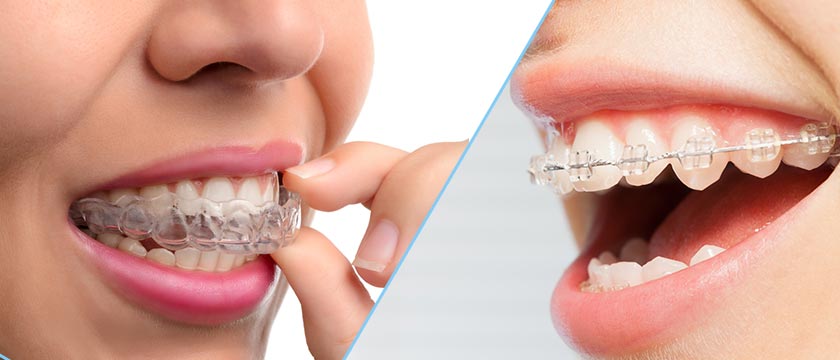
Choosing between Invisalign and braces comes down to three things: how complex your case is, how consistent you can be day to day, and how much the look of treatment matters to you. Invisalign fits mild to moderate crowding and spacing, stays nearly invisible, comes out for meals, and works only if you wear the trays 20 to 22 hours a day. Braces handle severe crowding, deep bites, and major rotations with more control, apply force around the clock without any effort from you, and are visible while they do it.
Below we compare the two on mechanics, appearance, comfort, oral health, speed, and case range, then walk through how the decision actually gets made.
Invisalign vs Braces: Which Is Right for You?
Neither Invisalign nor braces is better in general, because the right answer changes with the case in front of it. A reader looking for a universal winner will not find one, and any article that names one is selling rather than explaining.
The two appliances solve the same problem through different trade-offs. Braces buy mechanical control at the cost of visibility, diet, and cleaning difficulty. Invisalign buys discretion and freedom at the cost of depending on your discipline. Which trade you should take depends on what your teeth need and what your week looks like.
Scale tells you both approaches work. Align Technology reported in its annual filing that over 22 million people worldwide have been treated with Invisalign as of the end of 2025, with more than 2.4 billion aligners manufactured and roughly 295,000 trained practitioners. Braces have a century of clinical record behind them. The question is never whether one works. It is which one works for you.
How Do Invisalign and Braces Work Differently?
Invisalign and braces work differently in one fundamental way: Invisalign delivers force through a sequence of removable trays, while braces deliver it through a fixed bracket and wire that stays on your teeth. Everything else about the comparison follows from that single difference.
Invisalign plans the entire treatment before it begins. A digital scan produces a model of your teeth, planning software maps every movement in sequence, and the whole series of trays is manufactured from that plan at once. Each tray is shaped slightly differently from the one before it, so pressing it onto your teeth creates a small mismatch that becomes the force. We take those impressions using advanced dental technology and can project the finished result before a single tray is made.
Braces plan as they go. Brackets are bonded to each tooth and connected by an archwire, and the orthodontist adjusts that wire at each visit to redirect force where it is needed. Adjusting in real time is the source of the control advantage, because the appliance can respond to how teeth actually moved rather than to how they were predicted to move.
Both move teeth through the same biology. Steady light pressure triggers bone to dissolve ahead of a tooth and rebuild behind it, which is why research on orthodontic tooth movement finds that light continuous force moves teeth efficiently while heavy force slows the process down. The appliance chooses the direction. The bone does the work.
Invisalign vs Braces: A Side-by-Side Comparison
Side by side, Invisalign wins on appearance, diet, and cleaning, while braces win on case range, control, and not needing your cooperation. Typical treatment lengths of 6 to 18 months for aligners and 18 to 24 months for braces are consistent across published orthodontic ranges, and visit frequency data comes from the same body of clinical practice reporting.
| Factor | Invisalign | Braces |
|---|---|---|
| Visibility | Clear trays are difficult to notice in conversation | Metal brackets are visible; ceramic brackets are less obvious |
| Removability | Removed for eating, drinking, and brushing | Fixed in place for the whole treatment |
| Daily effort required | Must be worn 20 to 22 hours a day | None; the appliance works whether you think about it or not |
| Diet restrictions | None, since trays come out to eat | Hard, sticky, and chewy foods can break brackets or wires |
| Oral hygiene | Brush and floss normally with trays removed | Cleaning around brackets takes more time and extra tools |
| Office visits | Roughly every 6 to 8 weeks | Roughly every 4 to 6 weeks for adjustments |
| Case range | Mild to moderate crowding, spacing, and bite issues | Mild through complex, including severe crowding and major rotations |
| Typical length | 6 to 18 months | 18 to 24 months |
Reading the grid, most people spot their own priorities within a row or two. The sections below explain why each column looks the way it does.
What Are the Advantages of Invisalign?
The advantages of Invisalign are that it stays nearly invisible, comes out whenever you need it to, and leaves your daily habits almost untouched. Its strengths are built around ordinary life rather than around the appliance.
Appearance drives most of the interest. Clear trays are genuinely hard to notice across a table, which matters to adults in client-facing work and to teenagers who would rather not announce their treatment. Nothing metal appears anywhere in the system.
Removability is the second advantage and it compounds. Trays come out for meals, so there is no food you have to give up and no bracket that a bagel can break. They come out for brushing, so your existing routine continues unchanged. They come out for a wedding photo or a job interview, which no fixed appliance allows.
Fewer visits follow from the planning model. Because the full series is made up front, appointments are for checking progress rather than for adjusting hardware, which for our patients means coming in about every two months instead of monthly. Comfort tends to run in the same direction, since smooth plastic gives your cheeks and lips nothing sharp to rub against.
What Are the Advantages of Braces?
The advantages of braces are precise mechanical control, the ability to handle the full range of cases, and force that never depends on remembering anything. Where aligners trade power for convenience, braces make the opposite trade.
Control is the core of it. A bracket bonded to a tooth and connected to a wire can push, pull, rotate, tip, and torque that tooth with a directness that a plastic shell pressing from the outside cannot match. Complex movements that require lifting a tooth vertically or rotating a round tooth respond better to that direct grip.
Continuous force is the second advantage, and it removes the largest variable in aligner treatment. Braces apply pressure 24 hours a day because they cannot be taken out. For a patient who travels constantly, who knows their own habits, or who is a young teenager, that reliability is worth more than discretion.
Appearance is also less binary than it used to be. Ceramic brackets are tooth-colored and far less noticeable than the metal hardware people picture, which gives patients a way to get the mechanical advantage without the full visual cost.
Which Cases Are Better Suited to Braces?
Cases better suited to braces are the ones needing large vertical movement, severe rotation, major bite correction, or movement into extraction spaces. Clear aligners have widened their range considerably, and these specific movements remain where fixed appliances hold an edge.
The clinical picture is well documented. Research by Kravitz and colleagues published in the American Journal of Orthodontics and Dentofacial Orthopedics found that extrusion, pulling a tooth downward into position, was the least predictable aligner movement at 29.6 percent accuracy. A separate systematic review and meta-analysis found canine derotation accuracy of 61.2 percent with conventional attachments, improving to 71.5 percent with optimized shapes but still short of complete.
Case features that point toward fixed appliances include:
- Severe crowding where teeth need substantial repositioning rather than minor alignment
- Major rotations, especially on round teeth like canines and premolars that a tray struggles to grip
- Vertical movement, where a tooth sits too high or too low and needs to be lifted or pushed down
- Deep bites that require significant change in how the arches meet
- Extraction cases, where teeth must translate bodily across a closed space
- Skeletal differences between the upper and lower jaw rather than tooth position alone
- Known difficulty with consistency, since the best plan is the one you will actually follow
The honest numbers on case selection are worth knowing. A study by Kravitz and colleagues following 500 patients found that 17.2 percent, roughly one in six, switched from Invisalign to braces to complete treatment, and that the average case required 2.5 refinement scans. Those figures are not an argument against aligners. They are an argument for a careful evaluation before starting, which is exactly what a thorough dental exam and a full set of records provide.
Which Is Better for Your Gums and Enamel?
Invisalign is measurably better for your gums and enamel, and the gap is larger than most comparisons suggest. This is the one place where the comparison runs firmly in the opposite direction from case range.
White spot lesions make the clearest case. These are patches of demineralized enamel that appear where plaque sits against a tooth for months, and they are permanent marks rather than temporary stains. Research by Buschang and colleagues published in the Angle Orthodontist found white spot lesions formed in 1.2 percent of patients treated with clear aligners compared with 26 percent of patients treated with traditional braces.
Gum measurements follow the same pattern. A systematic review and meta-analysis published in the Korean Journal of Orthodontics found the risk of white spot lesions roughly ten times lower in aligner patients, along with significantly better plaque index, gingival index, probing depth, and bleeding on probing scores, with moderate to large effect sizes. The same review found aligner patients reported a better quality of life during treatment.
The mechanism behind all of it is simple. Brackets and wires create dozens of surfaces that a toothbrush cannot reach cleanly, and they hold plaque against enamel for the full length of treatment. Trays come out, so nothing new sits between your brush and your teeth. Anyone starting treatment with existing gum health concerns should weigh this difference heavily, and should have those concerns treated before orthodontic work begins either way.
Which Is Faster, Invisalign or Braces?
Invisalign is usually faster than braces for mild to moderate cases, at 6 to 18 months against 18 to 24 months, though real-world aligner timelines often run longer than the initial estimate. Speed depends more on case complexity than on appliance type.
The honest caveat matters here. That same Kravitz study of 500 patients found the average actual Invisalign treatment length was 22.8 months, well beyond the 12 to 18 months commonly quoted, and that only 6 percent of patients finished without a single refinement scan. Refinements are a normal part of finishing precisely, and they add time. A plan that accounts for them from the start produces fewer surprises than one that does not.
Tray count translates directly into duration, since each tray is worn for two weeks. Twenty trays is a completely ordinary series, working out to roughly ten months of active treatment, and it sits comfortably in the middle of the range rather than at the high end. Treatment stretching toward two years is also normal for a complex case or one that needed refinements, and it is not a sign anything went wrong.
Consistency is the one factor fully in your hands. Our patients typically complete short term Invisalign in 9 to 15 months, with simple cases finishing in as little as 6, and the cases that land at the fast end of that range are the ones where trays stayed in.
Which Hurts More, Invisalign or Braces?
Braces generally hurt more than Invisalign, though both produce soreness rather than sharp pain, and both fade within a few days of each change. The difference is in the kind of discomfort, not just the amount.
Invisalign soreness arrives when you switch trays and comes entirely from tooth pressure. Each new tray restarts the bone remodeling process, which feels like tightness or tenderness when biting. It peaks in the first day or two and eases as the teeth begin to move. Nothing in the system can cut or scrape soft tissue.
Braces produce two kinds of discomfort instead of one. The same pressure soreness follows each wire adjustment, and on top of it brackets and wire ends can irritate the inside of the cheeks and lips, particularly in the first weeks before the tissue toughens. Orthodontic wax handles most of that, and a loose wire is a quick fix, but it is a category of discomfort aligners do not have.
Do Dentists Prefer Invisalign or Braces?
Dentists do not prefer one over the other as a rule. They prefer whichever appliance the case actually calls for. A clinician who recommends the same treatment to every patient is not evaluating, they are defaulting.
What a clinician weighs is roughly the order this article has followed. First, what movements does the case need, and are any of them in the territory where fixed appliances hold an advantage. Second, how likely is this particular patient to wear trays consistently, which is a question about the person rather than the teeth. Third, what does the patient want from the experience, since a treatment someone resents is one they comply with poorly.
Appearance sits last on the clinical list and often first on the patient’s. That tension is normal and it is worth naming out loud during the consultation rather than discovering halfway through. For patients whose concerns are about the look of their teeth rather than their position, cosmetic dentistry may address the goal more directly than either orthodontic option would.
Are You Too Old for Invisalign or Braces?
You are not too old for Invisalign or braces at 35, at 55, or at 70. There is no upper age limit for orthodontic treatment, because the biology that moves teeth keeps working for life.
Bone remodeling continues throughout adulthood. Tooth movement can be somewhat slower in older adults and some movements are less predictable, which research bears out: a clear aligner review found anterior intrusion accuracy of 63.5 percent in adolescents compared with 45.3 percent in adults. Slower and less predictable are scheduling facts, not disqualifications.
Adults make up a large and growing share of orthodontic patients. The 500-patient study cited earlier had an average patient age of 33.6 years, which tells you the middle of the aligner market is nowhere near adolescence. What matters at any age is the health of the teeth and gums supporting the movement, not the number of birthdays behind them. Many adults finishing treatment pair it with teeth whitening, since evenly aligned teeth whiten more uniformly than crowded ones.
Is Invisalign Worth It for Just the Bottom Teeth?
Invisalign is worth it for just the bottom teeth in some cases, and single-arch treatment is a real option rather than a compromise. Lower front crowding is one of the most common complaints adults bring in, often because lower teeth crowd again years after childhood braces.
Single-arch treatment works when the bite is sound and only one arch needs alignment. It usually means fewer trays and a shorter timeline than treating both. The catch is that moving one arch changes how it meets the other, so a case that looks like a simple lower-crowding fix sometimes turns out to need both arches to keep the bite working properly.
That determination requires records rather than a mirror. If the goal is purely how the front teeth look and the underlying alignment is close to acceptable, dental veneers are worth discussing alongside aligners, since they solve a different problem on a different timeline.
What About Short-Term Options Like Six Month Smiles?
Short-term options like Six Month Smiles sit between clear aligners and full braces, using discreet fixed brackets to correct the teeth that show. The binary framing of this whole comparison hides that middle path.
Six Month Smiles uses triangular brackets that are clearer and more discreet than traditional ones, and it straightens the whole tooth at once rather than working the upper and lower portions separately. Because it focuses on the front teeth most people are actually concerned about, treatment can finish in as little as six months.
The trade-off is worth stating plainly. It is fixed, so nothing depends on your daily discipline, and it delivers the mechanical directness of brackets. It is also visible in a way clear trays are not, and it is aimed at cosmetic alignment of the visible teeth rather than at comprehensive bite correction. For a patient who wants a fast result and knows they would struggle with 22 hours a day, it often fits better than either alternative. We offer it alongside Six Month Smiles so the choice is not forced into two boxes.
How to Decide Which One Is Right for You
Deciding between Invisalign and braces starts with records of your actual teeth, not with a comparison article. Everything above narrows the field. Only an evaluation closes it.
The decision runs in this order:
- Get the case assessed. An exam and X-rays show what movements your teeth need, which is the one input no online comparison can supply.
- Find out whether your case falls inside the aligner range. If it needs the movements listed earlier, the choice narrows on its own.
- Be honest about consistency. Ask yourself whether 20 to 22 hours a day fits your actual routine, not your intended one. A patient who knows they would struggle is better served by a fixed appliance.
- Weigh appearance against the timeline. Decide how much the visibility of treatment matters across the months it will take.
- Consider the middle path. Short-term fixed options may fit a front-teeth goal better than either end of the comparison.
- Plan for retention from the start. Both options finish with a retainer, and that is permanent rather than optional.
Seeing finished cases helps more than reading about them, and our smile gallery shows results from patients whose starting points ran across the whole range. Patients throughout Sonora and Tuolumne County come in for this conversation before committing to anything, and that is the right order to do it in.
Dr. Berger reviews each case personally, and our team includes an orthodontic-certified assistant who manages treatment from the first appointment through to the retainer.
Frequently Asked Questions
How Long Is Too Long to Wear One Invisalign Tray?
Wearing one Invisalign tray longer than about three weeks is too long in most plans. Staying in a tray past its interval does not harm your teeth, but it stalls the schedule and pushes the whole series back. Tell us if you are stuck on a tray, since that is usually a sign a tooth is not tracking and needs attention.
Can You Switch From Invisalign to Braces Partway Through?
You can switch from Invisalign to braces partway through, and it happens more often than most patients expect. A study of 500 patients found 17.2 percent made that switch to finish treatment. Progress already achieved is not lost, and time already spent in trays usually shortens the fixed-appliance phase that follows.
Do Both Options Need a Retainer Afterward?
Both options need a retainer afterward, without exception. Newly rebuilt bone takes months to reach full density, and the fibers around each tooth pull gently toward their old positions during that window. Retainers hold everything still while both settle, and schedules typically step down from full-time to nights.
Can Invisalign Fix an Overbite as Well as Braces?
Invisalign can fix mild to moderate overbites effectively, usually with attachments bonded to specific teeth to achieve the necessary movements. Severe overbites and overbites rooted in jaw position rather than tooth position respond better to fixed appliances. Records determine which category yours falls into.
Can You Get Invisalign If You Have Crowns or Bridges?
You can often get Invisalign with crowns, and bridges are more complicated. A crowned tooth moves like any other tooth, though attachments bond less reliably to porcelain than to enamel. A bridge splints several teeth together into one unit, which limits how independently those teeth can move and may rule out aligner treatment for that section.
Can You Play Sports or a Wind Instrument With Braces?
You can play sports and wind instruments with braces, with adjustments. Contact sports call for a mouthguard sized to fit over brackets. Wind instrument players usually need a few weeks to adapt their embouchure, and many use wax over the brackets in the meantime. Clear aligners sidestep both issues, since the trays come out.
The Bottom Line
Invisalign and braces are not competing for the same patient. Invisalign fits mild to moderate cases in people who will genuinely wear the trays, and it comes with a measurable advantage for gums and enamel that most comparisons undersell. Braces fit cases needing large or complex movement, and they remove your daily discipline from the equation entirely. Short-term fixed options sit between them for front-teeth goals on a fast timeline.
What no article can tell you is which description fits your teeth. That takes an exam, X-rays, and a conversation about how you actually live. Our office is on Mono Way in Sonora, and the team at Jeff Berger Dentistry will give you a straight answer about which option suits your case, including when the answer is one we would not have guessed from the outside. Reach out whenever you are ready.


