


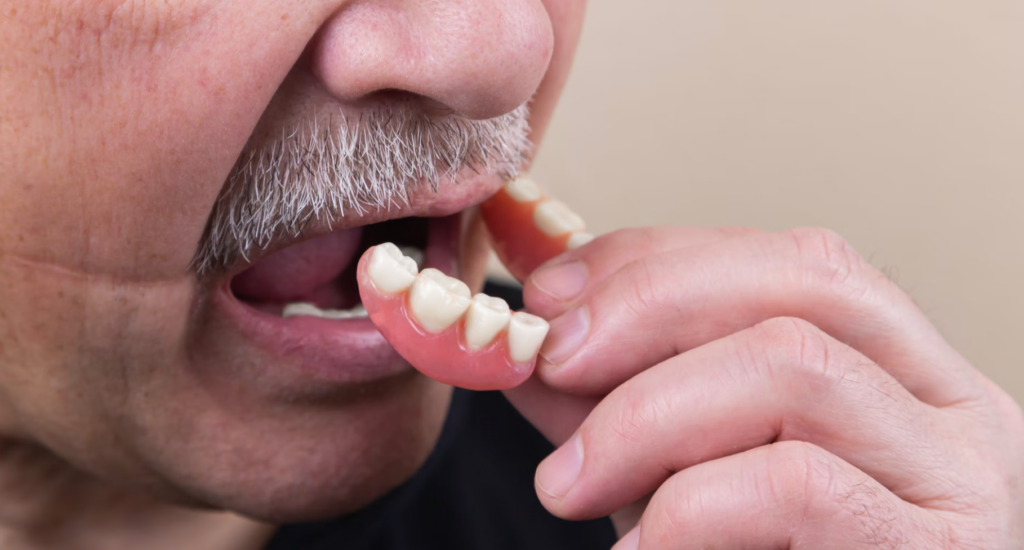
Dentures last 5 to 10 years on average before they need to be replaced. Full removable dentures last 5 to 7 years, partial dentures last 5 to 15 years depending on the framework material, implant-supported dentures last 10 to 20 years, and immediate dentures are transitional appliances built to carry a patient through a few months of healing. Two forces end a denture’s life: the jawbone underneath keeps changing shape, and the denture teeth keep wearing down.
Below we cover the lifespan of every denture type, what actually causes a denture to fail, how often relining buys more time, the specific signals that replacement is due, the habits that shorten a denture’s life, and how modern materials have changed the picture.
How Long Do Dentures Last?
Dentures last 5 to 10 years for most patients, and the type you wear sets where in that band you land. The American Dental Association recommends having dentures examined by a dental professional for possible replacement every 5 to 7 years. Cleveland Clinic puts the average denture lifespan at 7 to 10 years. The American College of Prosthodontists frames it differently and more precisely, describing removable dentures as medical devices with limited lifespans that should never be treated as permanent restorations.
Those three figures agree more than they appear to. A denture rarely fails on a calendar date. It drifts out of fit gradually, and the year it becomes unwearable depends on how fast the bone beneath it changes and how hard the patient chews. The table below gives the working ranges by type, drawn from the ADA, the American College of Prosthodontists and Cleveland Clinic.
| Denture Type | Typical Lifespan | What Usually Ends It |
|---|---|---|
| Full removable denture | 5 to 7 years | Ridge resorption beneath the base, plus flattening of the denture teeth |
| Partial denture | 5 to 15 years | Loss of a supporting natural tooth, or clasp fatigue and fracture |
| Implant-retained snap-in denture | 10 to 15 years | Wear of the attachment inserts and of the acrylic around them |
| Fixed implant-supported arch | 15 to 20 years | Wear of the prosthetic teeth, while the implants themselves often outlast it |
| Immediate denture | A few months to a year | Rapid gum shrinkage during healing, which the appliance is designed to bridge |
Tooth loss itself remains common enough that these numbers affect millions of households. The American Dental Association reports that more than 36 million Americans have no natural teeth and 120 million are missing at least one tooth. Roughly 90% of people without teeth wear dentures, and about 15% of that group has a new denture made every year. That annual replacement rate is not a sign of failure. It is simply what a five to ten year lifespan looks like spread across a large population. We provide full and partial dentures along with All-on-4 implant-supported dentures, and the expected lifespan differs meaningfully between them.
How Long Do Full Dentures Last?
Full dentures last 5 to 7 years before replacement is usually warranted. A full denture rests directly on the gum ridge and has nothing anchoring it, which means every millimeter of bone the body resorbs translates into a looser appliance. The upper arch gains some help from suction across the palate. The lower arch has no equivalent surface and therefore tends to reach the end of its useful life first.
Patients who take care of their dentures often push past seven years comfortably. Patients who lost their teeth recently rarely do, because bone change is fastest in the first years after extraction.
How Long Do Partial Dentures Last?
Partial dentures last 5 to 15 years, a wider band than full dentures because the framework material makes such a large difference. A cast metal partial resists fracture and holds its clasp tension for a decade or more. An acrylic resin partial weighs more, flexes under load and typically needs replacing sooner.
The other variable is the natural teeth the partial clasps onto. Lose one of those abutment teeth and the partial loses its anchoring geometry. The American College of Prosthodontists specifically lists the loss of a supporting tooth as a condition that triggers replacement evaluation, regardless of how new the appliance is.
How Long Do Implant-Supported Dentures Last?
Implant-supported dentures last 10 to 20 years, roughly double a conventional removable denture. Snap-in dentures retained by implants generally run 10 to 15 years, while a fixed full-arch prosthesis often reaches 15 to 20. The implants underneath frequently outlast the teeth attached to them. A 2019 meta-analysis published in the Journal of Dentistry found a 10-year implant survival rate of 96.4% at the implant level, with a more conservative sensitivity estimate of 93.2%.
The reason for the longer lifespan is mechanical. An implant transmits chewing force into the jawbone, and bone that receives force maintains itself instead of resorbing away. Remove that stimulation and the ridge shrinks, which is precisely what shortens the life of a conventional denture.
How Long Do Immediate Dentures Last?
Immediate dentures last a few months to about a year as a wearable appliance. They are built before extractions and placed the same day, which means they are fitted to a mouth that no longer exists by the time healing finishes. Rapid gum shrinkage during those first months is the entire reason they need soft liners, adjustments and eventually a reline or a conventional replacement.
Nobody should treat a short immediate denture lifespan as a problem with the appliance. Carrying a patient through healing with teeth in place is the job it was designed for, and it does that job well.
Why Do Dentures Need to Be Replaced?
Dentures need to be replaced because the jawbone beneath them keeps shrinking while the denture itself stays the same shape. That mismatch builds slowly and cannot be reversed. Everything else on the list is secondary to it.
Bone resorption after tooth loss has been measured precisely. A landmark 2003 clinical study by Schropp and colleagues, published in the International Journal of Periodontics and Restorative Dentistry, recorded roughly a 50% reduction in alveolar ridge width within twelve months of extraction, with two thirds of that loss happening in the first three months. Longer term work by Ashman found 40% to 60% of alveolar bone volume lost within two to three years, continuing afterward at 0.25% to 0.5% per year for life. A denture fitted to a ridge that has lost half its width no longer fits that ridge at all.
Alongside bone change, several other factors bring a denture to the end of its service:
- Occlusal wear. Acrylic teeth flatten under years of chewing, which shortens the bite and changes how the jaws meet.
- Material degradation. The American College of Prosthodontists points to the inherent porosity of acrylic resin, which absorbs fluids, stains and harbors microorganisms over time.
- Fracture and chipping. Repeated flexing under chewing load eventually cracks a base or breaks a tooth off.
- Loss of facial support. As tooth height drops, the lower face shortens and the cheeks and lips lose the fullness the denture originally restored.
- Chronic tissue irritation. An appliance that no longer seats properly creates pressure points that inflame the gums underneath.
Do Denture Teeth Wear Down?
Yes, denture teeth wear down, and the wear is permanent because acrylic cannot be rebuilt the way a natural tooth can. Years of chewing flatten the cusps, the pointed and grooved surfaces that do the actual grinding. Once those surfaces go flat, food gets mashed rather than cut, and chewing efficiency drops noticeably.
Flattening also shortens the vertical dimension, meaning the distance between the nose and the chin when the teeth meet. Lose enough of it and the corners of the mouth turn down, the lips fold inward and the face reads as older than it is. This is the change patients notice in photographs before they notice it in the mirror. Natural teeth restored with dental crowns follow a similar pattern, though porcelain resists flattening far better than denture acrylic does.
How Often Should Dentures Be Relined?
Dentures should be relined every 1 to 2 years, or sooner whenever the fit starts to change, according to Cleveland Clinic. A reline adds new base material to the tissue side of the denture so it seats against the ridge as the ridge is now, rather than as it was when the impressions were taken.
Relining is what stretches a denture toward the upper end of its lifespan. Without it, a five year denture becomes unwearable in three. Patients we see in Sonora for reline appointments are usually surprised at how much difference a single visit makes, because the looseness built up so gradually that they adapted to it without noticing.
Three procedures get confused constantly, so the distinction matters. A reline resurfaces the inside of the existing denture. A rebase replaces the entire base material while keeping the original teeth, which suits a denture whose teeth are still in good shape but whose acrylic has degraded. A replacement builds a new appliance from new impressions. Choosing correctly among these denture options can save years of service on an appliance that seemed finished.
How Do You Know When It’s Time to Get New Dentures?
You know it’s time to get new dentures when the denture slips during normal speech and eating, sore spots keep returning, the teeth look visibly worn or cracked, or you find yourself using more adhesive than you used to. The American College of Prosthodontists issued a position statement in 2015, reaffirmed in 2018, listing the specific conditions that should prompt a replacement evaluation.
Those conditions include chronic irritation or inflammation beneath the denture base, loss of a tooth supporting a partial denture or overdenture, degradation of the appliance itself, an inability to tolerate the prosthesis, and more than five years of function. Any single one of them is enough to warrant an assessment.
Increasing adhesive use deserves its own mention because patients treat it as a solution rather than a symptom. Adhesive is meant to add retention to a denture that already fits. Using progressively more of it to hold a denture that no longer fits masks the problem while the underlying tissue keeps taking the pressure.
Can Old Dentures Cause Health Problems?
Yes, old dentures can cause health problems, and the risk climbs the longer an ill-fitting appliance stays in service. The evidence-based guidelines published by the American College of Prosthodontists cite a review documenting adverse effects among patients wearing the same dentures beyond five years, most of them related to the soft tissue under the base.
Denture stomatitis is the most common of these. A 2021 systematic review placed its prevalence between 20% and 67% among denture wearers, which makes it one of the most frequent oral conditions in this population. It presents as redness and inflammation of the tissue the denture covers, driven by microorganisms colonizing the porous acrylic surface. Chronic friction from a poorly seated base can also produce epulis fissuratum, a fold of excess tissue that grows in response to the constant rubbing and often requires surgical removal.
Chewing efficiency is the quieter consequence. Patients with worn, loose dentures gradually stop eating foods that take effort, and the diet narrows toward soft, processed options that are easier to manage but harder on overall nutrition.
What Ruins Dentures?
What ruins dentures is heat, abrasion and impact, in that order of frequency. Each one causes damage that no adjustment can undo, and all three are avoidable.
The specific habits that shorten a denture’s life include:
- Hot water. Rinsing or soaking a denture in hot water warps the acrylic permanently, and a warped base never seats correctly again.
- Abrasive cleaners. Regular toothpaste, whitening products and scouring powders scratch the surface, and those scratches trap stain and bacteria.
- Dropping. A denture cleaned over an empty sink cracks when it slips. Filling the basin with water or laying down a folded towel prevents most breakages.
- Household adhesives. Super glue and similar products contain chemicals unsafe for oral tissue and make a professional repair far harder.
- Letting them dry out. Acrylic that dries fully can distort, which is why overnight soaking matters beyond simple cleanliness.
- Skipping professional review. Small fit problems compound into big ones when nobody checks them for years at a stretch.
How Can You Make Dentures Last Longer?
You can make dentures last longer by cleaning them daily with the right products, giving the tissue underneath time to recover, and having the fit checked before it becomes a problem. Daily habits account for more of a denture’s lifespan than most patients expect.
A routine that protects the appliance looks like this:
- Rinse the denture after eating to clear food debris before it settles into the base.
- Brush it once daily with a soft denture brush and a nonabrasive denture cleanser, never regular toothpaste.
- Clean over a water-filled sink or a folded towel so a slip does not become a fracture.
- Soak it overnight in water or a denture solution to keep the acrylic hydrated and reduce microbial buildup.
- Rinse thoroughly after soaking, since cleanser solutions are not meant to go back in the mouth.
- Brush the gums, tongue, palate and any remaining natural teeth twice daily.
- Have the denture professionally cleaned at least once a year, which the American College of Prosthodontists recommends alongside the daily routine.
Patients who follow that sequence and keep their reline appointments regularly reach the upper end of the range for their removable dentures. Patients who skip the professional side often replace theirs years early.
When Should You Not Wear Your Dentures?
You should not wear your dentures for at least 8 hours in every 24, a guideline Cleveland Clinic states directly. Most people take that time overnight, though the timing matters less than the total. Gum tissue compressed under a denture all day needs a stretch of hours with no pressure on it to recover.
Three things happen during that rest period. The gums decompress and their blood supply normalizes, harmful oral bacteria drop as saliva reaches the covered surfaces, and the jawbone gets a break from the constant load a denture places on it.
Can You Sleep With Dentures In?
No, you should not sleep with dentures in as a regular habit, because continuous wear raises the risk of tissue inflammation substantially. The evidence-based guidelines from the American College of Prosthodontists report that denture stomatitis is associated with continuous wear at an odds ratio of 6.20 for upper prostheses and 5.21 for lower prostheses.
That means patients who leave their dentures in around the clock develop the condition at roughly five to six times the rate of those who take them out. Sleeping in dentures occasionally, on a trip or after a long day, causes no lasting harm. Doing it every night for years is a different matter entirely.
Do I Still Need to Brush My Gums If I Have Dentures?
Yes, you still need to brush your gums if you have dentures, twice a day with a soft brush. Gum tissue accumulates plaque whether or not teeth sit in it, and the tissue under a denture base gets less saliva flow and less natural cleansing than exposed tissue does.
Brushing also stimulates circulation in the ridge, which supports the health of the tissue the denture depends on. Patients keeping some natural teeth alongside a partial have an additional reason to stay diligent, since gum health around those abutment teeth determines whether the partial keeps its anchoring.
What Is the Newest Type of Dentures?
The newest type of dentures is the digitally designed denture, milled or printed from a dense block of material rather than processed from poured acrylic. Digital fabrication starts with an intraoral scan instead of a physical impression, and the denture is then designed on screen and cut or printed to those specifications.
The durability advantage comes from the material structure. Milled dentures are produced from pre-polymerized pucks manufactured under high pressure, which gives them lower porosity than conventionally processed acrylic. Lower porosity means less fluid absorption, less staining and fewer microorganisms taking hold in the surface, all of which are among the degradation factors the American College of Prosthodontists names as lifespan limits. A digital design file also stays on record, so a replacement or a spare can be produced without starting the whole impression process again. Our investment in dental technology reflects the same principle that drives digital restorative work generally.
Material science has moved across restorative dentistry at a similar pace over the past decade, which is why modern veneers and prosthetic teeth alike hold their appearance longer than their predecessors did.
What Age Do Most People Start Wearing Dentures?
Most people start wearing dentures in their 60s and 70s, though tooth loss begins considerably earlier for many patients. Data from the National Health and Nutrition Examination Survey covering 2017 through March 2020 shows complete tooth loss affecting 1.2% of adults aged 35 to 49, 5.9% of adults aged 50 to 64, 11.4% of adults aged 65 to 74, and 19.7% of adults aged 75 and over.
Starting age changes the arithmetic of denture ownership in a way worth thinking through. A patient who receives a first full denture at 55 and lives into their 80s will go through four or five appliances across that span. A patient who starts at 75 may well never need a second. Nationally, edentulism is also falling, with CDC surveillance data showing complete tooth loss among adults 65 and over dropping from 16.2% in 2012 to 13.8% in 2020.
Do Dentures Last Longer Than Implants?
No, dentures do not last longer than implants. Implants routinely outlast several generations of denture, with 10-year survival measured at 96.4% in the 2019 meta-analysis cited earlier, and 91.5% among patients aged 65 and older. A removable denture reaching its second decade is unusual. An implant reaching its second decade is ordinary.
The distinction that matters is between the implant and the prosthesis attached to it. The titanium post integrates with bone and can serve for decades. The teeth mounted on it are still acrylic or composite in most designs, and they still wear. A patient with an implant-supported arch should expect to replace the prosthetic portion eventually while keeping the implants themselves. We place dental implants for both snap-in and fixed designs, and Dr. Berger completed his implant training through the Misch International Implant Institute.
Bone preservation is the longevity argument underneath all of this. Implants keep loading the jaw, which slows the resorption that shortens every removable denture’s life. Patients comparing longer-term options often weigh the same factors when considering bridges and implants for smaller gaps.
How Much Does It Cost to Replace a Full Set of Dentures?
Replacing a full set of dentures costs roughly $1,000 to $7,000 nationally, because a replacement is fabricated from scratch rather than repaired. A rebase or a reline costs a fraction of that and often postpones the full expense by several years, which is the practical reason to have the fit checked on schedule rather than waiting for failure.
Insurance rarely covers the whole amount. Most plans classify dentures as a major service reimbursed at the lowest tier, and the National Association of Dental Plans reports that about 65% of dental PPOs carry an annual maximum of $1,500 or more. Replacement frequency rules matter just as much, since many plans cover a new denture only once every five years. For work falling outside coverage, we offer interest-free in-office payment options along with a discount for payment made before treatment.
How Do You Protect the Dentures You Have Now?
You protect the dentures you have now by keeping the same appointment schedule a patient with natural teeth would keep. Denture wearers often stop coming in, on the reasoning that there are no teeth left to examine. The tissue, the ridge, the bite relationship and the appliance itself all still need review.
At a denture check we assess retention and base adaptation, look at the tissue under the base for early irritation, measure how much vertical dimension the teeth have lost, and screen the soft tissue for anything that needs attention. Problems caught at that stage are usually solved with a reline. The same problems caught two years later usually require a new appliance. Denture patients get more years out of their appliances when regular checkups stay on the calendar.
Frequently Asked Questions
Can Dentures Last 20 Years?
Dentures can last 20 years in rare cases, though wearing the same appliance that long is not advisable. The American College of Prosthodontists identifies more than five years of function as a reason to evaluate for replacement, and research cited in its guidelines documents adverse tissue effects past that mark. A 20-year-old denture is almost certainly sitting on a ridge that has changed dramatically since it was made.
Do Dentures Need to Be Replaced If They Still Fit?
Dentures may still need replacement even if they feel like they fit, because fit is only one of several criteria. Worn-down teeth, degraded or stained acrylic, a shortened bite and chronic tissue irritation each justify a new appliance independently. Patients also adapt to gradual looseness without registering it, which is why a professional assessment beats self-evaluation.
Is It Cheaper to Do Implants or Dentures?
Dentures are cheaper than implants at the outset, and the gap narrows over time. A removable denture costs far less upfront but needs relines every one to two years and full replacement every five to seven. Implants cost more initially and carry a 96.4% survival rate at ten years, which means fewer replacement cycles across a long horizon.
Will Medicare Pay for Dentures or Implants?
Medicare does not pay for dentures or implants under traditional coverage, which excludes routine dental care entirely. Some Medicare Advantage plans add supplemental dental benefits that include partial denture coverage, with amounts varying widely by plan. Medicaid programs differ state by state, and many limit a covered denture to once every five years.
Can a Broken Denture Be Repaired?
Yes, a broken denture can usually be repaired, provided the pieces are intact and the repair happens professionally. A cracked base or a tooth that has come loose is often fixable within a day or two. A denture that snapped after warping in hot water is a different case, since the shape itself has changed. Patients whose denture breaks unexpectedly should treat it as urgent care rather than waiting for a routine opening.
How Long Does It Take to Get Replacement Dentures?
Replacement dentures take about four to six weeks from the first impression appointment to final delivery. The sequence runs through preliminary impressions, final impressions with bite registration, a wax try-in to confirm fit and appearance, then lab processing and delivery. Digitally fabricated dentures can compress that timeline when a design file already exists on record.
The Bottom Line
Dentures last 5 to 10 years, with full dentures at the shorter end, partials spanning 5 to 15 years depending on their framework, and implant-supported designs reaching 10 to 20. The number that actually governs those ranges is bone loss, because a ridge that gives up half its width in the first year after extraction takes every denture out of fit eventually. Relining answers that drift for a while. Tooth wear, acrylic degradation and lost facial support finish the job.
Care habits move a denture several years in either direction. Daily cleaning with the right products, eight hours out of the mouth, no hot water, no abrasives, and a professional check each year are what separate an appliance that reaches its full service life from one that fails early. The signals that replacement is due are specific and recognizable, and none of them should be managed with more adhesive.
If your dentures are slipping, sore or simply getting on in years, we are glad to take a look and tell you honestly whether a reline will do or a new set makes more sense. You can find us at Jeff Berger Dentistry on Mono Way, and you are welcome to reach out whenever it suits you.


