


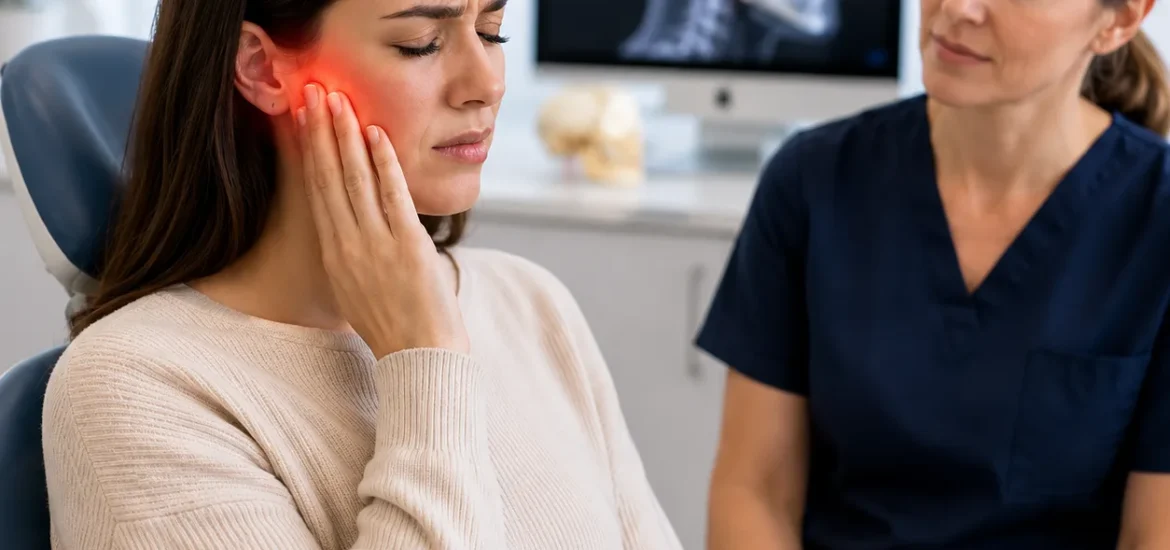
TMJ stands for the temporomandibular joint, the hinge on each side of your head that connects your lower jaw to your skull. Most people use the term differently in everyday conversation, saying they “have TMJ” when they mean they have a TMJ disorder, shortened to TMD. A TMJ disorder causes pain in the jaw and face, clicking or popping sounds, headaches, earaches, stiffness and trouble opening the mouth fully.
Treatment starts with simple, non-invasive care and moves to medical options only when it needs to. Below we cover what the joint actually does, the faull symptom picture, what causes TMD and what sets off a flare, the conditions that get mistaken for it, how to gauge severity at home, the complete treatment ladder from self-care upward, and where surgery actually sits in that sequence.
What Is TMJ?
TMJ is the temporomandibular joint, and you have two of them, one just in front of each ear. Each joint connects the mandible, meaning the lower jawbone, to the temporal bone of the skull. Between those two bones sits a small cushion of cartilage called the articular disc, which lets the joint glide as well as hinge.
That combination of motions is what makes this joint unusual. Most joints in the body do one thing. The temporomandibular joint rotates open like a hinge for the first portion of the movement, then slides forward along a bony track to let the mouth open the rest of the way. Every bite, word and yawn runs through it, which is roughly 2,000 movements a day for the average person.
When the joint, the disc inside it, or the muscles that move it stop working smoothly, the result is a temporomandibular disorder. The National Institute of Dental and Craniofacial Research describes TMD as an umbrella term covering more than 30 separate conditions affecting the jaw joints and the muscles that control them.
What Is the Difference Between TMJ and TMD?
The difference between TMJ and TMD is that TMJ names the joint itself while TMD names the disorder affecting it. Everyone has a TMJ. Not everyone has TMD. The shorthand caught on decades ago and stuck, so a patient who says “my TMJ is acting up” is understood perfectly well, even though the technically correct term is TMD.
TMD is common enough that the confusion matters. NIDCR estimates that 5% to 10% of the US population has some form of temporomandibular disorder, and Cleveland Clinic puts the figure at up to 12 million people nationally. These conditions appear at least twice as often in women as in men, and onset clusters between ages 20 and 40, which is unusual for a chronic pain condition since most become more common with age rather than less.
What Are the Symptoms of a TMJ Disorder?
The symptoms of a TMJ disorder are jaw pain, clicking or popping, headaches, earaches, limited jaw movement and difficulty chewing. Symptoms often extend well beyond the joint itself, which is why so many people spend months treating the wrong problem.
The full picture includes:
- Pain in the jaw, face or temple, usually worse with chewing, talking or first thing in the morning.
- Clicking, popping or grinding sounds when opening or closing the mouth.
- Jaw stiffness or locking, where the jaw catches partway open or partway closed.
- Headaches, often felt at the temples and sometimes mistaken for tension headaches or migraines.
- Earache, ear fullness or tinnitus, meaning ringing in the ears, because the joint sits directly against the ear canal.
- Neck and shoulder pain, since the muscles that position the jaw connect into the neck and upper back.
- Tooth pain with no dental cause, produced by referred muscle pain rather than by the tooth itself.
- Changes in how the teeth meet, where the bite suddenly feels off.
One symptom deserves separating from the rest. The TMJ Association notes that roughly one third of the population experiences some jaw clicking or popping with no pain and no restriction of movement, and for that group no treatment is necessary at all. A noisy jaw by itself is not a disorder. A noisy jaw that hurts or catches is a different matter.
What Causes TMJ Disorders?
TMJ disorders are caused by teeth grinding and clenching, jaw injury, arthritis in the joint, a misaligned bite, and sustained muscle tension. Most cases involve more than one of these at once, which is part of why a single treatment rarely solves the whole problem.
Grinding and clenching, known clinically as bruxism, is the most common contributor. A 2024 meta-analysis published in the Journal of Clinical Medicine put global bruxism prevalence at 22.22%, with sleep bruxism at 21% and awake bruxism at 23%. North America shows the highest sleep bruxism rate of any region at 31%, and when measured objectively through polysomnography, meaning an overnight sleep study, the figure reaches 43%. Clenching generates forces the joint was never built to absorb for hours at a stretch.
Injury accounts for another share. A blow to the jaw, a whiplash event or even a long dental appointment with the mouth held wide can strain the joint or displace the articular disc. Arthritis, whether osteoarthritis from wear or an inflammatory type, degrades the cartilage surfaces and reduces the smooth glide the joint depends on.
Bite relationship is the factor dentistry is best positioned to address. When the upper and lower teeth do not meet evenly, the jaw muscles work harder to find a comfortable resting position, and that extra work shows up as fatigue and pain. Correcting alignment with Invisalign or with targeted bite adjustment removes the underlying strain rather than masking it. Dr. Berger completed postgraduate training in occlusion, the study of how teeth contact each other, under Frank Spear.
Stress belongs on the list too, though indirectly. Stress does not damage the joint. It drives the clenching and the muscle guarding that do.
What Triggers a TMJ Flare Up?
A TMJ flare up is triggered by anything that loads the joint harder or longer than usual, and the trigger is often something small that would pass unnoticed in a healthy joint. Underlying causes explain why the disorder exists. Triggers explain why this week is worse than last week.
The usual culprits are chewy or hard foods, gum chewing, a stressful stretch at work that increases clenching, poor sleep, a cold or sinus infection that changes breathing patterns, a long dental or medical appointment with the mouth open, and cold weather that prompts muscle tensing. Wide yawning sets off more flares than most patients expect. So does holding a phone between the ear and shoulder.
Patients we see in Sonora often trace a flare back to a specific week rather than a specific day, which is useful information. Load builds up gradually in this joint, and it unwinds gradually as well.
What Could Be Mistaken for TMJ?
Conditions mistaken for TMJ include cracked teeth, tooth nerve infections, sinus infections, ear infections, trigeminal neuralgia and migraine. All of them produce pain in the same region of the face, and several of them produce pain that worsens with chewing, which is the symptom most people treat as proof of a jaw joint problem.
A cracked tooth is the most frequent impostor in dental practice. Cracks produce sharp pain on biting and release, and the pain often radiates along the jaw rather than staying at the tooth. An infected tooth nerve creates a deep, throbbing ache that can present as generalized jaw pain, and treating it with a root canal resolves symptoms that had been attributed to the joint for months.
Sinus infections press on the upper back teeth and the cheek, producing pressure that intensifies when bending forward. Ear infections generate pain within a centimeter of the joint itself. Trigeminal neuralgia causes brief electric-shock sensations along one side of the face, distinct from the dull ache of muscle-driven TMD. Migraine overlaps heavily with TMD in both symptoms and population, and NIDCR notes that TMDs commonly occur alongside migraine, fibromyalgia, back pain, irritable bowel syndrome and arthritis.
Sorting these apart is the practical reason to have jaw pain examined rather than self-diagnosed. Each one has a different treatment, and several worsen if left alone. A fair number of the jaw pain cases we see across Sonora and Tuolumne County turn out to start somewhere other than the joint.
How Do You Know If Your TMJ Is Severe?
Your TMJ is severe if the jaw locks, the pain is constant rather than intermittent, you cannot open wide enough to eat normally, or symptoms have persisted for months without improving. Severity is measured by function and duration more than by how much it hurts on a given day.
Mild TMD comes and goes, responds to rest and soft foods, and does not interfere much with eating or speaking. Moderate TMD produces daily symptoms, limits which foods are comfortable, and includes clicking with pain. Severe TMD involves locking, a measurable reduction in how far the mouth opens, pain that disturbs sleep, or symptoms that have not budged in three months or more.
A thorough dental exam establishes which category applies. Assessment includes listening to and feeling the joint through its full range, measuring maximum opening, pressing along the jaw muscles to locate tender points, and taking imaging when the joint structure itself needs evaluation.
A jaw that locks fully closed and will not open should not wait for a routine appointment. That situation warrants urgent care the same day.
What Is the 3 Finger Test for TMJ?
The 3 finger test for TMJ is a simple check where you stack three fingers vertically and try to fit them between your upper and lower front teeth. A healthy jaw opens wide enough to accept three fingers, roughly 40 to 50 millimeters. Fitting only two suggests restricted opening, which is one marker of a temporomandibular disorder.
This is a rough screen and nothing more. It does not diagnose anything, it does not identify which structure is involved, and a normal result does not rule out TMD, since plenty of painful cases open perfectly well. Use it as a reason to book an appointment, not as a substitute for one. Anyone whose jaw hurts should stop the test at the first sign of pain rather than forcing the opening.
How Do They Fix TMJ?
TMJ is fixed by working up a ladder that begins with self-care, moves to oral appliances and bite correction, then adds medications or physical therapy, and reaches injections or surgery only in the small minority of cases that need them. The National Institutes of Health strongly recommends using the most conservative and reversible treatments possible, meaning approaches that do not invade the tissues of the face or jaw and do not permanently change the position of the jaw or teeth.
The ladder below reflects the sequence described by NIDCR, Mayo Clinic and the TMJ Association, with the tiers ordered as those sources order them.
| Tier | What It Involves | When It Applies |
|---|---|---|
| Self-care | Soft diet, heat and cold, jaw rest, habit awareness, gentle stretching | First response for every case, mild through severe |
| Oral appliances | Custom night guards and stabilization splints that redistribute bite force | Grinding, clenching, morning pain, tooth wear |
| Bite correction | Adjustment of how teeth meet, orthodontic alignment, restoring worn teeth | Uneven contact or alignment is driving muscle strain |
| Medications | Anti-inflammatories, muscle relaxants, low-dose medications for chronic pain | Pain and muscle spasm not controlled by the tiers above |
| Physical therapy | Supervised stretching and strengthening, ultrasound, moist heat, TENS | Muscle-dominant cases and restricted range of motion |
| Injections and surgery | Corticosteroid or trigger point injections, joint flushing, arthroscopy, open-joint surgery | Structural joint problems that persist after conservative care fails |
One honest caveat belongs alongside that table. The National Academy of Medicine’s 2020 report on temporomandibular disorders concluded that evidence-based clinical practice guidelines for TMD treatment do not currently exist, despite treatment being common. That is precisely why the conservative-first principle carries so much weight. Reversible treatments can be stopped if they do not help. Irreversible ones cannot.
Home Care and Self-Treatment
Home care for TMJ starts with reducing load on the joint and calming the muscles around it. Most mild cases improve within weeks on self-care alone, and the TMJ Association notes that many people with periodic symptoms get better without any professional treatment.
A practical sequence looks like this:
- Switch to soft foods for a week or two. Cut food into small pieces, skip anything chewy or crusty, and stop chewing gum entirely.
- Apply ice for sharp, recent pain and moist heat for a dull, ongoing ache. Mayo Clinic advises 15 to 20 minutes at a time, several times a day.
- Combine moist heat with gentle stretching, repeated through the day. Mayo Clinic describes this pairing as very effective.
- Practice a resting jaw position: tongue gently on the roof of the mouth, teeth slightly apart, lips together. The teeth should only touch when you swallow or chew.
- Catch the habits. Clenching at a screen, chewing pens, nail biting and leaning on your chin all load the joint without registering as effort.
- Avoid extreme movements. Support the jaw when yawning, skip the loud singing, and take smaller bites.
If two to three weeks of consistent self-care produces no change, the problem has moved past what home measures alone will resolve.
Oral Appliances and Bite Correction
Oral appliances treat TMJ by placing a custom-fitted layer between the upper and lower teeth that redistributes bite force and discourages clenching. A night guard protects the teeth from grinding damage. A stabilization splint goes further, holding the jaw in a position where the muscles can release rather than brace. An umbrella review published in the Journal of Oral Rehabilitation found occlusal appliances effective for bruxism management, while evidence for most other bruxism therapies remained weak.
Fit is what separates a working appliance from an expensive one. A drugstore boil-and-bite guard is uniform thickness and does not account for how a specific jaw closes, which sometimes makes symptoms worse by introducing new uneven contacts. Our TMJ treatment approach starts from impressions of the actual bite, so the appliance supports the jaw where that particular jaw needs support.
Bite correction addresses the cause rather than the load. Where uneven contact is driving the muscle strain, adjusting how the teeth meet, aligning them orthodontically, or rebuilding worn tooth surfaces removes the reason the muscles were working overtime. Patients who grind heavily typically need both, with custom mouthguards protecting the teeth while the alignment work proceeds.
Medications and Physical Therapy
Medications and physical therapy treat the muscle and pain components that appliances alone do not reach. Over-the-counter anti-inflammatories are the usual starting point. Physicians sometimes prescribe stronger anti-inflammatories for short courses, muscle relaxants for spasm lasting days or weeks, or low doses of certain antidepressants, which at those doses are used to manage chronic pain and reduce night-time grinding rather than to treat mood.
Physical therapy adds supervised stretching and strengthening of the jaw muscles, and may include ultrasound, moist heat protocols, or TENS, meaning transcutaneous electrical nerve stimulation, which uses gentle electrical current to ease muscle tension. These options are delivered by physicians and physical therapists rather than in a general dental office, and they pair well with appliance therapy in muscle-dominant cases.
What Can I Do Instead of Jaw Surgery?
Instead of jaw surgery, you can do everything in the first five tiers of the treatment ladder, which resolves or substantially improves symptoms for the large majority of people with TMD. Self-care, a properly fitted appliance, bite correction, medication for pain and spasm, and physical therapy together cover most of the territory.
The reason to exhaust those options first is not simply caution. The NIH position on conservative and reversible treatment exists because surgical and other irreversible interventions cannot be undone if they fail to help, and the National Academy of Medicine found the evidence base for TMD treatments generally sparse. Moving quickly toward aggressive treatment does not reliably produce better outcomes.
Time is also a treatment in its own right. TMD symptoms frequently fluctuate, and a joint given several weeks of genuinely reduced load often settles without anything more being done to it.
At What Point Do You Need Jaw Surgery for TMJ?
You need jaw surgery for TMJ only when a structural problem inside the joint is clearly causing the pain and conservative treatment has already failed over an extended period. That combination applies to a small minority of cases.
The procedures that exist range from minimally invasive to major. Arthrocentesis flushes the joint with fluid to remove debris and inflammatory byproducts through small needles. Arthroscopy inserts a thin tube and camera into the joint space to release scar tissue or remove inflamed tissue. Open-joint surgery repairs or replaces joint structures and carries meaningfully more risk than the alternatives.
Anyone being offered surgery should ask what structural finding justifies it, what conservative treatments were tried and for how long, and what the expected outcome is if nothing is done. Those procedures are performed by oral and maxillofacial surgeons, not by general dentists, and a referral is the correct route when imaging points that direction.
Can You Live With TMJ Without Surgery?
Yes, you can live with TMJ without surgery, and most people with a temporomandibular disorder do exactly that. Conservative management is not a compromise position. It is the recommended standard, and for the majority of patients it produces good long-term function.
What living well with TMD looks like in practice is a combination of steady habits and periodic adjustment. The appliance gets worn and checked. The diet stays reasonable during flares and relaxes between them. Stress management gets real attention, since clenching is where stress lands in this particular body system. Symptoms may never disappear entirely, but they stop dictating what you can eat and how you sleep.
What Should You Avoid If You Have TMJ?
If you have TMJ, avoid anything that asks the joint to work hard, open wide, or stay loaded for long stretches. Removing these is often more effective than adding treatments.
- Chewing gum. Sustained repetitive loading with no nutritional payoff, and the single most common aggravator.
- Hard and chewy foods. Ice, hard candy, nuts, crusty bread, tough meat, bagels and caramel all require sustained force.
- Wide yawning. Support the chin with a hand when a yawn arrives.
- Resting on your chin. Leaning on a hand at a desk pushes the joint out of position for as long as you hold it.
- Using teeth as tools. Opening packaging, holding pins, tearing tape.
- Nail biting and pen chewing. Small forces sustained over long periods.
- Phone between ear and shoulder. This twists the neck muscles that position the jaw.
- Sleeping on your stomach. This turns the head to one side for hours and compresses one joint.
What Is the Best Sleeping Position for TMJ?
The best sleeping position for TMJ is on your back, with a pillow that keeps the head and neck in line with the spine. Back sleeping distributes weight evenly and places no lateral pressure on either joint.
Stomach sleeping is the position to abandon. It forces the head to rotate to one side for hours, compressing one temporomandibular joint against the mattress while stretching the muscles on the other side. Cleveland Clinic lists stomach sleeping among the habits that can make TMD worse. Side sleeping sits between the two extremes and works reasonably well with a supportive pillow that keeps the jaw from pressing into the mattress.
Sleep quality itself matters beyond position. Poor or fragmented sleep is associated with higher rates of night-time grinding, and patients who snore heavily or wake unrefreshed sometimes have an airway component worth evaluating. The oral appliances used for sleep apnea and those used for grinding both reposition the jaw, so the two conditions need sorting out before an appliance is made.
Does TMJ Eventually Go Away?
TMJ often does go away, and mild or periodic symptoms frequently resolve on their own within weeks or months with simple home care. The TMJ Association describes this as the typical course for most people with TMJ problems.
Cleveland Clinic frames the outlook similarly, noting that some people feel better within a week or two while others need ongoing care, and that with the right treatment most achieve relief and normal jaw movement. Whether symptoms clear depends largely on whether the driving cause has been removed. A flare set off by a stressful month and a lot of clenching resolves when the clenching stops. Pain rooted in an uneven bite or in joint arthritis does not resolve on its own, because the cause is still present every time the jaw closes.
That distinction is what separates a case worth watching from a case worth treating. Three months of persistent symptoms is the practical threshold for having it properly assessed rather than waiting longer.
What Happens If TMJ Is Left Untreated?
If TMJ is left untreated, symptoms can become chronic, chewing can become difficult, and ongoing grinding can damage the teeth themselves. Cleveland Clinic names long-term pain, chewing problems and grinding damage as the main complications.
Tooth damage is the consequence a dentist sees most often and the one patients notice least. Years of grinding flatten the biting surfaces, wear through enamel, crack fillings and fracture teeth, and that damage does not reverse. Restoring worn teeth with dental crowns rebuilds the surfaces and the bite height, though preventing the wear costs considerably less than repairing it.
Chronic pain is the other trajectory. Pain that persists tends to involve the nervous system more broadly over time, which is one reason NIDCR documents TMDs overlapping so frequently with migraine, fibromyalgia and other chronic pain conditions. Diet narrows as well, as patients quietly drop foods that hurt to chew, and nutrition follows.
None of this is an argument for alarm. It is an argument for addressing symptoms while conservative measures are still enough.
Should I See an Oral Surgeon for TMJ?
You should not start with an oral surgeon for TMJ. Start with a dentist or your primary care provider, since the first several tiers of treatment are conservative and a general dentist handles appliances, bite assessment and alignment directly. Mayo Clinic describes exactly this pathway, with referral to a specialist reserved for cases where suggested treatments do not give enough relief.
Dentistry is also the discipline best placed to rule out the dental impostors covered earlier. A cracked tooth or an infected nerve produces jaw pain that no splint will fix, and identifying it takes an exam and imaging rather than a referral.
An oral and maxillofacial surgeon becomes the right referral when imaging shows a structural problem inside the joint and conservative care has genuinely been tried. Patients looking for jaw pain relief usually find it well before that point. We have written more about what to look for in a TMJ dentist if you are weighing where to start.
Frequently Asked Questions
What’s the Best Cure for TMJ?
There is no single best cure for TMJ, because TMD covers more than 30 distinct conditions with different causes. The most effective approach is conservative care matched to the specific cause: an appliance for grinding, bite correction for uneven contact, muscle therapy for muscle-dominant pain. The NIH recommends the most conservative and reversible treatment that addresses the problem.
Does a Night Guard Help TMJ?
Yes, a night guard helps TMJ when grinding or clenching is part of the picture. It cushions the bite force, protects the teeth from wear, and discourages the clenching pattern itself. Occlusal appliances were found effective for bruxism management in a Journal of Oral Rehabilitation umbrella review. A custom-fitted guard outperforms a drugstore version because it accounts for how your specific jaw closes.
Can TMJ Cause Headaches?
Yes, TMJ can cause headaches, and temple headaches are among the most common TMD symptoms. The temporalis muscle, one of the main muscles that closes the jaw, fans across the side of the head above the ear. When it stays contracted from clenching, the resulting pain is felt as a headache rather than as jaw pain, which is why the connection gets missed so often.
Can TMJ Cause Ear Pain or Ringing?
Yes, TMJ can cause ear pain, a sense of fullness and tinnitus, meaning ringing in the ears. The joint sits immediately in front of the ear canal and shares nerve pathways with structures in the middle ear. Patients frequently see a physician for a suspected ear infection first, find no infection, and only later have the jaw joint examined.
How Long Does a TMJ Flare Up Last?
A TMJ flare up usually lasts a few days to a few weeks, depending on what triggered it and how quickly the load comes off the joint. Soft foods, heat or cold and jaw rest shorten most flares considerably. A flare that runs past three weeks without easing, or one that locks the jaw, warrants an exam rather than more waiting. A jaw stuck closed is a dental emergency.
Is Heat or Ice Better for TMJ?
Ice is better for sharp, recent TMJ pain and heat is better for chronic dull aching, according to Mayo Clinic. Apply either for 15 to 20 minutes at a time, several times a day. Moist heat combined with gentle stretching, repeated throughout the day, has been found particularly effective for the muscle component.
The Bottom Line
TMJ names the joint connecting your jaw to your skull, and TMD names the group of disorders that affect it. Symptoms reach well past the jaw into the temples, the ears, the neck and sometimes the teeth, which is why so many people spend months treating the wrong thing. Grinding, bite alignment, injury, arthritis and sustained muscle tension are the causes worth identifying, because the treatment that works follows directly from which of them applies.
Treatment climbs a ladder, and nearly everyone gets what they need from its lower rungs. Soft foods, heat and cold, habit changes, a properly fitted appliance and bite correction resolve or substantially improve the large majority of cases. Surgery exists for structural joint problems that persist after conservative care, and it stays where it belongs, at the top of the ladder rather than anywhere near the start of the conversation.
If your jaw has been clicking, aching or locking and you are not sure what is behind it, we are glad to take a proper look and sort out whether it is the joint, the bite, the muscles or a tooth. You can find us at Jeff Berger Dentistry on Mono Way, and you are welcome to get in touch whenever you are ready.


