


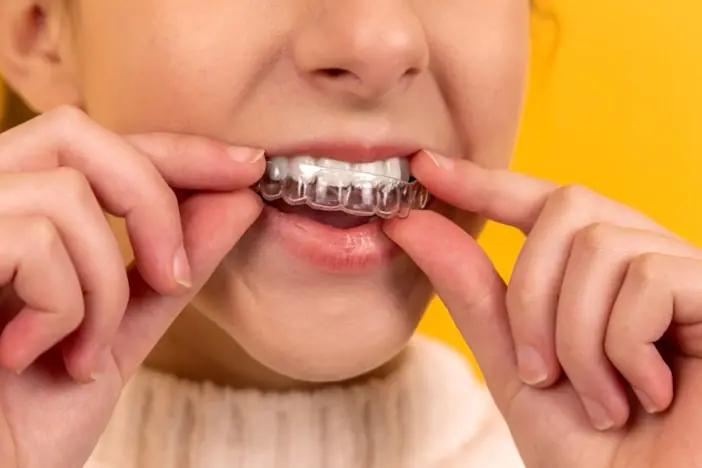
Invisalign takes 12 to 18 months on average, and your exact timeline depends on how far your teeth need to move and how consistently you wear your trays. Mild crowding or small gaps finish in 6 to 9 months. Moderate crowding and alignment corrections run 9 to 15 months. Complex bite issues take 18 to 24 months. Most patients notice visible change within the first 2 to 3 months.
Those ranges answer the question, but they do not explain why one person finishes in seven months and another wears trays for two years. Below we break down the math behind the timeline, the tray counts behind each case type, the daily wear number that controls your pace, and what to expect week by week from your first tray through your final retainer.
How Long Does Invisalign Take?
Invisalign takes 6 to 18 months for most patients, with an average of 12 to 18 months across all case types. At our practice, most patients finish in 9 to 15 months, and simpler cases can wrap up in as little as 6 months. Align Technology reached the same 6-month floor after analyzing 1,236,123 treatment orders, limiting that figure to mild and moderate crowding and spacing of up to 6 mm.
Crowding and spacing of up to 6 mm covers a large share of adult cases. Adults who want straighter teeth without metal brackets usually fall into that mild-to-moderate band, which is why clear aligners have become one of the most requested cosmetic dentistry options we provide. Align Technology reports 23 million people treated with the system since it launched.
The 6 to 18 month range is wide because the range is not really about time at all. It is about distance. Teeth that need to travel farther need more trays, and more trays take more weeks.
What Determines How Long Invisalign Takes?
What determines how long Invisalign takes is the total distance your teeth must travel, divided by how fast you move through your trays. Five factors set those two numbers:
- Case complexity. Rotations, bite correction, and severe crowding demand more movement than a single crooked front tooth.
- Daily wear time. Aligners apply force only while they are in your mouth. Hours out of the mouth are hours of no movement.
- Tray rotation speed. Trays changed every 7 days advance your plan twice as fast as trays changed every 14 days.
- Biological response. Bone remodels at different speeds in different people, and dense bone moves teeth more slowly.
- Gum and bone health. Teeth move through bone, and inflamed tissue slows that process, so healthy gums keep treatment on pace.
Case complexity is the factor you control the least and the factor that matters the most. It decides how many millimeters of movement your plan has to deliver, and millimeters are what the aligners are actually rationing.
How Far Does Each Aligner Actually Move a Tooth?
Each aligner moves a tooth about 0.25 mm, which is the standard maximum linear displacement built into most clear aligner systems. A 2025 scoping review of clear aligner therapy published through the National Library of Medicine confirms that 0.25 mm per tray ceiling, and earlier force-measurement research places the ideal per-step movement between 0.25 mm and 0.33 mm.
That 0.25 mm ceiling exists for a reason. Push a tooth harder and the tooth resists, the aligner loses its grip, and the movement stops tracking the plan. Gentle, repeated pressure over many small steps is what moves a tooth through bone safely.
Small steps produce predictable arithmetic. A tooth that needs to rotate and shift 3 mm needs roughly 12 trays. Twelve trays at two weeks each produce about six months of active movement. A tooth that needs 6 mm of correction needs roughly 24 trays, which produces close to a year. This is the whole timeline in one calculation, and it is why your dentist can quote you a range after a single set of digital scans.
How Many Aligners Does Invisalign Take?
Invisalign takes 20 to 30 aligners for a typical mild to moderate case, and more for complex corrections. Research published in the American Journal of Orthodontics and Dentofacial Orthopedics tracked 500 patients and found that those who finished without any additional scans used an average of 22 aligners. Across the full sample, including every complex case and every round of extra trays, the average total climbed to 64.1 aligners.
Is 20 Trays of Invisalign a Lot?
No, 20 trays of Invisalign is not a lot. Twenty trays sits right at the low end of normal and usually signals a straightforward case. At two weeks per tray, 20 trays equals about 10 months of active movement. At one week per tray, the same 20 trays finish in about 5 months.
Tray counts vary because the problems they correct vary. Closing a small gap asks for a fraction of the movement that rotating a canine or correcting a deep bite requires.
How Long Does Invisalign Take for Crowding, Gaps, and Bite Correction?
Invisalign takes 6 to 9 months for small gaps, 9 to 15 months for moderate crowding, and 18 to 24 months for bite correction. Align Technology’s treatment order data, the 500-patient study published in the American Journal of Orthodontics and Dentofacial Orthopedics, and our own case records in Sonora line up closely on the ranges below.
| Case Type | Typical Treatment Time | Typical Aligners | Visit Interval |
|---|---|---|---|
| Small gaps or mild crowding | 6 to 9 months | 20 to 30 | 6 to 8 weeks |
| Moderate crowding and spacing | 9 to 15 months | 30 to 45 | 6 to 8 weeks |
| Overbite, underbite, or crossbite | 18 to 24 months | 45 to 70 | 6 to 8 weeks |
| Severe crowding with rotations | 18 to 24 months | 50 to 80 | 6 to 8 weeks |
How Long Does Invisalign Take for Crowded Teeth?
Invisalign takes 9 to 15 months for crowded teeth in most moderate cases, and 12 to 18 months when crowding is severe. Crowded teeth need space before they can straighten, and space comes from expanding the dental arch or from interproximal reduction, a light polishing of enamel between contacting teeth.
Interproximal reduction opens fractions of a millimeter at a time, so the space arrives gradually across many trays. Rotations extend the timeline further, since rotation is the movement aligners deliver least efficiently.
How Long Does Invisalign Take to Close a Gap?
Invisalign takes 6 to 9 months to close a gap in most cases, and small single gaps under 2 mm often close in 4 to 6 months. Gap closure is straight translation of a tooth through bone without rotation or vertical movement, and straight translation is one of the movements aligners handle most predictably.
Predictable movement produces short timelines, which is why spacing cases finish fastest of any group we treat. Patients who want faster cosmetic change alongside aligners often pair treatment with other cosmetic treatments once their teeth reach their final position.
How Long Does Invisalign Take to Fix an Overbite?
Invisalign takes 18 to 24 months to fix an overbite in most cases, and mild overbites can finish in 12 to 18 months. Overbite correction moves teeth vertically as well as horizontally, and vertical movement, called intrusion and extrusion, demands more trays than side-to-side movement.
Extra trays mean extra weeks, and extra weeks mean the daily habit matters more than ever. Wear time is the single variable a patient controls from day one.
How Long Do You Wear Invisalign Daily?
You wear Invisalign 20 to 22 hours daily, removing the trays only to eat, to drink anything other than water, and to brush and floss. That leaves 2 to 4 hours a day out of the mouth, which is enough time for three meals and a full hygiene routine.
Hygiene routines are easy to keep. Wear hours are harder than most people expect. A clinical trial using minute-by-minute wear sensors measured an average of 15.2 hours of daily wear, which is 67 percent of the required time. The same research found patients overreport their own wear by about 5 hours a day, and that patients who knew a sensor was tracking them wore their aligners 4.4 hours longer per day than patients who did not.
Those missing hours do not disappear from your treatment. They move to the back end and stretch your finish date.
Can I Leave My Invisalign Out for 3 Hours?
Yes, you can leave your Invisalign out for 3 hours occasionally without derailing treatment, as long as you return to 20 to 22 hours the following day. Three hours out once in a while costs you a small amount of tracking, and the tray recovers within a day or two.
Recovery stops being automatic when three hours becomes a daily habit. Aligners left out three hours every day deliver 21 hours of movement per week instead of 147, and teeth begin drifting back between wears.
Can You Eat With Invisalign In?
No, you cannot eat with Invisalign in. Chewing with trays in place cracks the thermoplastic, traps food against enamel, and distorts the fit that drives tooth movement. Remove your aligners for every meal and every drink except plain water.
Plain water is the one exception because it carries no sugar, no acid, and no pigment. Coffee, tea, soda, and juice stain the trays and feed bacteria sitting against your teeth under a sealed plastic surface.
How Often Do You Change Invisalign Trays?
You change Invisalign trays every 1 to 2 weeks, following the schedule your dentist sets for your case. We move most patients on a two-week rotation and see them every two months to confirm the teeth are tracking the plan. Faster rotation is possible for straightforward cases, and that choice has a measurable effect on your finish date. If you want to see how a full aligner case is planned from the first scan forward, our Invisalign treatment page walks through each step.
Is Invisalign 1 Week or 2 Week Better?
Invisalign at 1 week per tray finishes faster, and Invisalign at 2 weeks per tray produces slightly more accurate movement in the back teeth. A randomized clinical trial of 80 patients published in The Angle Orthodontist compared 7-day, 10-day, and 14-day protocols and found the 7-day group finished in an average of 5 months against 9 months for the 14-day group.
The 14-day group did score higher on accuracy for several molar movements, including intrusion and crown torque. Those differences stayed under the threshold researchers set for clinical significance, which is why the study authors concluded a 7-day protocol is an acceptable treatment protocol for many cases.
Acceptable does not mean universal. Cases involving molar intrusion, heavy rotation, or bite correction still benefit from the slower schedule, and your dentist picks the rotation speed that fits the movements your plan requires.
How Soon Will You See Your Teeth Move?
You will see your teeth move within 2 to 3 months, and many patients notice a difference in photos after the first few weeks. Front teeth respond first because they are single-rooted and sit in less dense bone than molars.
Less dense bone remodels faster, so the visible part of your smile changes earliest in treatment. That early change is useful motivation, since the first month is the month that builds the wear habit everything else depends on.
What Is the Hardest Week of Invisalign?
The hardest week of Invisalign is the first week, when your mouth adjusts to constant gentle pressure and to speaking with trays in place. Pressure feels strongest in the first 24 to 48 hours after a new tray goes in, then fades as the teeth settle into the new shape.
Settling happens with every tray, not just the first. Each new aligner brings a day or two of tightness, and patients describe that tightness as pressure rather than pain. Speech normalizes for nearly everyone within one to two weeks.
How Do I Survive the First Week of Invisalign?
You survive the first week of Invisalign by building the routine that carries the rest of treatment. Follow these steps in order:
- Insert a new tray at bedtime so the first several hours of pressure pass while you sleep.
- Seat the trays fully with chewies, the small foam cylinders your dentist provides, for five minutes after every insertion.
- Set a timer for meals so trays are back in within 30 to 45 minutes.
- Keep a case, a toothbrush, and floss in your bag so removing trays away from home is simple.
- Rinse trays in cool water every time they come out, since hot water warps the thermoplastic.
- Track daily wear hours for the first two weeks until 20 to 22 hours becomes automatic.
Automatic habits carry you through the middle of treatment. The end of treatment brings one more stage that most patients are not warned about.
What Are Invisalign Refinements and How Much Time Do They Add?
Invisalign refinements are additional aligners made from a new scan at the end of your original series, and they add 1 to 3 months to treatment. Refinements correct the small differences between where the plan predicted each tooth would land and where each tooth actually landed.
Those differences are expected. Research in the American Journal of Orthodontics and Dentofacial Orthopedics measured average accuracy of planned tooth movement at 41 percent in 2009, improving to 50 percent by 2020 as the material and planning software advanced. The same 500-patient study found an average of 2.5 refinement scans per case, and only 6.0 percent of patients finished with no refinement at all.
Needing a refinement is the norm, not a setback. It is the stage where a good result becomes an excellent one, and it is the main reason a quoted timeline shifts.
Is It Normal to Have Invisalign for 2 Years?
Yes, it is normal to have Invisalign for 2 years, particularly for bite correction, severe crowding, or cases that include refinement rounds. The 500-patient study published in the American Journal of Orthodontics and Dentofacial Orthopedics recorded an average actual treatment length of 22.8 months, which ran 5.1 months longer than the estimate given at the consultation.
That gap between estimate and reality is worth saying out loud. We would rather quote you a range you can trust than a number that sounds good in a consultation room and slips by five months. Our own cases run 9 to 15 months because we assess complexity carefully before quoting, and we tell patients directly when a case sits in the two-year band.
Two-year cases are also the cases with the most dramatic change. You can see finished results from patients who started with significant crowding and bite issues in our smile gallery.
Does Age Affect How Long Invisalign Takes?
Age affects how long Invisalign takes, though less than most people assume. Teenagers often move slightly faster because growing bone remodels more readily, while adult bone is denser and responds more gradually. The 500-patient study found no difference between age groups in treatment outcomes, but did find that patients over 30 required significantly more refinement scans than younger patients.
More refinement scans translate to a few extra months, not a different outcome. Adults finish treatment successfully at every age we treat.
What Is the Best Age to Get Invisalign?
The best age to get Invisalign is any age after the permanent teeth have come in, typically 12 and up. Teens benefit from active growth, and adults benefit from consistent wear habits that teenagers sometimes struggle to maintain.
Consistent wear beats fast bone every time, which is why adult cases frequently track as well as teen cases.
Is 35 Too Old for Invisalign?
No, 35 is not too old for Invisalign. The average age in the 500-patient treatment study was 33.6 years, and the largest single group in that sample was patients over 30. Healthy bone and healthy gums matter far more than the number on your birth certificate.
Healthy gums are the one prerequisite we check before starting anyone. Dr. Berger evaluates gum health, existing dental work, and bite function at the consultation, then builds the plan around what your mouth can support.
Does Invisalign Take Longer Than Braces?
Invisalign does not take longer than braces for mild and moderate cases, and the two finish in comparable time for complex cases. A time-efficiency study published in The Angle Orthodontist found aligner therapy required fewer office visits and less total chair time than conventional edgewise braces, and a separate study in the American Journal of Orthodontics and Dentofacial Orthopedics using the Peer Assessment Rating index found aligner treatment efficient against fixed appliances.
Efficiency looks different for complex cases. Severe rotations, large vertical corrections, and significant skeletal discrepancies are movements fixed brackets deliver more directly, and a case built around those movements may finish sooner in braces.
The honest answer is that the appliance matters less than the match between the appliance and the movement. That match is what a proper consultation determines, and it is one of the things worth asking about when choosing a dentist for aligner treatment.
How to Keep Invisalign Treatment on Schedule
You keep Invisalign treatment on schedule by protecting your daily wear hours and seating every tray completely. Those two habits account for most of the difference between a case that finishes on the quoted date and a case that runs months past it.
Seating matters as much as wearing. A tray that sits a fraction of a millimeter off the back teeth is not delivering the force the plan calls for, even if it is in your mouth all day. Chewies close that gap.
Gum health protects the rest. Teeth move through bone, and bone responds poorly to inflammation, so keeping routine cleanings on the calendar during treatment keeps your tissue ready to remodel. Patients who brush before reinserting trays also avoid trapping sugar and acid against enamel for 20 hours at a stretch.
Finishing on schedule is only half the goal. Keeping the result is the other half, and that part lasts longer than treatment does.
How Long Do You Wear a Retainer After Invisalign?
You wear a retainer after Invisalign indefinitely, full time for the first several months and then nightly for the long term. Teeth carry a natural tendency to drift back toward their original positions, and that tendency never fully disappears.
Drift is well documented. A Cochrane Oral Health review reports that only 30 to 50 percent of orthodontic patients still hold satisfactory alignment 10 years after treatment, and that figure falls to roughly 10 percent at 20 years without consistent retention. Nightly retainer wear is what separates the patients who keep their result from the patients who watch it slip.
A retainer costs you a few seconds a night after months of daily aligner discipline, which is why patients who complete short term Invisalign rarely find retention difficult.
Frequently Asked Questions
Is Invisalign Painful to Wear?
Invisalign is not painful to wear. A randomized prospective trial published in The Angle Orthodontist compared discomfort between aligners and traditional brackets and found aligners more comfortable for adults with mild to moderate crowding. Most patients describe a tight, pressured feeling for the first day or two of each new tray, then nothing.
How Painful Is Invisalign on a Scale of 1 to 10?
Invisalign rates about a 2 to 3 out of 10 on a pain scale for most patients, peaking briefly at a 4 during the first 24 to 48 hours of a new tray. The sensation registers as pressure rather than sharp pain. Over-the-counter pain relief is rarely needed beyond the first tray or two.
Do Dentists Prefer Invisalign or Braces?
Dentists prefer whichever appliance matches the movement a case requires. Aligners handle crowding, spacing, and tipping efficiently, while fixed brackets deliver large vertical movements and severe rotations more directly. A global survey of 1,786 clear aligner providers conducted by IQVIA identified Invisalign as the most doctor-recommended clear aligner brand.
Will Invisalign Change My Face Shape?
Invisalign will not change your bone structure, though it can subtly change how your smile and lips look. Correcting a deep bite or flared front teeth alters lip support and can make the lower face appear slightly more balanced. Those changes are small and follow the tooth positions, not the jaw itself.
Can You Speed Up Invisalign Treatment?
You can speed up Invisalign treatment by wearing aligners the full 20 to 22 hours every day and, in suitable cases, by switching to a 7-day tray rotation. A randomized trial in The Angle Orthodontist found 7-day changes cut average treatment from 9 months to 5 months without clinically significant loss of accuracy. Your dentist decides whether your specific movements allow the faster schedule.
What Happens If You Lose an Invisalign Tray?
If you lose an Invisalign tray, call your dentist the same day. Depending on how far along you are in that tray, you will either return to your previous aligner to hold position or advance early to the next one. Waiting several days without any tray in place allows teeth to drift and adds weeks to treatment.
Do You Wear Invisalign While Sleeping?
Yes, you wear Invisalign while sleeping. Sleep provides the largest uninterrupted block of wear time in a normal day, usually 7 to 8 of the required 20 to 22 hours. Removing trays overnight makes the daily target nearly impossible to reach.
The Bottom Line
Invisalign takes 12 to 18 months on average, 6 to 9 months for small gaps and mild crowding, 9 to 15 months for moderate cases, and 18 to 24 months when the bite needs correcting. Your number inside that range comes down to how far your teeth have to travel, how fast you rotate through trays, and how close you stay to 20 to 22 hours of daily wear. Refinement aligners add another 1 to 3 months for nearly every patient, and a nightly retainer protects the result for good.
A consultation replaces all of those ranges with one answer built from your own scans. We see patients from across Tuolumne County who want a clear timeline before they commit to anything, and we are happy to give you one. Call Jeff Berger Dentistry whenever you are ready, or schedule a visit at your convenience.


