


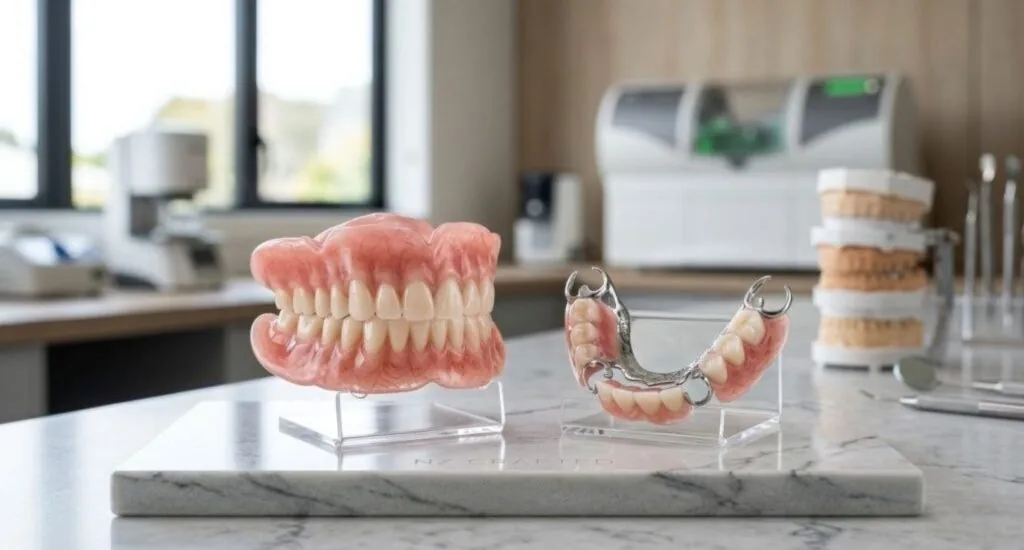
Dentures cost $500 to $3,500 per arch for traditional removable options, which puts a complete upper and lower set at roughly $1,000 to $7,000 without insurance. Implant-supported dentures start higher and run $3,000 to $15,000 or more per arch. Three things move that number: the type of denture you choose, the materials and lab work behind it, and whether teeth need to be removed before the denture is made.
Below we walk through the price of every denture type, the preparation costs that rarely show up in a phone quote, what dental insurance actually pays, the long term expenses most people never plan for, and how to get an estimate that matches your own mouth instead of a national average.
How Much Do Dentures Cost?
Dentures cost $500 to $3,500 per arch for traditional removable options, and premium or implant-supported work pushes well past that. An arch means one jaw, either the upper or the lower. Nearly every dental office in the country quotes dentures this way, which is the single biggest reason patients feel confused comparing prices. One office quotes a plate. Another quotes a set. The two numbers look like they describe the same thing and do not.
National averages give useful bearings. The 2026 procedural cost study conducted by ASQ360° Market Research for Synchrony’s CareCredit put the average full traditional removable denture at $2,022 per arch, with a working range of $1,493 to $3,309. The same study placed low cost removable dentures at an average of $460 and premium removable dentures at an average of $6,703. That spread, roughly fifteen times from the bottom of the market to the top, is real. It reflects genuine differences in material, fit and lab craftsmanship rather than random price setting.
Tooth loss itself is far more common than most patients assume. The American Dental Association reports that more than 36 million Americans have no natural teeth, and that 120 million are missing at least one tooth. About 90% of people without teeth wear dentures, and roughly 15% of that group has a new denture made every year.
What Is the Average Cost of Top and Bottom Dentures?
The average cost of top and bottom dentures runs $1,000 to $7,000 for the complete set, because a full set is simply two arches priced separately and added together. A basic upper and lower set lands near the bottom of that band. A mid range set with custom impressions and a proper try in appointment sits in the middle. A premium set with high grade acrylics and detailed gum shading sits at the top.
Doubling the per arch figure gets you close, though it rarely lands exactly. Offices sometimes price a full set slightly below two single arches because the exam, the impressions and the bite registration appointments cover both jaws at once. That efficiency is worth asking about directly when you request a written estimate.
How Much Do Different Types of Dentures Cost?
Different types of dentures cost anywhere from $500 to $15,000 or more per arch, and the type you need does more to set your price than any other single factor. The ranges in the table reflect national pricing compiled from the ASQ360° cost study cited above and published fee data from large multi state dental groups. They are planning figures for comparison, not our fees.
| Denture Type | Typical Cost Per Arch | What the Price Buys |
|---|---|---|
| Economy full denture | $500 to $1,500 | Standard acrylic base, stock tooth molds, limited shade matching, fewer appointments |
| Standard full denture | $1,000 to $3,000 | Custom impressions, better tooth molds, a wax try in before final delivery |
| Premium full denture | $2,000 to $4,000+ | High grade acrylics or porcelain teeth, detailed gum contouring, stain resistance |
| Partial denture | $700 to $3,100 | Replaces a section of teeth; resin base at the low end, cast metal framework at the high end |
| Immediate denture | $1,200 to $4,000 | Built before extractions and placed the same day, worn while the gums heal |
| Implant supported denture | $3,000 to $15,000+ | Snap on or fixed, anchored to implants placed in the jawbone |
Geography shifts these figures too. The same national study placed the California average for traditional removable dentures at $2,455 per arch, above the national average of $2,022. Higher lab fees, higher staffing costs and higher overhead all feed that gap, and patients here in Sonora see it reflected in quotes across the region.
We provide full and partial dentures along with All-on-4 implant supported dentures, so the conversation about type happens before any number gets attached to a treatment plan.
How Much Do Partial Dentures Cost?
Partial dentures cost $700 to $3,100 per arch, and the framework material drives most of that range. A resin based partial averages $1,784 according to the ASQ360° study. A cast metal partial averages $2,293. A flexible nylon partial averages $1,780 and appeals to patients who dislike the feel of rigid clasps against remaining teeth.
Cast metal frameworks cost more because the metal is thinner, stronger and less likely to fracture under chewing load. Thinner also means less bulk across the palate, which matters for speech and taste. Resin partials weigh more and break more often, though they repair easily and serve well as a transitional appliance while a longer term plan comes together.
How Much Do Implant-Supported and Snap-In Dentures Cost?
Implant-supported and snap-in dentures cost $3,000 to $15,000 or more per arch, with the implant surgery accounting for most of the difference. The ASQ360° study put the average full implant supported denture at $4,093 per implant, ranging from $2,830 to $7,203. Snap on implant retained dentures averaged $2,540 for the denture itself, separate from the implants it attaches to.
The All-on-4 approach anchors an entire arch on four implants rather than one implant per missing tooth, which is what keeps full arch implant work inside reach for many patients. Four posts carry the load that twelve or fourteen individual implants would otherwise share. Fewer posts means less surgery, less healing time and a materially smaller bill than a tooth by tooth implant plan.
Why Are Dentures So Expensive?
Dentures are expensive because a denture is a custom prosthetic built around one person’s jaw, bite and face, not a product pulled off a shelf. Two dentures that photograph identically can differ enormously in the work behind them. That work is where the money goes.
The specific cost drivers behind any denture quote include:
- Tooth quality. Stock acrylic teeth wear flat within a few years. Layered, multi shade teeth hold their shape and color far longer and cost several times more per set.
- Base material. Standard processed acrylic sits at the bottom of the market. High impact acrylics and reinforced bases resist cracking when a denture hits a bathroom sink.
- Impression technique. A single stock tray impression is fast and cheap. Custom trays plus border molding capture the exact contour of the ridge and produce noticeably better suction.
- Bite registration and try in appointments. Recording how the upper jaw meets the lower jaw, then testing the setup in wax before processing, adds two appointments and prevents a denture that rocks.
- Lab craftsmanship. Tooth position, midline, smile line and gum shading are judgment calls made by a technician. Skill costs money and shows immediately in the mirror.
- Condition of the ridge. A flat, resorbed lower ridge takes more planning, more adjustment and more chair time than a full, well healed one.
Those same craft variables drive pricing across restorative dentistry generally, which is why a smile makeover quote varies just as widely from office to office.
What Is Included in the Cost of Dentures?
The cost of dentures usually includes the impressions, the lab fabrication, the fitting appointment and a short window of early adjustments, and usually excludes everything that happens before the denture is started. That boundary is the reason two quotes for the same denture can differ by thousands of dollars without either office being dishonest.
Items commonly billed separately from the denture fee:
- The comprehensive exam and diagnostic X-rays
- Extractions of any remaining teeth
- Alveoloplasty, meaning surgical smoothing of the jawbone ridge
- Treatment of active gum infection before impressions are taken
- Soft liners placed during healing
- The first hard reline after the gums settle
- Repairs and adjustments beyond the included window
Ask any office for the total treatment estimate and the denture fee as two separate numbers. A quote that covers only the appliance is not comparable to a quote that covers the full path from first exam to final delivery. The same principle applies to dental crowns and other restorative work, where the lab fee and the clinical fee are often quoted as one figure by some offices and two by others.
How Much Does It Cost to Have All Your Teeth Pulled and Get Dentures?
Having all your teeth pulled and getting dentures costs roughly $3,000 to $12,000 per arch once the extractions, the preparatory work and the denture itself are added together. The extractions alone account for a large share of that. National averages place a simple extraction near $165 per tooth and a surgical extraction near $375 per tooth. A full upper arch holds fourteen teeth, so the arithmetic moves quickly.
Preparatory work adds further line items. A dental exam with X-rays averages $210, a panoramic X-ray averages $205, and a full mouth series averages $230. Alveoloplasty runs $300 to $1,500 or more depending on how much of the ridge needs reshaping, and it is not optional when the bone left behind after extractions has sharp or uneven edges. A denture resting on an irregular ridge produces sore spots that no amount of adjustment fully resolves.
Every one of these steps begins with a dental exam that establishes which teeth can be saved and which cannot. Saving a healthy tooth that can anchor a partial denture often costs less over a lifetime than removing it and paying for a full denture instead.
Do You Have No Teeth While Waiting for Dentures?
No, you do not have to go without teeth while waiting for dentures, because an immediate denture is built in advance and placed the same day the extractions happen. Immediate dentures cost $1,200 to $4,000 per arch, priced above a conventional denture because the lab works from pre extraction impressions and the dentist plans the tooth setup before the mouth changes shape.
That extra cost buys something most patients value highly. Nobody has to take three months off from work, from family dinners or from photographs. The trade off is that an immediate denture is a transitional appliance by design. It will need relining, and in many cases it eventually gets replaced by a conventional denture made on fully healed gums.
How Long Do You Have to Wait to Get Dentures After Teeth Are Pulled?
You have to wait about eight to twelve weeks after teeth are pulled before conventional dentures can be fitted, because the gums and bone need that long to settle into a stable shape. Patients who receive an immediate denture wear teeth throughout that window and skip the wait entirely.
A conventional denture follows a predictable sequence once healing is underway:
- Preliminary impressions of the healed ridges, usually a thirty minute appointment.
- Custom tray fabrication at the lab, about two weeks.
- Final impressions plus bite registration, recording how the upper jaw meets the lower jaw, about an hour.
- Wax try in, where the teeth are set in wax so the fit, the bite and the appearance can be checked and changed before anything is processed.
- Lab processing of the final denture, about two more weeks.
- Delivery and initial adjustment, followed by a short series of sore spot visits over the next few weeks.
Start to finish, that sequence runs about two months after healing is complete. Skipping the try in appointment shortens the timeline and lowers the fee, and it also removes the last chance to change a bite or a tooth position before the denture is permanent.
How Much Do Relines and Adjustments Cost Over Time?
Relines and adjustments cost $50 to $250 per adjustment and $200 to $650 per reline, and almost every denture wearer pays for them eventually. The reason is anatomical rather than financial, and it is the part of denture ownership competitors mention without ever explaining.
Bone under the gums exists to support tooth roots. Remove the roots and the bone begins remodeling away. A landmark 2003 clinical study by Schropp and colleagues, published in the International Journal of Periodontics and Restorative Dentistry, measured roughly a 50% reduction in alveolar ridge width within twelve months of extraction, with two thirds of that loss occurring in the first three months. Longer term work by Ashman found 40% to 60% of alveolar bone volume lost within two to three years, continuing afterward at a slower rate of 0.25% to 0.5% per year.
Ridge shrinkage of that magnitude explains the loose denture problem completely. A denture fitted perfectly in March sits on a measurably smaller ridge by September. A reline adds new base material to the inside of the appliance so it seats against the changed tissue again. Patients wearing removable dentures after recent extractions typically need the first reline within six to twelve months, and further relines every few years after that.
Over a decade, adjustments, relines and occasional repairs commonly add $1,000 to $2,500 to the original figure. That total belongs in any honest comparison between a removable denture and an implant supported one.
How Much Does It Cost to Replace a Full Set of Dentures?
Replacing a full set of dentures costs $1,000 to $7,000, essentially the same as the original set, because a replacement denture is fabricated from scratch. Most dentures last five to ten years before replacement becomes necessary, and the American College of Prosthodontists has long recommended evaluating replacement around the five year mark.
Wear rather than breakage usually forces the decision. Acrylic teeth flatten with years of chewing, which shortens the distance between the nose and the chin and gives the lower face a collapsed look. A denture can also become unwearable simply because the ridge beneath it has changed past what relining can correct. Replacement at that point restores both the bite height and the facial support.
One cost saving worth knowing: keeping the old denture as a spare costs nothing and prevents an emergency. A cracked denture with no backup means days without teeth while the lab works.
Which Is Easier, Top or Bottom Dentures?
Top dentures are easier to wear than bottom dentures, because an upper denture covers the palate and gains suction, while a lower denture must sit on a narrow horseshoe of bone with the tongue working against it. That anatomical difference shapes both comfort and cost.
Suction across the palate holds an upper denture in place through simple physics. The lower arch offers no such surface. The tongue lifts during speech and swallowing, the cheek muscles pull from the outside, and the denture floats on a ridge that resorption narrows year after year. Lower dentures generate most of the complaints, most of the adhesive purchases and most of the reline appointments.
Cost follows that pattern. Many patients end up spending more on the lower arch over time, not because the denture itself costs more, but because it takes more adjustments and more relines to keep it usable.
Are Implant-Supported Dentures Worth the Extra Cost?
Implant-supported dentures are worth the extra cost for patients whose lower denture moves, because implants stop the movement and slow the bone loss that causes it. A removable denture rests on the ridge and does nothing to preserve it. An implant transmits chewing force into the jawbone, and bone that receives force maintains itself.
That mechanism is the strongest argument for the higher price. Two implants under a lower denture convert a floating appliance into a stable one for a fraction of a full arch fixed case. Four implants supporting an All-on-4 arch go further and eliminate palate coverage on the upper, which returns normal taste and temperature sensation. We place dental implants for both approaches, and Dr. Berger completed his implant training through the Misch International Implant Institute.
The financial comparison is not as lopsided as the sticker prices suggest. A removable set at $4,000 plus a decade of relines, adjustments and one replacement can approach $8,000 to $10,000 across fifteen years. An implant retained lower denture costs more at the start and needs far less maintenance afterward. Patients weighing fixed against removable often find the same reasoning helpful when comparing bridges and implants for smaller gaps.
What Disqualifies You From Getting Dentures?
Very little permanently disqualifies you from getting dentures, though active infection, untreated gum disease, and insufficient bone volume all have to be addressed before a denture is made. These are sequencing issues rather than disqualifications, and each one carries its own cost.
Active infection comes first. A denture placed over infected tissue traps bacteria and guarantees pain, so gum disease is treated before impressions are taken. Scaling and root planing averages $260 per quadrant nationally, which is a real addition to a denture budget and a necessary one.
Bone volume matters specifically for implant supported work. Implants need enough height and width of jawbone to anchor into, and patients who lost teeth many years ago may have resorbed past that threshold. Bone grafting can rebuild the site, adding both cost and several months of healing. Patients who do not want that step still have excellent removable options, and those with only a few missing teeth may be better served by dental bridges instead.
Medical factors including uncontrolled diabetes, active cancer treatment and heavy smoking do not rule out dentures, though they affect healing after extractions and get factored into the treatment sequence.
Does Dental Insurance Cover Dentures?
Yes, dental insurance covers dentures, and most plans classify them as a major service reimbursed at roughly 50% after the deductible. The National Association of Dental Plans confirms that dentures, crowns and bridges sit in the lowest reimbursement tier across the market.
The annual maximum is what actually limits the benefit. NADP data shows about 65% of dental PPOs carry an annual maximum of $1,500 or more, with most plans falling in the $1,000 to $2,000 band. A $4,000 set of dentures billed at 50% coverage would theoretically draw $2,000 from the plan, which many plans simply do not have available in a single year. The remainder falls to the patient.
Three other plan rules deserve checking before treatment starts. Waiting periods for major services commonly run six to twelve months on a new policy. Replacement rules often limit a covered denture to once every five years. Implant components are frequently excluded outright even when the denture attached to them is covered.
Does Medicare or Medi-Cal Cover Dentures?
Medicare does not cover dentures, while Medi-Cal does cover dentures for eligible adults. Traditional Medicare excludes routine dental care entirely, a point Medicare.gov states directly. Some Medicare Advantage plans add supplemental dental benefits that include partial denture coverage, though the amounts vary widely by plan and rarely cover a full case.
Medi-Cal Dental, administered by the California Department of Health Care Services, lists complete dentures, immediate dentures, partial dentures, adjustments, repairs and relines as covered adult benefits for full scope members. Approval runs through a prior authorization process, and replacement is generally limited to once every five years. Coverage rules change, so verifying current eligibility directly with the program is the reliable path.
How Can You Lower the Cost of Dentures?
You can lower the cost of dentures by phasing treatment across benefit years, choosing the right tier rather than the cheapest one, and pinning down the full estimate in writing before anything begins. The largest savings come from avoiding a denture that has to be redone, not from shaving the initial fee.
Work through these questions with any office before committing:
- Is this estimate for one arch or for a complete set?
- Are the exam and X-rays included, or billed separately?
- How many extractions are in the plan, and are any of them surgical?
- Does the plan include alveoloplasty, and at what fee?
- Is this an immediate denture, a conventional denture, or both?
- How many adjustment appointments are included after delivery?
- Is the first reline included, and when would it be expected?
- Does the fee include a wax try in before processing?
- How much of my annual maximum is still available this year?
- Can extractions happen in December and the denture in January to use two benefit years?
That last question saves more money than any other. Splitting a case across two plan years effectively doubles the available annual maximum. Beyond insurance, we offer interest free in office payment options along with a discount for payment made before treatment, and our front desk handles benefit verification so nobody is guessing at the balance.
How Do You Get an Accurate Denture Estimate?
You get an accurate denture estimate from a clinical exam with X-rays, not from a phone call. A denture quote depends on the condition of the remaining teeth, the health of the gums, the shape and height of the ridge, the bite relationship and the bone volume available. None of that is visible over the phone.
What an exam produces is a written treatment plan with every line item priced: the extractions by tooth and by type, any ridge reshaping, the denture tier, the immediate denture if one is needed, and the expected relines. Patients who arrive with a number from a competitor’s website are usually comparing a denture fee against a complete treatment plan, which is not a comparison at all. Once the full sequence is on paper, choosing among denture options becomes a straightforward decision about material, stability and budget.
Frequently Asked Questions
How Much Do Dentures Cost Without Insurance?
Dentures cost $500 to $3,500 per arch without insurance, or about $1,000 to $7,000 for a complete upper and lower set. Extractions, X-rays and ridge reshaping add to that when teeth still need to be removed. Economy dentures average $460 per arch nationally, while premium dentures average $6,703.
How Long Do Dentures Last?
Dentures last five to ten years with proper care before replacement becomes necessary. Acrylic teeth wear down, the base loses its fit as the ridge resorbs, and facial support drops as the bite height shortens. The American College of Prosthodontists recommends a replacement evaluation around the five year mark rather than waiting for a failure.
Are Immediate Dentures More Expensive?
Yes, immediate dentures are more expensive than conventional dentures, running $1,200 to $4,000 per arch compared with $1,000 to $3,000 for a standard conventional denture. The lab builds them from pre extraction impressions, and they require more follow up adjustments because the gums reshape underneath them during healing.
How Much Does a Denture Reline Cost?
A denture reline costs $200 to $650 depending on whether the material is soft or hard. Soft liners cushion tender tissue during early healing and are replaced more often. Hard relines restore the fit permanently and typically last several years before the ridge changes enough to need another.
Do They Put You to Sleep When They Pull Your Teeth for Dentures?
No, most dentists do not put you to sleep when they pull your teeth for dentures. Extractions are routinely performed with local anesthetic, which numbs the area completely while the patient stays awake. Anxious patients can add sedation options such as nitrous oxide or conscious sedation, which change the comfort level rather than the anesthesia itself.
Are Dentures Cheaper Than Dental Implants?
Yes, dentures are cheaper than dental implants at the outset. A traditional removable denture averages $2,022 per arch, while implant supported work averages $4,093 per implant. The gap narrows over fifteen to twenty years once relines, adjustments and one replacement denture are counted against the lower maintenance demands of implants.
The Bottom Line
Dentures cost $500 to $3,500 per arch for removable options and $3,000 to $15,000 or more per arch with implants, which means the honest answer to the price question is a treatment plan rather than a figure. Type sets the tier, materials and lab work set the quality within that tier, and extractions plus ridge preparation account for a share of the total that almost never appears in an advertised price. Insurance typically covers half of a major service and then runs into an annual maximum that stops well short of the balance.
Bone changes after tooth loss are the variable most people never plan for, and they are the reason relines, adjustments and eventual replacement belong in the budget from day one. Knowing that ahead of time turns a surprise into a line item. Whether the right answer is an economy denture, a premium set or an implant supported arch depends entirely on your ridge, your bite and what you want out of the next fifteen years.
If you are weighing dentures and want a real number instead of a range, we are glad to sit down with you at Jeff Berger Dentistry and walk through what your own mouth actually needs. Our office on Mono Way keeps an easy schedule for consultations, so feel free to get in touch whenever you are ready.


